








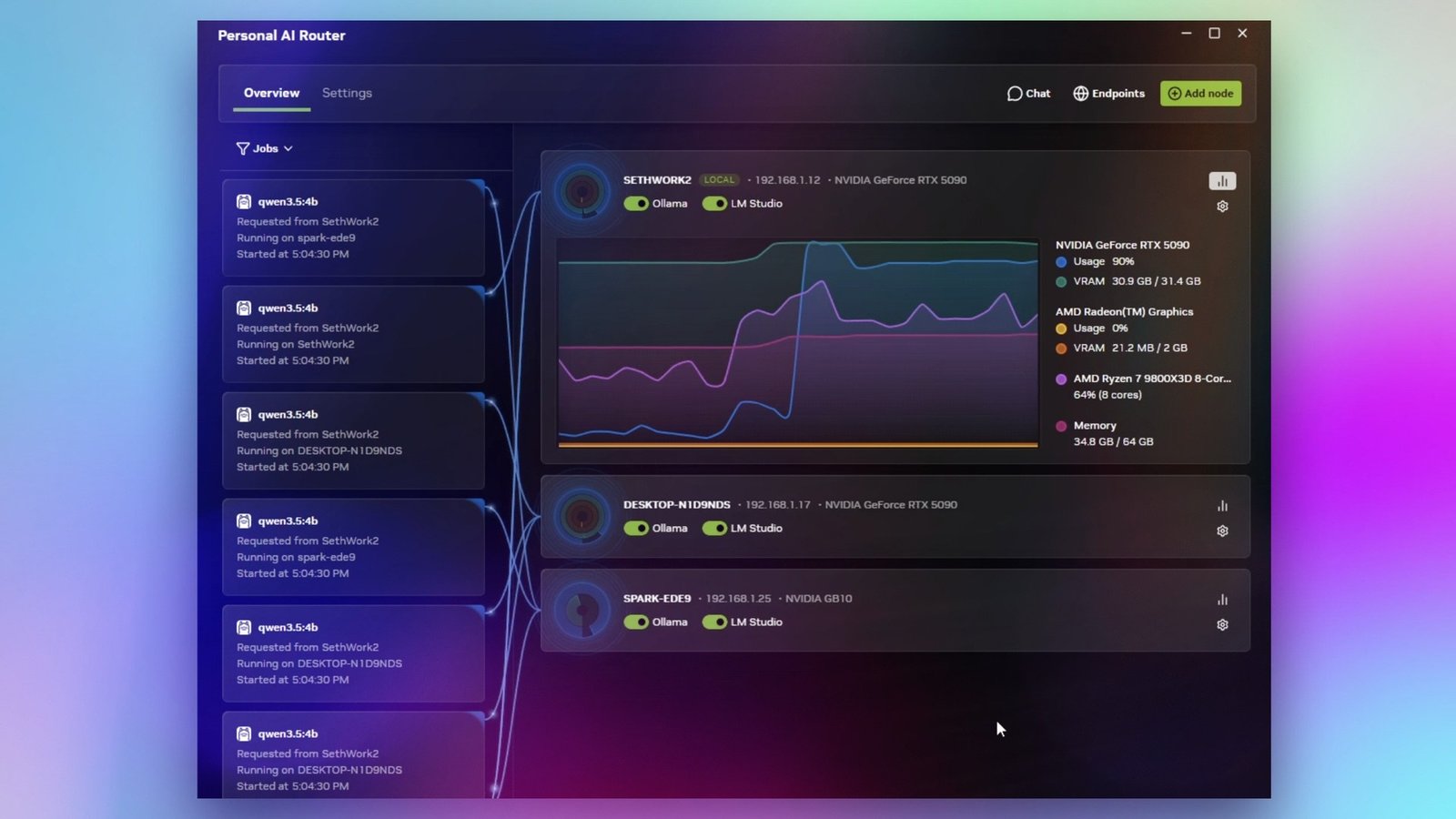
Nvidia Launches ‘PAIR’: A New Tool to Supercharge Local AI by Harnessing Your Home Network
For power users juggling complex AI workflows, the biggest bottleneck is often the hardware sitting right in front of them. Today, Nvidia announced a novel solution to this problem: Nvidia PAIR (Personal AI Router). This new open-source software allows users to offload compute-heavy AI tasks to other machines on their local network, effectively turning a home of disparate devices into a private, high-performance AI cluster.
The Nvidia PAIR system is specifically designed for users who run complex, agentic AI tasks that can be broken into smaller, parallel sub-processes. Instead of taxing a single machine, PAIR acts as a traffic controller, distributing these subagents to other idle computers—such as a MacBook Pro or another desktop—connected to the same network.
How It Works: Distributing the Load
The system functions via an orchestration model. A user runs an AI agent (like OpenClaw or Hermes Desktop) on a primary machine, which acts as the “brain.” This agent identifies which tasks need to be completed and hands them off to PAIR. PAIR then functions as a proxy, identifying which of your connected devices has the capacity and the necessary software environment to handle the workload.
Crucially, this process remains entirely local, addressing common privacy concerns regarding AI data processing. PAIR is built on established networking standards, utilizing mDNS for device discovery and mutual TLS (MTLS) to ensure secure communication between your machines.
System Requirements and Compatibility
Currently, the software is in its beta phase and available via GitHub. While the primary controller node typically requires a PC with an Nvidia RTX-class GPU, the auxiliary nodes can run on Windows, Linux, or macOS.
There are, however, specific hardware requirements for the devices receiving the offloaded tasks. On the Apple side, the system currently requires machines equipped with M4-generation chips or newer. For software compatibility, PAIR currently supports the Ollama and LM Studio inference engines, allowing it to tap into the local models already configured on those systems.
The Limits of the Technology
While PAIR is a powerful tool for load balancing, Nvidia is clear about what the software is—and isn’t. PAIR does not “pool” GPU memory or raw processing power. You cannot, for example, use it to force a single massive model to run across multiple machines if it doesn’t fit on one. Instead, it operates on a per-task basis, where each subagent is assigned to a single machine.
Furthermore, it requires a “smart” approach to home computing. Users must ensure their secondary devices are powered on and capable of handling the tasks assigned to them. Nvidia is currently working to refine the criteria PAIR uses to judge workload, such as GPU bandwidth and system utilization, to ensure that the primary user’s gaming or streaming experience isn’t interrupted by background AI processes.
As the demand for local agentic AI continues to grow, tools like PAIR represent a significant step forward in making enterprise-style parallel computing accessible to the average enthusiast, enabling them to squeeze every ounce of potential out of the hardware they already own.