








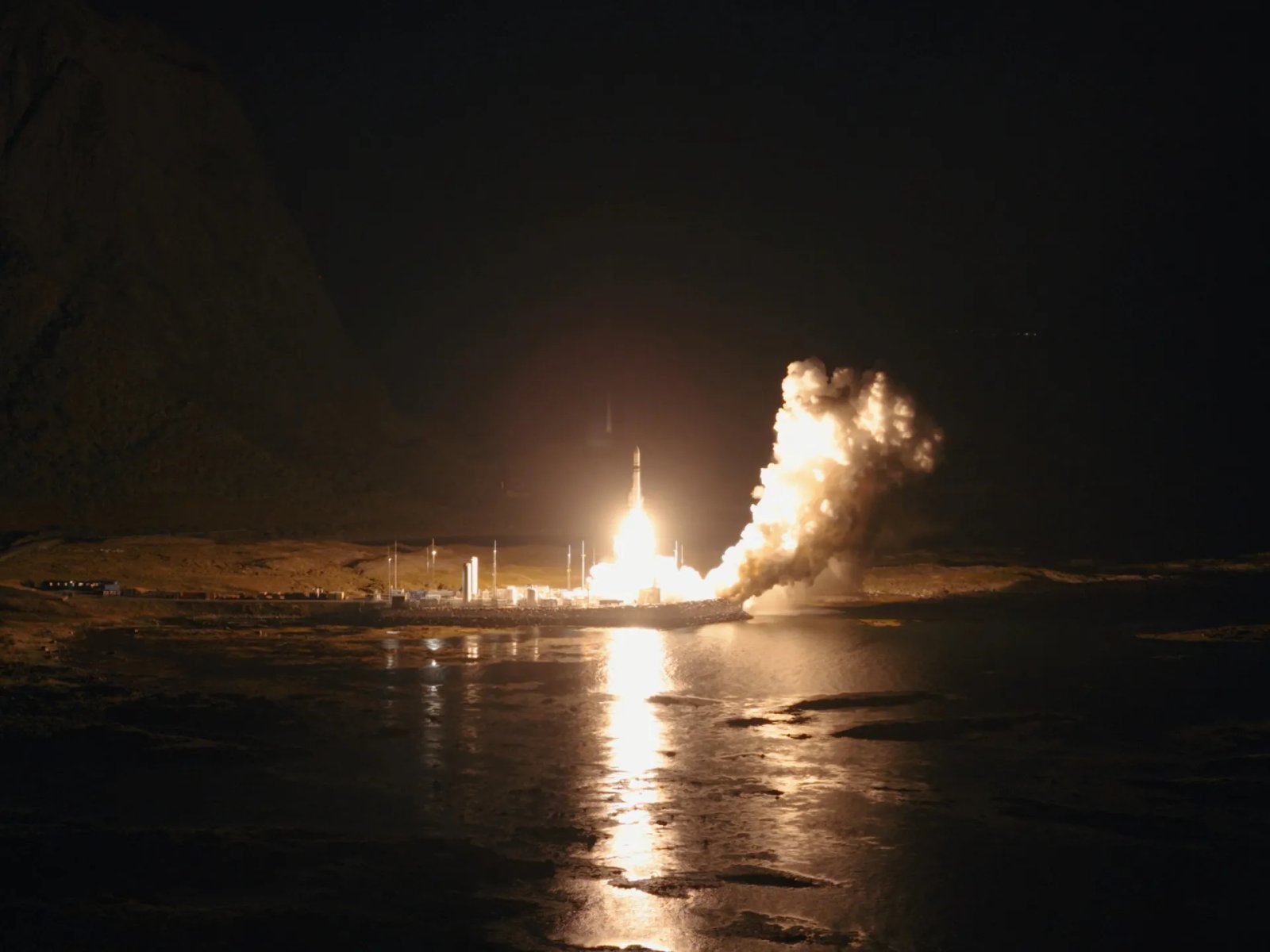
In a historic leap for European space sovereignty, German startup Isar Aerospace has successfully sent its Spectrum rocket into orbit from the Andøya spaceport in Arctic Norway. The launch, which took place late Saturday night, marks a significant shift in the continent’s ability to deploy satellites independently, reducing its reliance on foreign launch providers.
The 28-metre-tall Spectrum rocket ascended at 20:12 GMT, successfully reaching an altitude of 100 kilometers—the Kármán line marking the boundary of space—in under four minutes. Following the ascent, the company confirmed the successful deployment of five onboard satellites, a milestone that solidifies the startup’s transition from a developmental phase to an operational orbital carrier.
## Breaking the Cycle of Dependence
For years, Europe’s space ambitions have been hampered by a lack of domestic launch capacity. Since the geopolitical shift led to the termination of cooperation with Russia’s Soyuz program, European entities have been forced to rely heavily on Elon Musk’s SpaceX, which operates exclusively from the United States.
The disparity in launch cadence has been stark. According to data provided by Isar Aerospace, the United States executed 198 rocket launches in the previous year, while Europe managed only eight. This dependency has caused mounting concern among European political leaders. German Chancellor Friedrich Merz, who toured the Andøya facility earlier this year alongside Norway’s leadership, underscored that achieving independent space access is now a critical pillar of European strategic autonomy. By fostering a new generation of commercial launchers, the European Space Agency (ESA) aims to level the playing field, with Isar Aerospace recently securing a $230 million contract to scale production to as many as 40 vehicles annually.
## Overcoming Technical Setbacks
The path to this weekend’s success was paved with significant challenges. Isar Aerospace’s initial test flight in March 2022 resulted in a catastrophic failure when the vehicle exploded shortly after liftoff. A subsequent attempt was delayed repeatedly due to technical and weather-related constraints. These struggles are not unique; the European space sector has been marked by high-profile failures, including the 2023 attempt by Virgin Orbit to launch from the United Kingdom, which failed to reach its target orbit.
Isar Aerospace’s achievement represents a major turnaround for the private space sector in Germany. The success suggests that the company’s pivot toward high-volume manufacturing could offer a viable solution for the continent’s backlog of satellite launches, particularly for smaller commercial constellations.
## The Role of Tech and AI in Modern Launch Infrastructure
The success of the Spectrum rocket is also a testament to the digitization of aerospace engineering. Much like the tech industry’s transition toward AI-driven simulation and predictive modeling, modern launch startups are increasingly leveraging advanced data analytics to mitigate risk.
Integrating real-time sensor fusion and automated flight-control systems is essential for companies like Isar Aerospace to keep costs low and launch frequency high. As the company looks toward scaling its production, it is focusing on automated manufacturing processes that mirror the high-efficiency models seen in other tech-heavy industrial sectors.
By moving away from the slow, traditional procurement models of the past and embracing agile, software-defined launch operations, Europe is attempting to mirror the success of its American counterparts. This mission serves as a critical proof-of-concept, suggesting that the European commercial space ecosystem is finally ready to move beyond experimental phases and into a competitive, high-frequency operational era. As the space economy continues to expand, the ability to launch from domestic soil—independent of third-party geopolitical pressures—will be the deciding factor in Europe’s long-term technological and economic independence.
Disclaimer: This content is auto-generated for informational purposes only.
Source: Read Original News