









Breakthrough in Biologic Stability: Schreiner MediPharm’s Specialty Labels Slash Oxygen Ingress in COC Syringes
MUNICH — In a significant development for the pharmaceutical packaging industry, independent testing has confirmed that specialty barrier labels developed by Schreiner MediPharm significantly reduce oxygen ingress in Cyclic Olefin Copolymer (COC) syringes. The findings, validated by rigorous academic and external research, offer a critical solution for manufacturers looking to protect sensitive biologics and biosimilars without sacrificing the functional advantages of plastic packaging.
COC syringes have increasingly become the preferred choice for drug delivery due to their lightweight properties, high break resistance, and lower protein adsorption compared to traditional glass alternatives. However, a persistent technical hurdle has been their natural gas permeability. Unlike glass, COC plastic is more susceptible to oxygen infiltration, which can degrade sensitive drug formulations and drastically shorten shelf life.
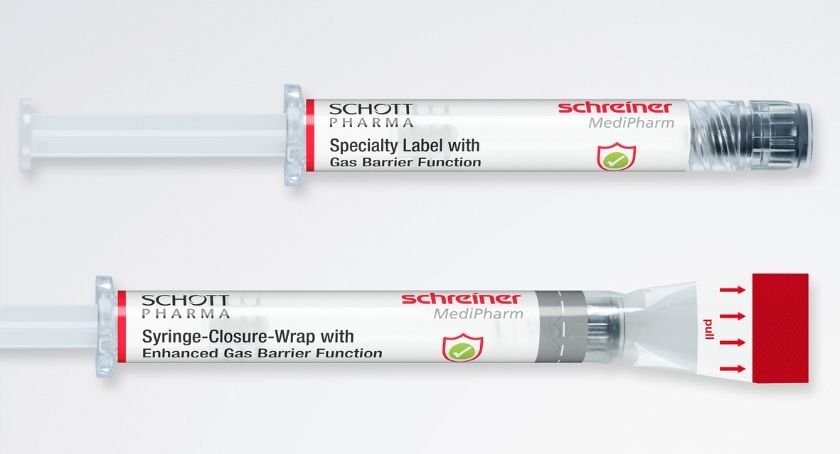
To combat this, Schreiner MediPharm engineered functional labels with an integrated gas barrier. These labels are designed to be applied directly to the primary container, providing a protective shield that prevents oxygen from reaching the sensitive medication inside.
The effectiveness of this technology was put to the test in a series of studies led by Professor Sven Sängerlaub at the Munich University of Applied Sciences, alongside another renowned independent testing institute. Using a contactless process powered by optical oxygen sensors, researchers measured oxygen concentration levels within nitrogen-purged, sealed COC syringes over an extended duration.
The results are striking. When applied to a 1ml SCHOTT TOPPAC syringe, Schreiner MediPharm’s “Gas-Protect-Label” extended the timeframe before the drug reached critical oxygen levels by approximately sevenfold compared to an identical, unlabeled syringe. Even more impressive results were recorded for the company’s “Syringe-Closure-Wrap,” which incorporated a more robust gas barrier, achieving a tenfold increase in the protective period.
For pharmaceutical manufacturers, the innovation is particularly attractive because it does not require a redesign of the primary container or expensive modifications to existing filling and assembly lines. The labels are highly flexible, allowing them to be adapted to various COC syringe geometries while maintaining the integrity of the manufacturing process.
“This solution addresses a major gap in the use of plastic syringes for high-value biologics,” stated industry analysts familiar with the findings. “By providing a validated, aftermarket-style protective layer, Schreiner MediPharm is enabling the industry to fully transition to safer, more durable plastic delivery systems without compromising the stability of sensitive substances.”
As the global demand for biologics and complex biosimilars continues to climb, the ability to ensure product efficacy through improved secondary packaging has become a top priority for developers. With this independent confirmation of their performance, Schreiner MediPharm’s barrier labels are poised to become an essential tool for maintaining the quality and safety of life-saving medical treatments stored in COC syringes.
Disclaimer: This content is auto-generated for informational purposes only.
Source: Read Original News