






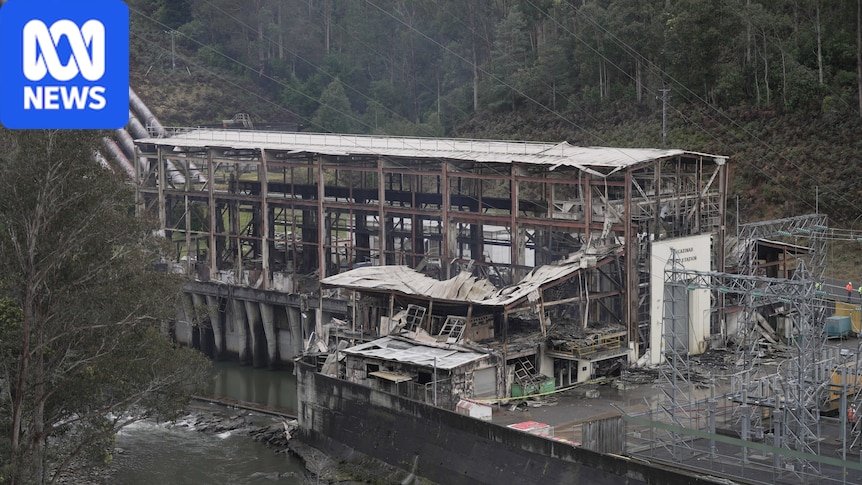
The Tasmania Fire Service (TFS) has officially ruled that the catastrophic fire which gutted the Tungatinah Power Station last week was accidental.
The blaze, which completely destroyed the facility located in the state’s Central Highlands, prompted an intensive, multi-agency investigation. While the on-site examination has now concluded, Deputy Chief Officer Matt Lowe confirmed that the broader inquiry will continue for several months as experts analyze a variety of potential ignition sources.
“Following extensive scene examinations, fire investigators have determined the fire was accidental,” Mr. Lowe said. “Preliminary findings have identified several potential ignition sources that will be subject to further investigation, however, we have determined the fire originated on the assembly bay floor, away from the main turbines.”
The investigation proved to be a challenging task for authorities. Mr. Lowe noted that the size of the facility, combined with severe structural damage and harsh weather conditions in the Central Highlands last week, significantly complicated the forensic process. Investigators from the TFS worked closely with Tasmania Police and Hydro Tasmania to secure the site and piece together the sequence of events.
The site has now been formally handed back to Hydro Tasmania, though ongoing recovery works will continue in the coming days.
For Hydro Tasmania, the road to recovery is expected to be long and costly. CEO Rachel Watson confirmed that the damage to the facility is beyond repair. “The building has sustained significant damage and, unfortunately, will need to be demolished,” Ms. Watson stated.
She added that it remains unclear whether the power-generating equipment inside can be salvaged, as engineers still require full and safe access to the interior of the structure. “We won’t be able to confirm the state of the generating equipment until we can get full and safe access to that part of the station,” she said.
The destruction of Tungatinah is a significant blow to the state’s infrastructure. When fully operational, the station was capable of generating 142 megawatts of electricity, accounting for approximately five per cent of Tasmania’s total power supply.
Beyond the logistical and economic impact, the loss of the station has been felt deeply by the workforce. Many employees have spent decades at the remote site, fostering a strong professional and personal attachment to the historic facility.
“This is not just a building to us,” Ms. Watson said. “This is an incredibly difficult time for staff, both past and present, who have spent much of their career working out of the offices at Tungatinah and dedicated their time to looking after this important power station.”
Hydro Tasmania has yet to provide a timeline for the rebuilding process or a plan for how the lost generation capacity will be replaced in the state’s energy grid.
Disclaimer: This content is auto-generated for informational purposes only.
Source: Read Original News