








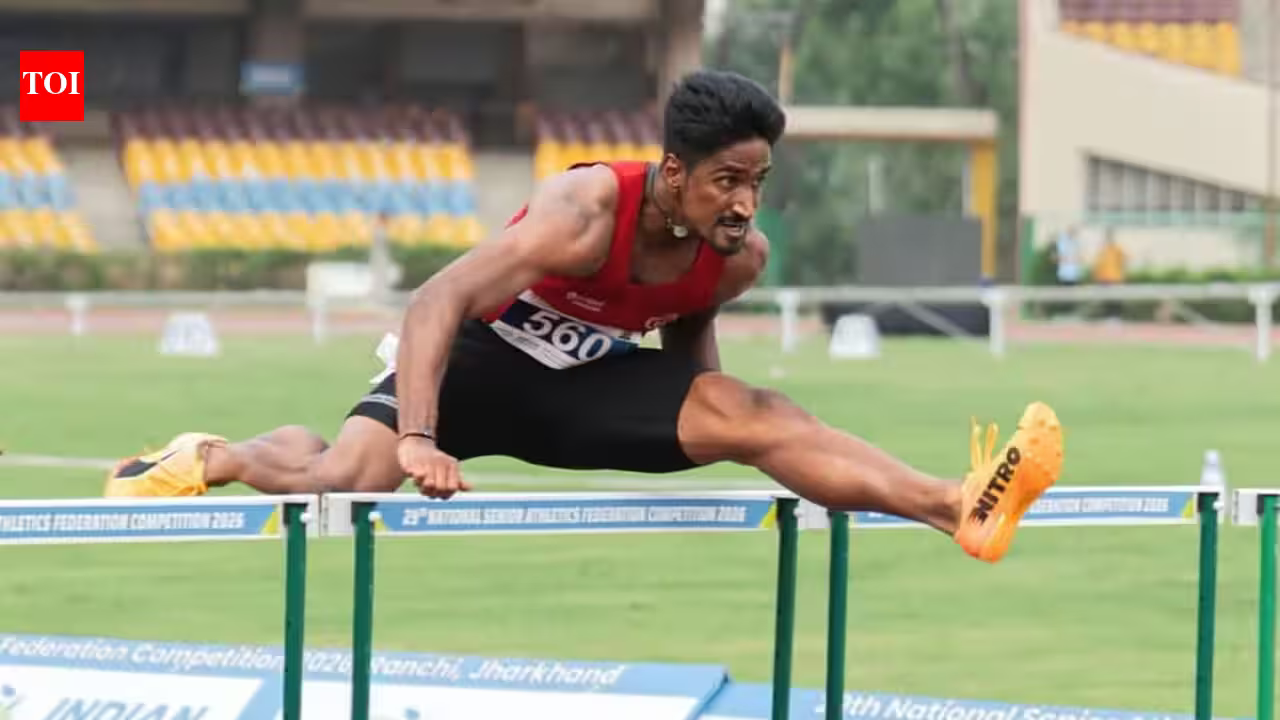
CRUSHING DISAPPOINTMENT has become the defining narrative for Karnataka’s sprint sensation Krishik M, as the 22-year-old hurdler grapples with the cold reality of being sidelined from the upcoming Asian Games squad. Despite a season defined by explosive speed and consistent adherence to the rigorous standards set by the Athletics Federation of India (AFI), the Tumakuru native finds himself on the outside looking in, fueling a growing debate over selection transparency and potential institutional bias.
The 110-metre hurdles prospect, a BTech graduate who has sacrificed years of his youth to the grind of the track, has met the federation’s official qualifying benchmark three separate times. Yet, his omission—coupled with the federation’s refusal to consider him even after a primary candidate withdrew due to injury—has cast a long shadow over the selection process leading into the continental games in Japan.
## A Season of Excellence Ignored
To understand the frustration surrounding Krishik’s exclusion, one must look at the raw data. The AFI set a formidable qualifying standard of 13.63 seconds for the 110m hurdles. Krishik did not merely flirt with this mark; he dismantled it.
His season trajectory serves as a testament to his elite conditioning: a blistering personal best of 13.44 seconds at the Indian Athletics Series (IAS) 6 in Chennai, followed by a 13.52-second finish at the Senior Federation Cup in Ranchi, and a 13.55-second performance at the IAS 9 in Ludhiana. By any objective metric, the 22-year-old had proven he belonged among the continent’s elite.
Yet, when the final rosters were drawn, his name was conspicuously absent. The federation’s justification rests on a single, high-pressure event: the Inter-State meet in Bhubaneswar. In that race, Krishik finished third, failing to meet the AFI’s mandate of a top-two podium finish.
“I should have performed well at the Inter-State and secured at least a second position,” Krishik admitted in a recent interview. “Having said that, it’s only once in four years that we get an opportunity to represent India at the Asian Games. I got three false starts in the final race. With even one foul, one comes under pressure, so I think that affected me.”
## The Elephant in the Room: Inconsistent Standards?
The core of the controversy lies in the perception of a “double standard.” Critics and industry observers have been quick to point out that the AFI’s strict adherence to the Inter-State results appears selectively applied. Seasoned veterans such as shot putter Tajinderpal Singh Toor and javelin thrower Annu Rani, both of whom encountered similar qualifying hurdles and performance dips, were granted leniency—a privilege not extended to the rising star from Karnataka.
The situation was further compounded when Tejas Shirse, the athlete initially selected for the men’s 110-metre hurdles, withdrew from the squad due to injury. Under typical circumstances, a federation looking to fill a vacancy with a high-performing athlete would immediately look to the next available talent. Krishik, currently ranked seventh in Asia, was the logical choice. Instead, the slot remained vacant, leaving many to wonder if the decision was based on merit or something far more opaque.
## Personal Sacrifices and Professional Resolve
For Krishik and his family, the emotional toll of this decision is profound. His father, Manjunatha, famously walked away from his professional career to dedicate his time and resources to the athletic journeys of his sons, Krishik and Kanishk. The dream of seeing his son don the national colors at the Asian Games was meant to be the culmination of years of financial and emotional investment.
“We appealed the decision,” Krishik noted, referring to his camp’s efforts to overturn the ruling. “But the AFI insisted that I ought to have finished at least second at the Inter-State meet.”
Despite the sting of rejection, the young hurdler is refusing to let the setback define his career trajectory. His focus has already shifted to the immediate challenge of the Indian Athletics Final Series in New Delhi. With the tenacity that has become his trademark, Krishik is looking ahead, using the frustration of the past weeks as fuel for his training.
“I am 100% sure about winning and earning the qualification mark,” he stated, his voice carrying the defiance of an athlete with much to prove.
As the sporting community looks toward the Asian Games, the case of Krishik M serves as a sobering reminder of the fragile line between institutional policy and athlete destiny. For now, the track remains his only courtroom, and he intends to let his spikes do the talking once more in New Delhi. Whether or not the AFI is listening remains a question that hangs heavy over the future of Indian athletics.
Disclaimer: This content is auto-generated for informational purposes only.
Source: Read Original News