









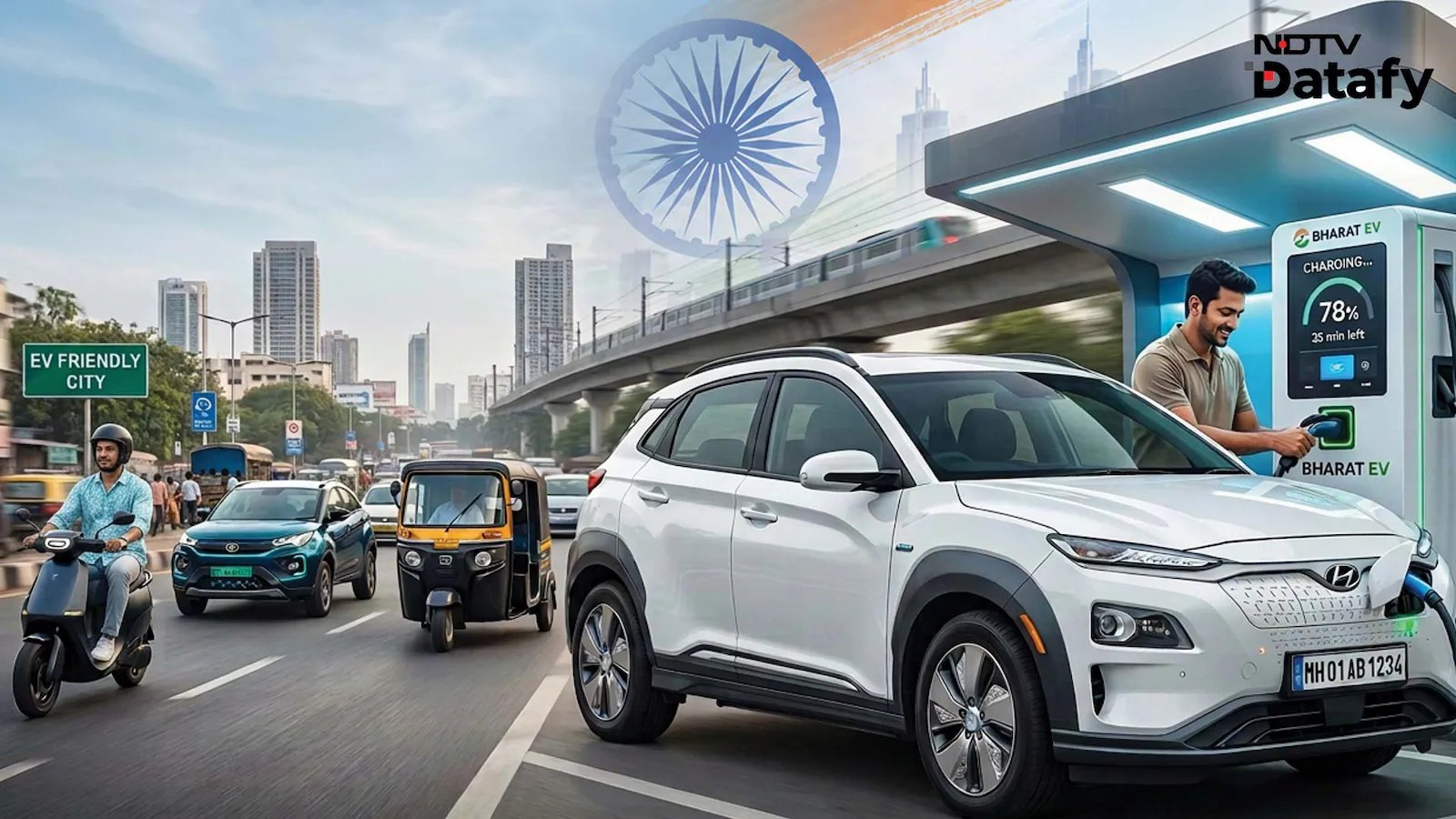
India’s Electric Vehicle Transition: A $620 Billion Economic Catalyst for the ‘Viksit Bharat’ Goal
As the world marks Electric Vehicles Day, the narrative surrounding India’s automotive sector has shifted from mere sustainability goals to a massive economic opportunity. The country stands at a pivotal juncture where the transition to electric mobility is poised to become a cornerstone of its national growth strategy, potentially reshaping its industrial landscape, job market, and economic output over the next two decades.
A comprehensive new report by the International Council on Clean Transportation (ICCT) underlines the scale of this transformation. According to the research, the economic output tied to electric vehicles in India could surge from a modest $12.8 billion in 2024 to a staggering $620.5 billion by 2040. This trajectory is specifically aligned with the government’s ambitious “Viksit Bharat” (Developed India) vision, highlighting that rapid electrification is not just an environmental imperative but an economic engine.
Pathways to Growth: Comparing Scenarios
The ICCT report outlines three distinct trajectories for the Indian EV market. The “Business as Usual” (BAU) path, which reflects existing policies and current market trends, estimates a contribution of $172.1 billion by 2040. A middle-ground approach—the “Industry Commitment” scenario—leverages the publicly announced electrification targets of major automakers to reach $506.1 billion.
However, the most optimistic path—the one aligned with the Viksit Bharat vision—demands high-ambition policy measures and accelerated electrification. Achieving this vision would unlock significantly higher economic value, positioning India as a global hub for clean technology manufacturing.
A Massive Surge in Job Creation
Perhaps the most significant impact of this transition is on the labor market. The shift to electric propulsion is projected to be a major generator of employment. Under the high-ambition scenario, direct jobs within the EV manufacturing sector are expected to climb from approximately 90,000 in 2024 to 4.3 million by 2040.
Crucially, this figure is highly sensitive to the extent of battery localization. If India manages to achieve full domestic production of battery cells, direct employment in the EV sector could exceed seven million. Beyond the factory floor, the ripple effect on the economy is even larger; indirect job creation in logistics, financing, trade, and maintenance services is expected to reach 17.3 million, pushing total EV-related employment in India beyond the 20 million mark.
The Battery Manufacturing Imperative
Central to this economic success is the development of a robust domestic battery supply chain. Currently, India faces a significant gap between current manufacturing capacity—estimated at 1.4 GWh—and the burgeoning demand.
Under the Viksit Bharat pathway, the demand for batteries is projected to skyrocket from 12 GWh in 2024 to 480 GWh by 2040. While announced projects may boost domestic capacity to roughly 128 GWh, the report emphasizes that significantly more investment and local manufacturing infrastructure will be required. Strengthening this domestic capacity is the only way to ensure that the value generated by the EV transition remains within India, fueling further innovation and economic stability.
As India accelerates toward its 2040 targets, the message is clear: the electric transition is no longer just about reducing emissions; it is about building the next generation of India’s industrial prowess.
Disclaimer: This content is auto-generated for informational purposes only.
Source: Read Original News