








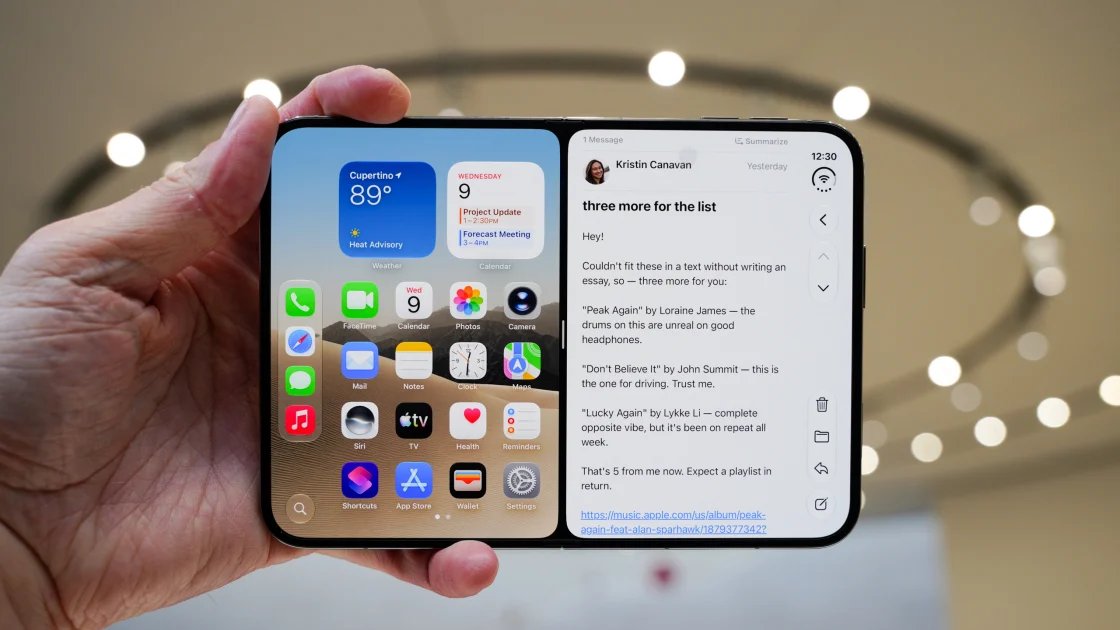
Apple has officially entered the foldable smartphone arena with the launch of the iPhone Duo, a device that aims to challenge the established dominance of industry veterans like Samsung, Google, and Motorola. Unveiled at the company’s recent “Surprise and Shine” event in Cupertino, the iPhone Duo marks a significant shift in Apple’s hardware strategy, transitioning from traditional slate designs to a flexible form factor.
Design: A Refined Approach to Foldables
The iPhone Duo arrives in a market that has spent half a decade refining the mechanics of folding screens. While Apple is undeniably late to this segment, the design of the Duo reflects a meticulous focus on portability and usability. Measuring with a passport-like profile, the device employs a book-style hinge mechanism that allows it to fold completely flat.
Constructed from premium materials including titanium, stainless steel, and high-strength aluminum, the device maintains a robust build quality consistent with the Pro line of iPhones. When closed, it offers a compact, thick footprint, while unfolding reveals a large, seamless display. The integration of magnets for secure closure and spring-assisted mechanisms ensures a smooth transition between modes, allowing the screen to hold firm at virtually any angle. This versatility provides users with a stable platform for content consumption or hands-free photography.
Hardware Engineering and Durability
One of the primary concerns with foldable hardware is long-term reliability and environmental resistance. Apple has addressed these requirements by engineering a hinge system composed of hundreds of individual parts, shielded by a titanium housing. Despite the complexity of its folding components, the iPhone Duo carries an IP68 rating for dust and water resistance, setting it apart from some competitors that utilize lower-rated standards.
The attention to detail extends to the internal display, which features a ten-layer construction. To mitigate the common issue of glare, Apple has incorporated a nano-etched texture into the top layer. This diffuse finish significantly reduces reflections without sacrificing clarity, providing a matte appearance that remains highly legible in bright lighting. The display also includes a dedicated rigid titanium plate to provide structural support for the flexible OLED panel, ensuring that the screen remains durable under daily interaction.
Software Integration and Multitasking
The transition to a folding form factor has necessitated changes to the mobile operating system. While the device runs on the foundation of iOS 27, the interface introduces significant modifications to account for the larger, adaptable screen real estate. Apple has moved core navigation controls to the side edges of the display, prioritizing accessibility for thumb-based interaction when the device is fully open.
Multitasking is a central feature of the experience. The system allows users to run two applications side-by-side in landscape orientation, mirroring functionality found on larger tablets. When the device is rotated, the interface intelligently shifts to a single-app focus, providing a seamless transition between productivity and media consumption. To support this, Apple has introduced new APIs that empower third-party developers to optimize their applications for the unique dimensions and folding state of the iPhone Duo. Furthermore, the device offers native support for the Apple Pencil USB-C, expanding the utility of the screen for creative tasks and annotation.
Market Positioning and Future Outlook
The iPhone Duo is positioned at the top tier of the current mobile landscape, with a pricing structure that reflects its high-end build and novel engineering. Starting at $1,999 for the 256GB model, the price climbs significantly for higher storage capacities, positioning it as a premium tool for power users and early adopters.
As with any first-generation product, there are inevitable trade-offs. The physics of folding devices often place constraints on battery density and camera module volume. While the device showcases impressive software refinements and hardware assembly, its true performance in real-world scenarios—such as cellular radio efficiency, battery longevity under sustained use, and the long-term integrity of the folding seam—remains to be validated.
For users accustomed to the traditional iPhone experience, the shift to a folding device requires an adjustment period. However, by leveraging its mature software ecosystem and high-grade materials, Apple is attempting to bring a level of stability to the foldable market that has historically been lacking. With preorders beginning on October 16 and a retail release following on October 23, the iPhone Duo stands as a major test of whether Apple’s late-stage entry can successfully redefine the expectations for premium foldable technology.
Disclaimer: This content is auto-generated for informational purposes only.
Source: Read Original News