








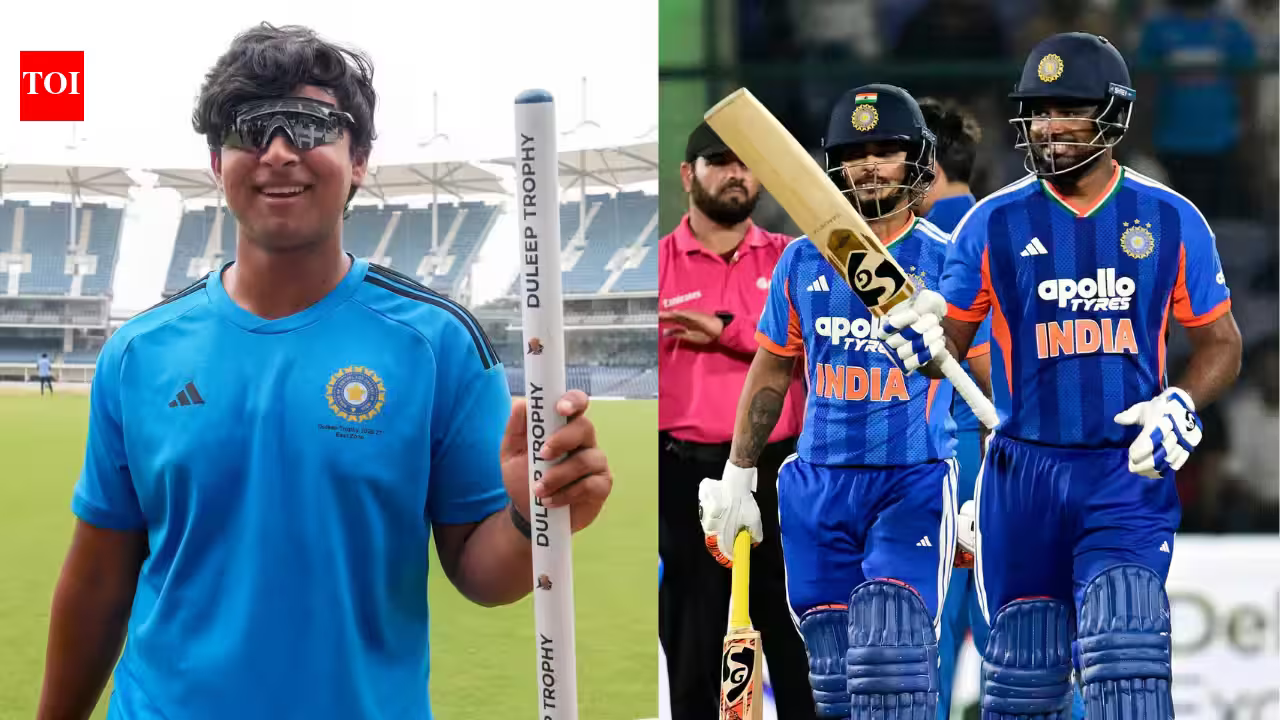
Confidence, clarity, and a commitment to the collective—these are the pillars upon which Sanju Samson is currently rebuilding his T20I narrative. In the wake of a blistering 57-run performance against Afghanistan that helped seal an unassailable 2-0 series lead for India, the dynamic opener has opened up about the complexities of team selection, the rise of teenage sensation Vaibhav Sooryavanshi, and the ever-present shadow of “outside noise.”
The chatter surrounding the Indian dressing room has been dominated by the tug-of-war for the opening slots. With Samson returning to the side alongside Abhishek Sharma, 15-year-old batting prodigy Vaibhav Sooryavanshi found himself relegated to the bench, despite a stellar showing in Zimbabwe that earned him the Player of the Series award. For the casual observer, it was a selection headache; for Samson, it was simply the reality of high-stakes international cricket.
Prioritizing the National Crest
Addressing the media in the post-match press conference, Samson dismissed the notion that competition for spots creates a toxic environment. Instead, he painted a picture of a squad driven by a singular purpose, where the individual’s desire for a starting role takes a back seat to the team’s tactical requirements.
“I think they are competitors for the outside world, but we are a team, and we are playing for a country,” Samson stated. “We want to win the game first, and then it comes down to the other individuals. We can’t sulk or be in a negative frame of mind, thinking, ‘Why did he get the spot instead of me?’ Those kinds of mindsets don’t work here.”
Samson’s perspective is born from his own journey—a rollercoaster ride of peaks and valleys that saw him named Player of the Tournament at the T20 World Cup, only to face scrutiny following lean patches against Ireland and England. His humility in assessing Sooryavanshi’s inclusion is telling; he acknowledges that when a youngster is scoring 700-800 runs and demonstrating superior current form, leadership must act accordingly. “He was in form, and we wanted to win. It was very understandable from a leadership point of view,” Samson added, showcasing a maturity that has clearly evolved over his years in the national setup.
The “Wi-Fi” Philosophy: Managing the Noise
In the ecosystem of Indian cricket, the pressure to perform is magnified by a constant stream of social media commentary and expert analysis. Samson, with characteristic wit, described his coping mechanism as “switching off the Wi-Fi.”
“I try to switch the Wi-Fi off. But sometimes the Wi-Fi gets switched on, and comments become visible,” he laughed. “Some senior player says something—it’s very normal.”
However, beneath the humor lies a candid admission of vulnerability. Samson refuses to posture as a stoic, emotionless entity. He admits that criticism stings, noting, “I’m not a machine. We are not robots. It definitely affects you.” His growth has come not from ignoring the pain, but from decoupling his on-field aggression from the fear of public judgment. “If I paid attention to those things, I couldn’t bat like this. Before hitting a shot, I would think ten times, ‘If I get out, the Wi-Fi problem will start again.’ So instead, I tell myself, ‘Koi baat nahi’ (It’s okay).”
Form Meets Function: A Masterclass in Power-Hitting
That mental liberation was on full display during the second T20I against Afghanistan. After a modest 10 off eight balls in the series opener, Samson unleashed a devastating 57 off just 22 deliveries. The innings was a masterclass in controlled aggression, decorated with seven boundaries and four towering sixes.
Alongside Abhishek Sharma, who contributed a quick-fire 39 off 19, the duo dismantled the Afghan bowling attack, steering India toward a target of 160 with clinical precision. The partnership added 88 runs in just 38 deliveries, setting the tone for a comfortable seven-wicket victory. Combined with an impressive bowling effort spearheaded by Nitish Reddy’s 3/24, India’s performance was complete and dominant.
As the series moves toward its conclusion, the broader narrative for the Men in Blue seems to be one of transition and depth. While the spotlight inevitably follows young talents like Sooryavanshi, veterans like Samson are proving that their value lies not just in their technical prowess, but in their ability to foster a resilient team culture.
For Sanju Samson, the path forward is clear: keep the internal focus sharp, the external “Wi-Fi” firmly off, and continue to prioritize the name on the front of the jersey over the one on the back. As the team looks ahead to future challenges, this brand of selfless, aggressive cricket may prove to be the most potent weapon in India’s T20 arsenal.
Disclaimer: This content is auto-generated for informational purposes only.
Source: Read Original News