








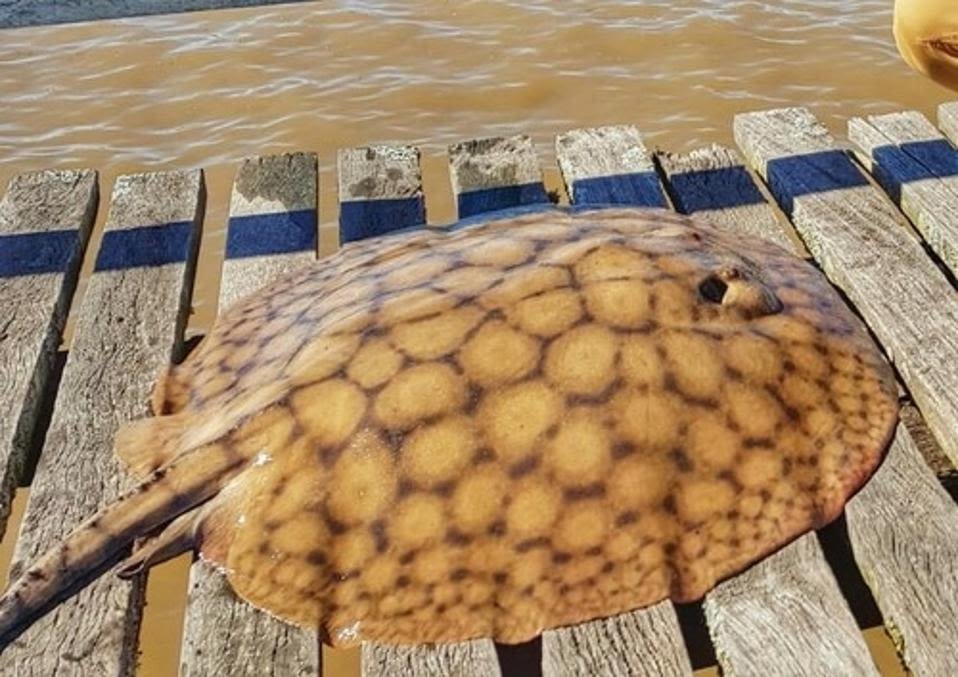
For years, scientists studying the elusive inhabitants of the world’s river systems have held a firm belief: freshwater stingrays are homebodies. Unlike their oceanic cousins, which traverse vast blue expanses, obligate freshwater elasmobranchs—species that spend their entire lives in rivers—were thought to stick to small “neighborhoods,” rarely straying more than a few kilometers from their birthplace.
That long-standing scientific narrative has now been shattered by a single, record-breaking giant.
In a recent study conducted in Argentina’s Paraná River, researchers tagged a female giant freshwater stingray (Potamotrygon brachyura). When the animal was later detected, the data revealed a startling journey: the stingray had traveled approximately 105 miles (170 kilometers). This discovery marks the longest movement ever recorded for an obligate freshwater elasmobranch anywhere in the world, leaving researchers to rethink the fundamental ecology of these mysterious creatures.
Freshwater sharks and rays remain among the least studied vertebrates on Earth. Because they often inhabit remote or difficult-to-monitor river systems, researchers have historically lacked the resources to track them effectively. This knowledge gap is particularly concerning given that many of these species are already teetering on the edge of extinction, threatened by pollution, overfishing, habitat degradation, and the increasing fragmentation of river systems.
Until now, the consensus among conservationists was that protection efforts could be localized; if a stingray stayed within a small stretch of river, safeguarding that specific habitat would theoretically keep the population secure. The journey of the Paraná River stingray suggests a far more complex reality. If these giants are capable of such extensive travel, protecting a single section of a river may be insufficient to ensure their survival. Instead, conservation strategies may need to shift toward managing entire river corridors to account for their mobility.
The finding also raises difficult questions regarding the future of river infrastructure. As dams and water diversions increasingly fragment global waterways, the potential for these barriers to disrupt essential migration or movement patterns becomes a grave concern. If these rays rely on different habitats at various stages of their lives, cutting off these pathways could have disproportionately negative effects on the species.
While scientists urge caution—noting that one individual does not necessarily reflect the behavior of an entire population—the event serves as a humbling reminder of how little we truly know about freshwater ecosystems. “The absence of evidence is not always evidence of absence,” researchers noted, suggesting that we may have been underestimating these animals simply because our monitoring duration and geographic coverage have been too narrow.
As tracking technology improves, experts hope to determine whether this 105-mile journey is an anomaly or a standard, overlooked component of the species’ life cycle. For now, the “giant of the Paraná” has proven that even in the most well-mapped rivers, these ancient creatures still have secrets to share.
Disclaimer: This content is auto-generated for informational purposes only.
Source: Read Original News