

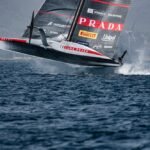






Luna Rossa has officially returned to the water following their summer break, launching a high-intensity testing phase that places a heavy emphasis on engineering and real-time data analysis. The sailing team and a specialized group of engineers—embedded directly within the Guest Racer pod—spent the day putting a new rudder design to the test, marking the first significant hardware innovation of the current cycle.
## Innovation in the Spotlight: The New Rudder Design
The focus of the session was clearly defined: evaluate the performance of a newly modified rudder. Reconnaissance reports indicate that the new blade features a design shift, moving more surface area to the top of the rudder by extending the leading edge forward, while slightly reducing the area at the base.
This mechanical update represents a critical juncture for the team. In modern America’s Cup campaigns, the ability to iterate on underwater components like rudders is essential for mastering stability and flight control. Throughout the day, the team pushed the boat into aggressive maneuvers specifically designed to stress-test the new component under varied load conditions, transitioning from light-air warm-ups to high-speed, 14-knot sea breezes.
## Navigating Technical Challenges
The transition to new hardware is rarely seamless. During an aggressive one-board bear-away maneuver, the new rudder experienced a moment of ventilation and stall. This caused the AC75 to trip, resulting in a dramatic, hullborne splashdown.
Vittorio Bissarro, one of the team’s leading flight controllers and trimmers, provided transparency regarding the incident. “We lost the rudder, so we didn’t have any control of the blade or the yaw of the boat,” Bissarro explained. He emphasized that in such high-stakes moments, the primary directive for the crew is ensuring the elevator remains submerged to maintain structural integrity, prioritizing the hardware over the aesthetic positioning of the bow. Despite the dramatic visual of the boat crashing down, the team managed to recover quickly without sustaining any major damage, allowing them to resume their session almost immediately.
## Data-Driven Sailing and the Role of Modern Engineering
Much like the tech industry’s shift toward AI-integrated diagnostics and simulation-heavy development, the modern America’s Cup environment is increasingly defined by the integration of onboard engineering. With engineers stationed in the cockpit during live maneuvers, the feedback loop between the “what happened” and “why it happened” has been significantly shortened.
This collaborative approach—pairing world-class sailors with onboard engineering talent—mirrors the agile development cycles seen in software and hardware tech giants. The team’s ability to conduct 135 minutes of foiling time, manage a battery swap, and rotate crew members—including high-profile sailors like Peter Burling and Marco Gradoni—demonstrates a rigorous, data-heavy methodology.
As the team prepares for their next outing, the focus will remain on refining these incremental innovations. The goal is to move past the initial instability noted during the “touch-and-go” maneuvers and translate the new rudder’s design potential into consistent, efficient flight. By integrating engineers into the heart of the sailing experience, Luna Rossa is betting that this blend of human skill and real-time technical analysis will provide the edge needed as they continue their intense schedule of preparation.
Disclaimer: This content is auto-generated for informational purposes only.
Source: Read Original News