





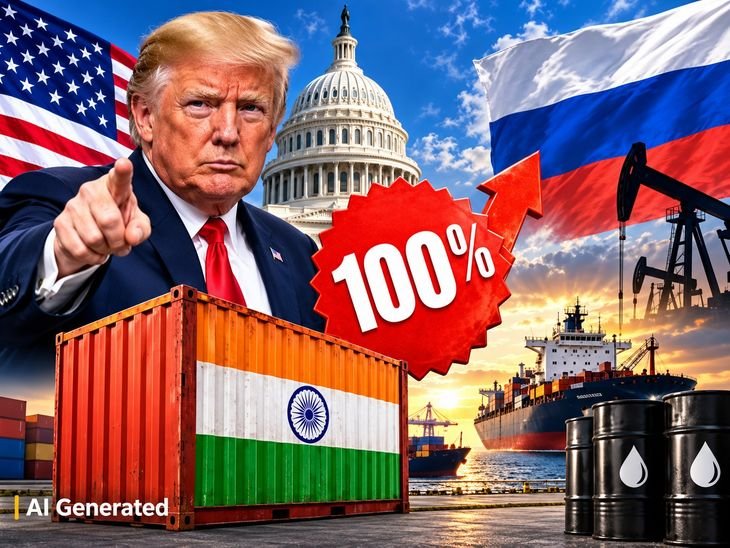
Export Uncertainty: Indian Industry Faces Potential 100% US Tariff Blow
The recent enactment of the “Sanctioning Russia and Iran Act” by US President Donald Trump has triggered widespread apprehension across India’s export-oriented sectors. With the law authorizing the US administration to impose punitive tariffs of up to 100% on nations that are among the top five purchasers of Russian energy, Indian businesses are bracing for a period of extreme trade volatility.
Trade Relations at a Crossroads
Industry leaders have voiced grave concerns, warning that such aggressive protectionist measures could severely cripple India’s export pipeline to the United States. SC Ralhan, President of the Federation of Indian Export Organisations (FIEO), expressed the industry’s collective anxiety, noting that importers simply cannot absorb such massive tariff hikes. He warned that if these duties materialize, they would effectively halt a significant portion of Indian shipments to the American market.
For many domestic firms, the fear of the unknown is proving as damaging as the potential tariffs themselves. Sharad Saraf, CMD of Technocraft Industries, highlighted that the current lack of clarity is paralyzing decision-making. “We are in a state of limbo,” Saraf noted, adding that the impact on trade relations depends heavily on the specific duty structures applied and how the US chooses to treat competing nations like China.
Textile Sector in the Crosshairs
The textile and apparel industry, which relies on the US as its largest single-market destination, is particularly vulnerable. The Confederation of Indian Textile Industry (CITI) has issued a stern warning, stating that the sector—dominated by Micro, Small, and Medium Enterprises (MSMEs)—is already struggling with the aftermath of geopolitical turmoil in West Asia. Chairman Ashwin Chandran cautioned that additional levies would make it nearly impossible for Indian apparel to remain competitive in the US market, threatening the livelihoods of millions involved in the supply chain.
Data from the April-August 2026 period indicates that while textile exports saw moderate growth, apparel exports have faced a decline of 9.10%. New trade barriers could exacerbate this downward trend, further complicating the sector’s recovery.
Strategic Leverage or Economic Pressure?
The US is currently India’s largest trading partner, with bilateral trade reaching $140.76 billion in the previous fiscal year. However, the new American legislation is being viewed by experts as a potential tool to force India into modifying its energy procurement policies.
The Global Trade Research Initiative (GTRI) has warned that the law could be used to pressure New Delhi into reducing its reliance on Russian crude oil under the threat of punitive duties. Ajay Srivastava, founder of the GTRI, advised that India must tread carefully. He argued against sacrificing national energy security for “temporary tariff relief,” noting that even concessions on energy imports might not offer long-term protection against future American protectionist policies, such as Section 301 investigations or sectoral tariffs.
As Indian exporters await further clarification from Washington regarding product coverage and implementation timelines, the prevailing sentiment is one of caution. Whether this shift marks a temporary diplomatic friction or a structural change in Indo-US trade remains to be seen, but the economic stakes for Indian manufacturers have never been higher.
Disclaimer: This content is auto-generated for informational purposes only.
Source: Read Original News