


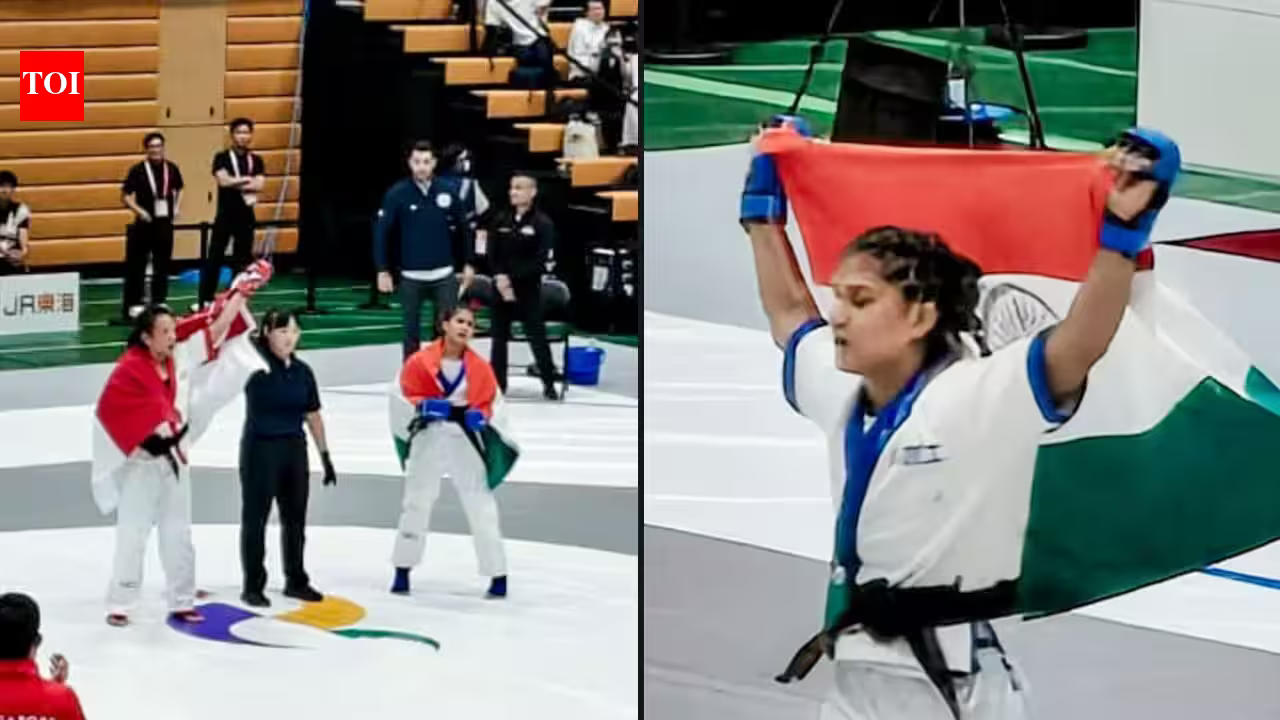


HEARTBREAK met history on the mat this Monday as Indian fighter Suchika Tariyal secured a bronze medal in the women’s traditional 60kg Mixed Martial Arts (MMA) event at the Aichi-Nagoya Asian Games. In a dramatic conclusion to her semifinal bout, the 36-year-old found herself on the wrong side of a technicality that left her in tears and sparked a debate over the officiating protocols governing the sport’s debut at these Games.
While the bronze represents a landmark achievement for Indian combat sports, the manner of her exit from gold-medal contention was defined by a rulebook nuance that has left both the athlete and her camp questioning the fairness of the outcome.
The Weigh-In Tie-Breaker
The controversy centered on the semifinal clash between Tariyal and Singapore’s Hui Hoon Teo. Following an initial decision that favored Teo, the Indian camp moved swiftly to challenge the ruling. The appeal was accepted, and an arbitration process was initiated, involving a secondary panel of judges.
Nikhil Kunder, president of the MMA Sports Federation, detailed the tense arbitration proceedings. “We challenged the decision by paying an arbitration fee of $1,000,” Kunder explained. “Three new judges were added to the earlier three to conduct the arbitration and score the bout again. When those three new judges came in, the bout was officially declared a draw.”
With the scoreboard leveled, the protocol shifted from subjective fighting analysis to objective physical data. Under the International Mixed Martial Arts Federation (IMMAF) regulations, a draw in such high-stakes matches is resolved by the fighters’ body weights recorded during the morning weigh-in.
The data was surgical: Tariyal had weighed in at 59.2kg, while Teo came in at 58.5kg. That difference of just 700 grams—roughly the weight of a standard hardcover book—effectively ended India’s pursuit of the gold medal.
“I Thought I Won the Fight”
For Tariyal, a decorated athlete who has previously competed in judo at the 2022 Commonwealth Games and kurash at the 2022 Asian Games, the technical loss felt like an injustice. Hailing from the village of Kiloi in Haryana’s Rohtak district, the 2024 world jiu-jitsu champion believed her performance on the mat was superior to her opponent’s, citing her aggression and ground control.
“I am a little disappointed with the result of today’s bout because I thought I won the fight,” Tariyal told reporters following the match. “I am not able to agree with the result. I was saying that this is not fair. Because if you look at a player, he or she gives 100 per cent everywhere. And if you feel that the decision is unfair, then it is my right to express myself.”
Tariyal broke down the mechanics of the bout, asserting that her offensive output clearly outweighed Teo’s defensive maneuvers. “I won both my rounds very well because I took her down. She did not even take me down,” she noted. “I landed a connecting punch, and in the last minute, she was going back and forth, and I was applying my kick. I was hitting her again and again.”
A Landmark for Indian MMA
Despite the emotional toll of the semifinal loss, the achievement of securing a bronze medal cannot be overstated. This is India’s first-ever medal in the sport of Mixed Martial Arts, which is making its highly anticipated debut at the Asian Games.
The result brings India’s overall medal count at the current Games to six, joining a tally that includes four silver medals and one bronze from the Indian shooting contingent. Tariyal’s path to this moment has been defined by versatility; her transition from the tactical discipline of judo and jiu-jitsu into the multifaceted world of MMA has been both swift and successful.
Reflecting on her journey, Tariyal managed to pivot from her frustration to a sense of national pride. “I have given my 100 per cent and worked hard to reach here,” she said. “I am happy I have won a bronze medal for the country.”
Looking Toward the Future
The incident has opened a wider dialogue regarding the IMMAF’s tie-breaking protocols. While the use of morning weigh-ins acts as an objective fallback in the event of a stalemate, critics argue that the outcome of an athletic contest should ideally be decided by the action within the cage rather than a pre-bout weigh-in scale.
For the Indian federation, the focus now shifts to the lessons learned from the arbitration process. While the protest successfully forced a re-evaluation of the scorecards, the strict adherence to the weight rule suggests that future competitors will need to be hyper-aware of these margins in the lead-up to their matches.
As the dust settles in Aichi-Nagoya, Suchika Tariyal returns home as a pioneer. She has firmly planted the Indian flag on the podium of a burgeoning global sport. Regardless of the bitter taste left by the weigh-in ruling, her performance in the cage has solidified her reputation as one of India’s most tenacious and versatile martial artists. With MMA gaining significant momentum on the continental stage, Tariyal’s bronze serves as the foundation upon which the next generation of Indian fighters will look to build.
Disclaimer: This content is auto-generated for informational purposes only.
Source: Read Original News