
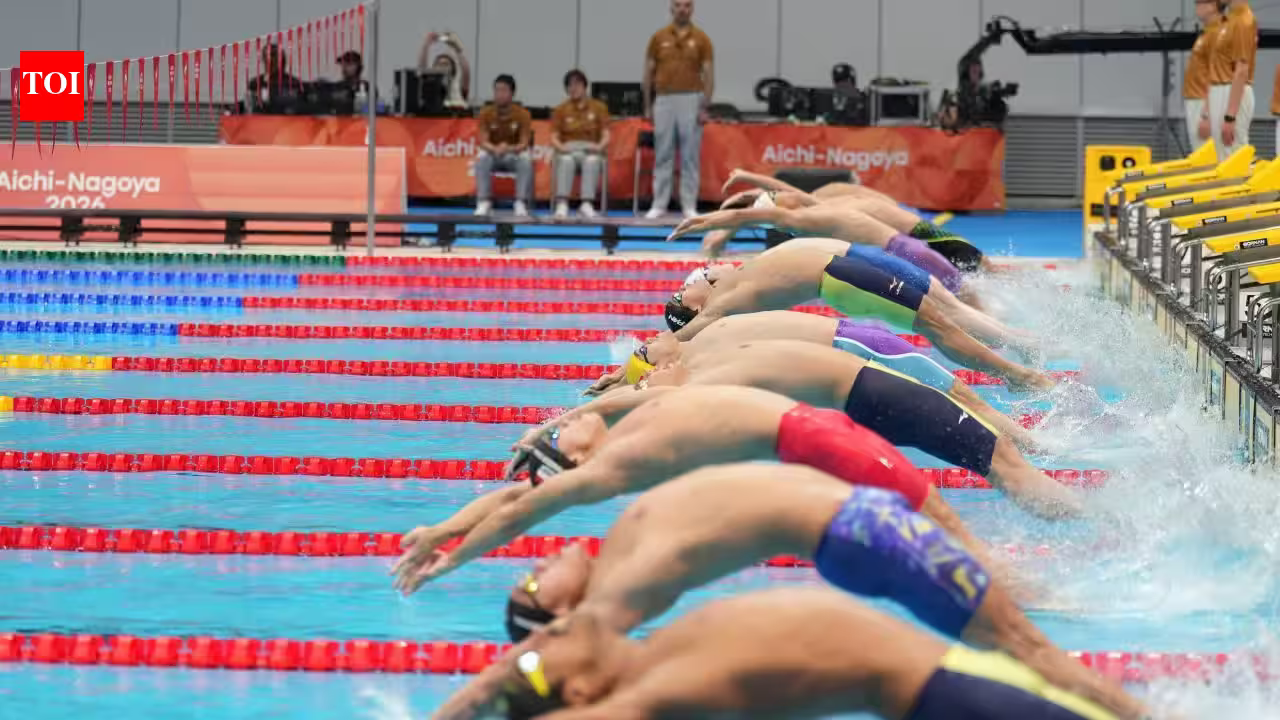






TOKYO — The blue waters of the Tokyo Aquatics Centre proved unforgiving for the Indian contingent on Monday as the 2026 Asian Games continued to present a steep challenge for the nation’s swimmers. In a day defined by narrow margins and missed opportunities, the Indian squad struggled to break into the medal bracket, with high-profile names failing to find their rhythm in the pool.
Nataraj Struggles in Backstroke Final
The spotlight heading into the men’s 50m backstroke final was firmly fixed on two-time Olympian Srihari Nataraj. Having navigated the heats with a composed performance, Nataraj entered the final looking to make a statement. However, the 25-year-old could not replicate his earlier form, clocking 25.52 seconds to finish last in the field.
The result was a frustrating drop-off from his morning session, where he had clocked 25.37 seconds to qualify for the final. That time had seen him finish third in his heat and secure a spot as the ninth-fastest qualifier, level with Iran’s Homer Abbasi. Given that Nataraj’s personal best stands at 25.18 seconds—a mark set in Belgrade back in June 2021—the gap between his potential and his Monday performance was palpable.
While the Indian camp looked for answers, the race itself was historic. China’s Xu Jiayu put on a dominant display, surging to the gold medal with a time of 24.04 seconds. In doing so, Xu obliterated the existing Asian Games record of 24.28 seconds, previously held by Japanese legend Junya Koga since the 2014 Incheon Games.
Narrow Margins for Relay Team
Perhaps the most stinging setback of the day arrived in the men’s 4x200m freestyle relay. The Indian quartet, comprised of Sajan Prakash, Dhakshan Shashikumar, Vedaant Madhavan, and Aneesh Sunil, put up a valiant fight but ultimately fell short of securing a berth in the final.
The team finished with a time of 7:24.32, placing them ninth out of 13 teams. With only the top performers moving forward, the math was brutal. Vedaant Madhavan, whose participation has garnered significant media attention, took to social media shortly after the race to process the result.
“Missed finals by 0.2 and best Indian by 0.5,” Vedaant wrote in an Instagram Story, reflecting both the pride in his performance relative to his peers and the frustration of the razor-thin margin. His father, actor R. Madhavan, showed his support by resharing the post with a message of gratitude. Despite the heartbreak, Vedaant’s campaign is far from over; he is scheduled to return to the blocks for the 200m freestyle on September 23 and the 200m backstroke on September 25.
The Search for a Breakthrough
The difficulty for Indian swimmers was a theme that echoed throughout the day’s sessions. Rishabh Das, who had shown promise with a sixth-place finish in the 100m backstroke on Sunday, narrowly missed a chance at redemption in the 50m event, clocking 25.41 seconds to place 11th overall.
In the men’s 50m freestyle, the story was much the same. Akash Mani managed to clock a personal best of 23.43 seconds to top his heat, but even that career-high performance was only enough to place him 26th overall. Geetesh Shah followed shortly after in 28th position with a time of 23.57 seconds. The class of the field was highlighted by South Korea’s Youngbeom Kim, who set a blistering new Asian Games record in the event, touching the wall in 21.71 seconds.
Additionally, Danush Suresh faced a tough outing in the men’s 100m backstroke, finishing eighth in his heat and 22nd overall with a time of 1:03.46.
A Legacy of Near Misses
As the sun sets on another day at the Tokyo Aquatics Centre, the drought continues for Indian swimming on the continental stage. India’s last visit to an Asian Games podium in swimming remains the 2014 edition in Incheon, where Sandeep Sejwal claimed a bronze medal in the men’s 50m breaststroke.
For the current generation of swimmers, the Tokyo Games represent an opportunity to shatter that long-standing ceiling. While the results on Monday were admittedly disappointing, the team remains focused on the remaining schedule. With the competition intensity reaching its peak, the Indian swimmers are looking to channel their frustration into future heats, hoping that the next touch of the wall brings the breakthrough the nation has been waiting for for over a decade.
Disclaimer: This content is auto-generated for informational purposes only.
Source: Read Original News