







The Paradigm Shift in Processor Architecture
The traditional relationship between a central processing unit and system memory has undergone a radical transformation. For decades, the performance ceiling of a gaming PC was dictated by a precarious balance: the raw clock speed of the CPU cores versus the latency and bandwidth of the installed DDR memory. When AMD introduced its chiplet-based architecture, moving the memory controller away from the core dies and onto a separate I/O die, the reliance on the Infinity Fabric interconnect introduced a new bottleneck. This configuration made system RAM latency a critical factor in frame time consistency and overall gaming throughput.
However, the introduction of 3D V-Cache technology has disrupted this historical dependency. By vertically stacking a massive pool of L3 cache directly onto the processor die, AMD has effectively moved the most frequently accessed data significantly closer to the execution units. This proximity reduces the number of instances where the processor must traverse the memory bus to fetch information from the system RAM. With the Ryzen 7 9800X3D featuring 96 MB of L3 cache, the architecture is designed to keep a vast working set of gaming data within the cache hierarchy, theoretically minimizing the performance penalty of slower system memory.
Testing Methodology and Memory Configurations
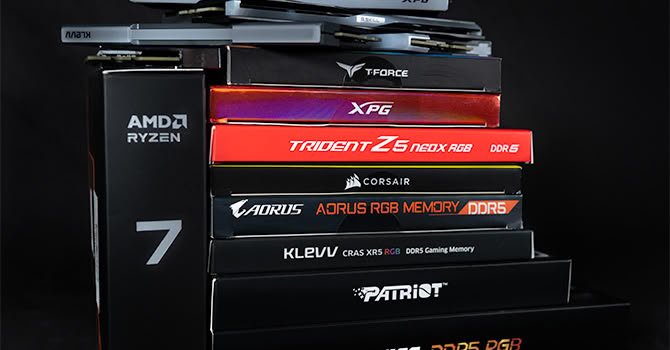
To determine the true relevance of high-speed system memory in an era where massive on-die cache exists, we conducted an extensive series of tests using the AM5 platform. Our testing suite encompassed eight distinct memory profiles, ranging from entry-level DDR5 specifications to high-performance, low-latency kits favored by enthusiasts. We analyzed the performance scaling across various resolutions and titles, focusing on the minimum 1 percent frame rates, which are often the most sensitive indicator of memory-induced stutters.
The configurations ranged from the standard JEDEC baseline of DDR5-4800 to high-frequency kits running at DDR5-6400 with tight secondary timings. By holding the processor frequency constant and isolating the memory variables, we aimed to uncover whether the 3D V-Cache effectively “masks” the latency characteristics of the RAM or if there is still a tangible benefit to investing in high-end memory modules. The goal was to provide empirical data for builders who are currently deciding where to allocate their hardware budget: on faster, more expensive RAM, or by investing the savings into other aspects of the system.
The Impact of Cache on Memory Bottlenecks
Our observations suggest that the Ryzen 7 9800X3D behaves markedly differently from its non-X3D counterparts. In CPU-bound scenarios—typically found at 1080p gaming resolutions—the benefit of high-speed RAM is measurably reduced. Because the L3 cache captures a larger percentage of the game’s working set, the system experiences fewer “cache misses.” When a cache miss occurs, the CPU must reach out to the DDR5 modules; however, with a 96 MB cache, the frequency of these events is drastically lower than it would be on a standard processor.
Consequently, the performance delta between basic DDR5-4800 memory and high-end DDR5-6400 CL30 memory is significantly tighter on the 9800X3D than it is on a Ryzen 7 9700X. This indicates that while memory speed still impacts the final frame count, the law of diminishing returns sets in much earlier. For many users, the performance gains achieved by moving from a mid-tier memory kit to an extreme-performance kit become statistically insignificant in the majority of gaming titles. The 3D V-Cache acts as an architectural buffer that levels the playing field, making the system less sensitive to the specific latency characteristics of the RAM installed.
Use-Cases and Practical Implementation
For the average gamer, the findings suggest a move toward more practical, budget-conscious memory builds. If the objective is to maximize the performance of an X3D processor, the priority should shift from chasing the highest possible DDR5 frequency to prioritizing stability and capacity. Our testing indicates that a “sweet spot” exists for the AM5 platform, generally sitting at the DDR5-6000 mark with lower CAS latency timings. This configuration offers the best balance of system stability, compatibility with the Infinity Fabric clock, and gaming performance.
Builders focusing on workstation tasks, such as video rendering or large-scale data compilation, will still see benefits from faster memory bandwidth. In these specific workloads, where the dataset often exceeds the capacity of the L3 cache, the system reverts to a memory-bound state. Here, the raw bandwidth of high-speed DDR5 modules provides a measurable reduction in completion times. Therefore, the “necessity” of high-speed RAM depends entirely on whether the system is being built primarily for gaming or for professional productivity applications.
Architectural Conclusion and Future Outlook
The arrival of 3D V-Cache technology marks the beginning of a shift where the processor is increasingly self-reliant. By reducing the frequency of communication between the CPU and external memory, AMD has effectively mitigated one of the primary hardware bottlenecks that has persisted for decades. This architectural evolution serves as a reminder that hardware optimization is no longer just about pushing raw clock speeds or increasing memory frequency; it is about managing data locality.
For the enthusiast community, the takeaway is clear: the 9800X3D is highly forgiving regarding memory selection. While faster RAM provides a marginal boost, it is no longer the prerequisite for high-end gaming performance that it once was. Moving forward, as processors continue to incorporate larger amounts of cache—and eventually move toward heterogeneous integration—we expect the reliance on external memory speeds to continue to diminish. For the current AM5 user, investing in a balanced, reliable DDR5 kit rather than an ultra-high-speed, unstable overclocking kit is the most rational path to achieving a responsive and high-performing gaming system.
Disclaimer: This content is auto-generated for informational purposes only.
Source: Read Original News