








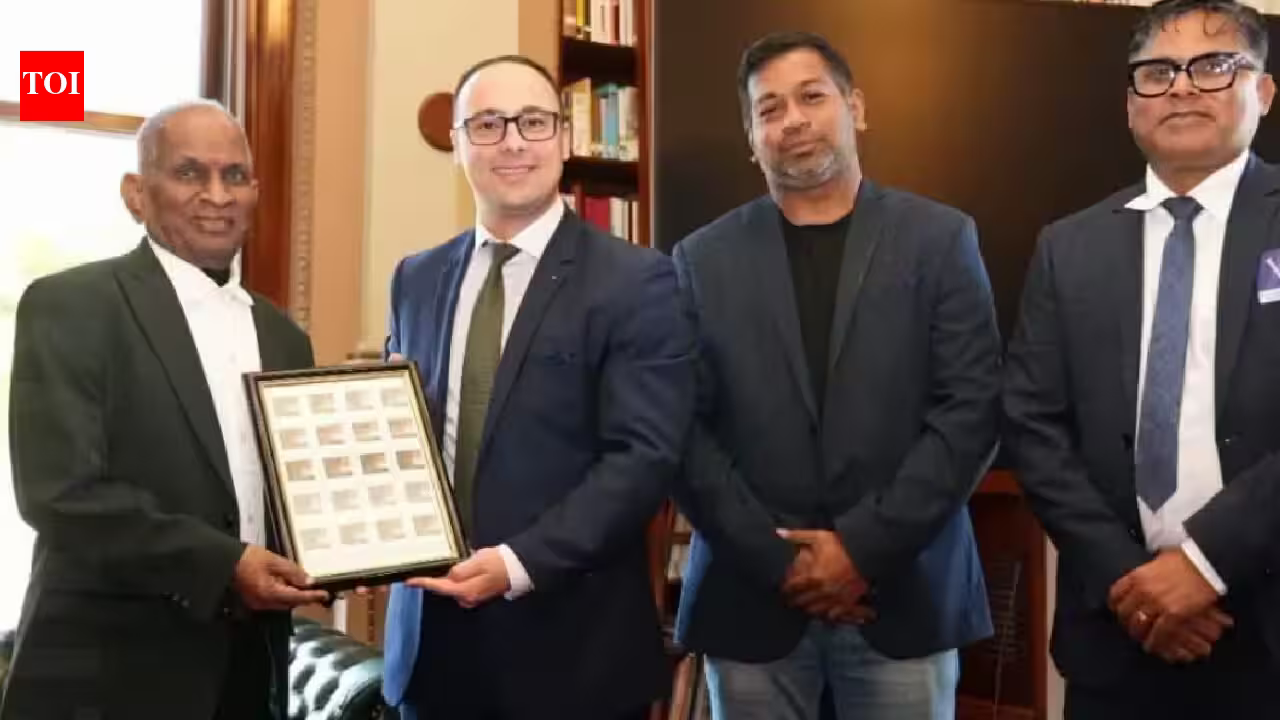
The air in the Australian Parliament is usually thick with the hum of political discourse, the clatter of legislative agenda-setting, and the measured cadence of diplomatic exchange. But recently, the halls of power in Victoria took on a different resonance—one defined by the sweeping violins and rhythmic percussive genius that has defined the soundscape of Indian cinema for over half a century. In an unprecedented gesture of cultural bridge-building, the legendary maestro Ilaiyaraaja has been honored by the Australian government with a special commemorative stamp, cementing his status not just as a national treasure of India, but as a global icon of musical transcendence.
For the uninitiated, the name Ilaiyaraaja is synonymous with the very heartbeat of South Indian film music. But for those who have lived their lives to the soundtrack of his orchestrations, this stamp is merely a formal acknowledgment of a reality that has existed since the mid-70s: the man is an institution.
A Legacy Etched in Postage and Passion
The unveiling of the commemorative stamp—a collaborative effort involving Victoria’s Treasurer Enver Erdogan and various members of the Australian Parliament—is more than a piece of postal memorabilia. It is a profound acknowledgment of a career that defies conventional logic. With a catalog spanning over 1,500 films and a stylistic range that stretches from the intricate nuances of Carnatic ragas to the bold, synthetic experimentation of the 80s, Ilaiyaraaja has effectively scored the lives of millions.
To see such a tribute emerge from the Southern Hemisphere is a testament to the diaspora’s enduring connection to its roots. The stamp, which features the visage of the composer who transformed the linguistic barriers of cinema into a universal language of emotion, serves as a bridge. It reminds us that while the geography of his success began in a modest village in Tamil Nadu, the geography of his influence now knows no borders.
From Pannaipuram to the Halls of Parliament
Perhaps the most poignant aspect of this recognition is the contrast in scale. Ilaiyaraaja himself touched upon this during the ceremony, his voice carrying the weight of a man who remembers the soil of his childhood as clearly as the resonance of a symphony hall.
“Being honoured in the Australian Parliament after being born in a small village in Tamil Nadu is deeply touching,” he remarked, his gratitude palpable. There is a quiet, stoic humility in the way the composer processes these global accolades. He has never been a man of the spotlight; his personality is tucked away within the melody, in the sudden key change that breaks your heart or the brass section that makes you want to dance.
For the Australian legislators involved, the gesture was an acknowledgement of the power of cultural diplomacy. Music, unlike policy, requires no translation. By honoring Ilaiyaraaja, the Victorian government has acknowledged that the “Maestro”—a title his fans bestowed upon him long ago—has contributed as much to the global cultural fabric as any politician or statesman.
The Maestro’s Unstoppable Creative Engine
One might expect a musician with fifty years behind him to lean into the comfortable sunset of legacy acts and nostalgic tours. Yet, Ilaiyaraaja remains an outlier. He does not treat his discography as a museum exhibit; he treats it as a living, breathing entity.
His recent work on Karthik Subbaraj’s Dorothy proves this point with startling clarity. Tracks like “Kalyana Virundhu” and “Muthumani” possess that unmistakable Raaja-esque magic—a seamless blend of traditional instrumentation and modern sensibilities that feels both timeless and urgent. Whether he is working with a seasoned director or a green filmmaker like the team behind the upcoming Lenin Pandiyan, he approaches every project with the same rigorous demand for perfection.
There is a restlessness to his artistry. He isn’t satisfied with resting on the laurels of past hits; he is consistently looking for new textures and new sonic spaces to conquer. This refusal to fade away is exactly why he remains a relevant force for the younger generation of cinephiles who are discovering his 80s hits on streaming platforms even as they line up for his new compositions.
The Collective Soul of a Musical Journey
While the stamp bears his name, Ilaiyaraaja is quick to point out that this journey was never a solo flight. In his reflections following the Australian tribute, he pivoted—as he often does—to the legion of singers, technicians, and filmmakers who have served as the architects of his visions.
To look back at five decades of Ilaiyaraaja is to look at the history of the Indian film industry’s evolution. He has worked through the era of analog tape, the birth of the synthesizer, and into the high-fidelity digital age, evolving his workflow without losing the “soul” of his sound. He remains one of the few composers who still insists on the power of a live orchestra, believing that the micro-fluctuations of human performance are what truly resonate with the listener’s spirit.
A Legacy That Needs No Stamp
As we look at the stamp, we aren’t just looking at a piece of paper meant to carry mail. We are looking at a milestone. The Victorian government’s recognition is a signal that the “Raaja wave” has successfully traversed the oceans, settling into the hearts of an international audience that values authentic, emotionally resonant art.
Will there be more awards? Undoubtedly. Will there be more retrospectives? Surely. But there is something uniquely beautiful about the permanence of a commemorative stamp. It is a reminder that in the grand mail-run of history, few artists have managed to package their emotions so perfectly that they are still being delivered, intact and powerful, to audiences half a world away.
Ilaiyaraaja’s journey from a small Tamil village to the legislative heart of Australia is the story of modern Indian excellence. It is a story that proves, quite definitively, that when a melody is pure enough, the whole world eventually learns to hum along.
Disclaimer: This content is auto-generated for informational purposes only.
Source: Read Original News