








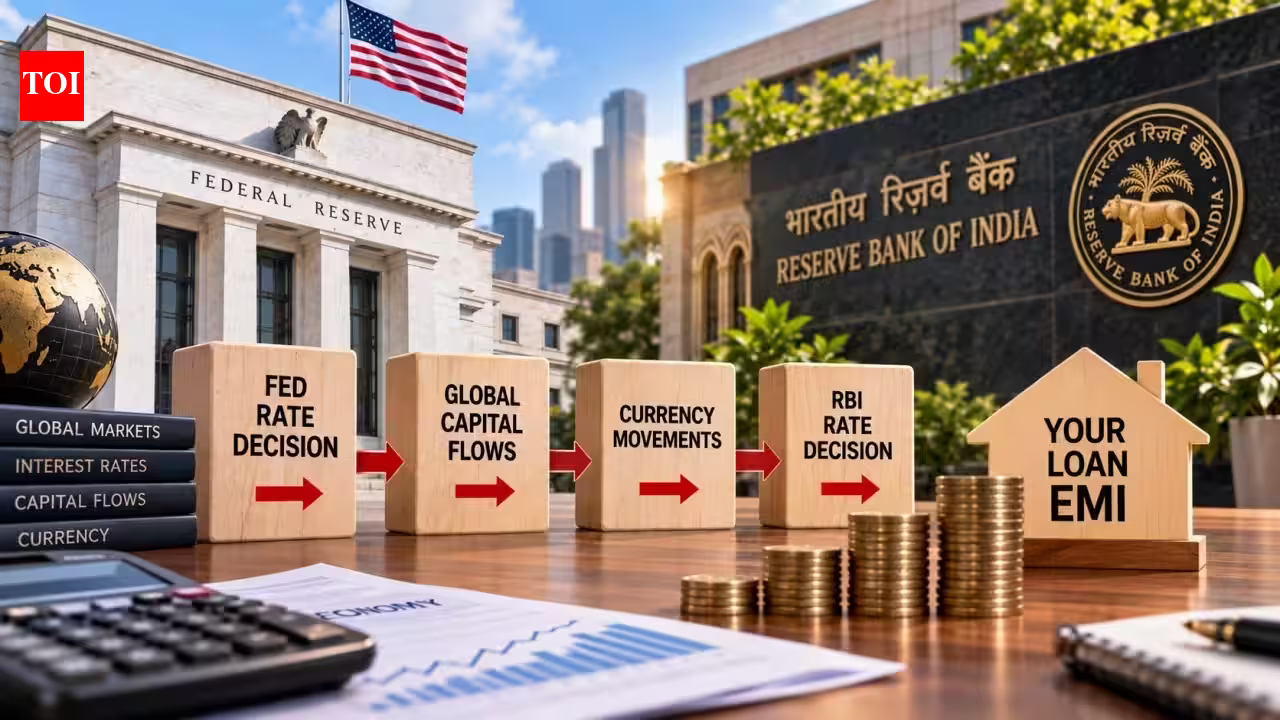
The interconnected nature of global finance means that a policy shift in Washington D.C. can have immediate consequences for household budgets in Mumbai or Bengaluru. When the United States Federal Reserve adjusts its benchmark interest rates, it triggers a ripple effect that crosses oceans, influencing capital flows, currency valuations, and, ultimately, the monetary policy stance of the Reserve Bank of India (RBI). As the US central bank moves toward tightening, Indian borrowers face the prospect of rising borrowing costs, underscoring the delicate balancing act the RBI must perform to manage domestic inflation while maintaining economic growth.
The Mechanics of Global Interest Rate Spillover
The relationship between US Fed rates and Indian home loan EMIs is rooted in the movement of global capital. When the US Fed increases interest rates, dollar-denominated assets—such as US Treasury bonds—become more attractive to international investors. As capital flows toward these higher-yielding, safe-haven assets, it inevitably moves out of emerging markets like India.
This capital outflow puts downward pressure on the Indian rupee. Because India relies heavily on imports to meet its domestic demand, particularly for crude oil—which accounts for a significant portion of the country’s import bill—a depreciating rupee makes these essential commodities more expensive. When the cost of importing fuel rises, it permeates the entire economy, increasing logistics, manufacturing, and transportation expenses. This phenomenon, known as imported inflation, forces the RBI to take notice. While the RBI mandates policy primarily based on domestic inflation targets and growth indicators, persistent currency weakness and rising input costs often leave the central bank with little choice but to maintain higher interest rates to prevent price levels from spiraling out of control.
Inflationary Pressures and the Monetary Policy Dilemma
The RBI currently finds itself navigating a complex landscape. While India’s GDP growth remains resilient, beating estimates and signaling robust economic health, inflation has shown persistent signs of stickiness. Retail inflation, measured by the Consumer Price Index (CPI), remains a primary concern for the Monetary Policy Committee (MPC). With global oil prices remaining volatile due to geopolitical tensions in West Asia and supply-side constraints, the threat of inflation breaching the RBI’s comfort zone is significant.
Market experts observe that the combination of rising crude oil prices, a weaker rupee, and tighter global financial conditions creates a “cost-push” environment. When inflation exceeds the target threshold, the RBI traditionally utilizes the repo rate—the rate at which it lends funds to commercial banks—as a primary tool to drain excess liquidity and curb demand. By raising the repo rate, the central bank signals to the financial system that the cost of borrowing money has increased. Consequently, banks recalibrate their lending rates, which translates directly into higher interest payments for retail borrowers holding floating-rate loans.
Assessing the Probability of a Repo Rate Hike
Economic forecasting for the coming quarters reflects a cautious, data-dependent outlook. While some analysts believe a rate hike is inevitable, others suggest that the MPC may adopt a “wait-and-watch” stance during its upcoming reviews. The rationale for a pause is the need to sustain the current growth momentum; prematurely tightening credit could dampen industrial production and consumer spending.
However, the argument for a hike is gaining traction. Financial reports suggest that if the CPI continues to trend toward or beyond the 6% mark, the RBI will be compelled to act to maintain credibility in its inflation-targeting framework. Factors such as the growth of money supply (M3) and the persistent pressure from food and energy prices provide a compelling case for a pre-emptive strike against inflation. Many analysts anticipate that if the October or December policy reviews confirm that inflationary pressures are entrenched, a 25-basis-point hike in the repo rate could be introduced to anchor price expectations and stabilize the currency.
Navigating the Impact on Personal Finance
For the individual borrower, a potential repo rate hike carries tangible consequences. Loans linked to external benchmarks, such as those tied directly to the repo rate, are the most sensitive to these policy shifts. Unlike older lending structures, external benchmark-linked loans react almost immediately to changes in the repo rate, as the interest rate on the loan is adjusted according to the terms stipulated in the agreement.
The impact of a rate hike is twofold: it can manifest as either an increase in the monthly Equated Monthly Installment (EMI) or an extension of the loan tenure. For a borrower with a home loan of Rs 40 lakh and a remaining term of 25 years, a 25-basis-point increase in the interest rate can result in a significant rise in monthly obligations. While the specific increase depends on the bank’s internal transmission of rates, the cumulative effect over several years can be substantial. Borrowers are encouraged to review their loan documents to understand their specific reset cycles. Understanding whether a loan is linked to the Marginal Cost of Funds-based Lending Rate (MCLR) or an external benchmark is crucial, as the former may have a lag period before the full impact of a rate hike is felt, whereas the latter is designed for rapid adjustment.
Long-term Economic Resilience
Despite the immediate concerns regarding EMI hikes, India’s economic fundamentals remain a critical buffer. The country’s GDP growth, which has consistently outperformed many other major economies, provides the RBI with the necessary space to manage the transition through global interest rate volatility. The current situation serves as a reminder that the Indian economy is deeply integrated into the global financial system.
As global central banks shift toward a higher-for-longer interest rate environment, Indian households and businesses must prepare for a period of adjustment. Monitoring the RBI’s communication, understanding the link between global commodities and domestic inflation, and maintaining a buffer in personal finances are prudent strategies for navigating this era of uncertainty. While the Washington-led interest rate cycle poses challenges, the focus of the RBI remains clear: protecting the purchasing power of the rupee while ensuring that the engines of domestic economic growth continue to turn. Through careful calibration and strategic monitoring of high-frequency indicators, the central bank aims to steer the economy toward stability, even when external pressures mount.
Disclaimer: This content is auto-generated for informational purposes only.
Source: Read Original News