








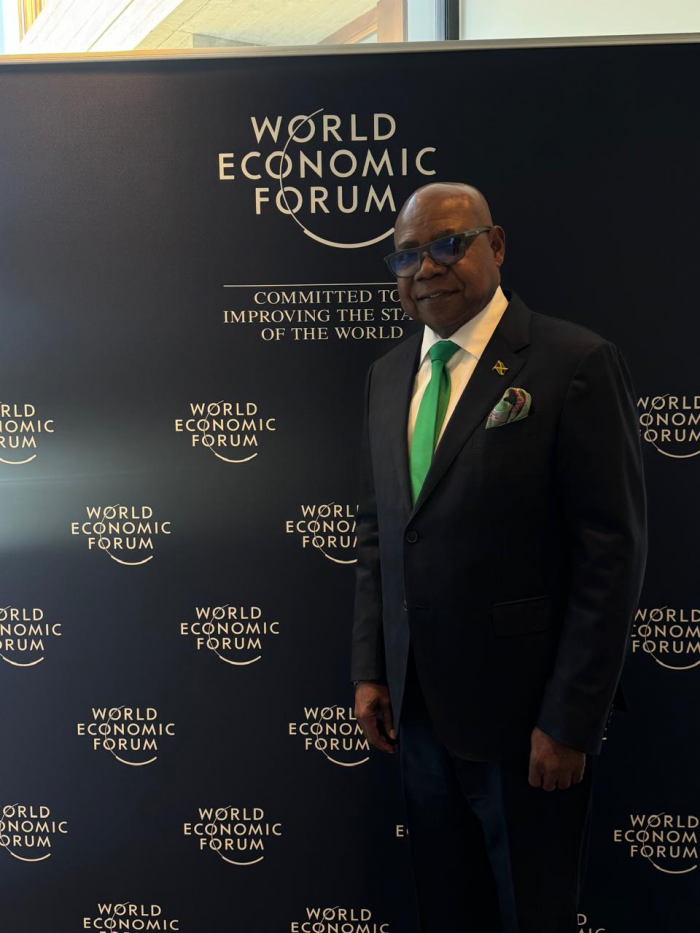
GENEVA – Jamaica’s Minister of Tourism, Hon. Edmund Bartlett, delivered a landmark address at the World Economic Forum today, issuing a clarion call to redefine the global tourism industry. Moving beyond traditional metrics of arrival numbers and gross earnings, Bartlett urged world leaders to position tourism at the “nucleus of global development,” anchored by a new model he calls “Tourism 3.0.”
Central to his proposal is the creation of a Global Tourism Resilience Fund, with a bold mobilization ambition of US$10 billion. This proposed financial instrument aims to provide a vital safety net for Small Island Developing States (SIDS) and other tourism-dependent economies that frequently face global shocks—such as pandemics and climate-driven disasters—with limited local resources.
“I come before you with a conviction born of Jamaica’s experience: tourism belongs at the nucleus of global development,” Bartlett told the assembly. “The ultimate test of tourism’s success must extend beyond the visitor’s departure to the life that continues within a destination after the visitor has gone.”
Bartlett noted that in 2025 alone, travel and tourism contributed a staggering US$11.6 trillion to the world economy, supporting 366 million jobs—roughly one in every nine workers globally. Despite this massive economic footprint, he argued that the industry has historically been treated as a peripheral concern in international policy. He asserted that the sector’s scale requires a corresponding level of responsibility regarding environmental protection, carbon reduction, and social equity.
“Small islands should never have to face risks of global origin with resources of local scale,” Bartlett stated.
To address this, the proposed US$10 billion Global Tourism Resilience Fund would operate through three distinct windows: financing preventative infrastructure to mitigate climate risks; providing immediate, rapid assistance to workers and small enterprises following a shock; and funding long-term recovery projects that ensure communities are more resilient to future crises.
At the core of the Minister’s vision is the “Tourism 3.0” model, which Jamaica has been developing as a “working proof of concept.” This approach shifts the focus from simply growing visitor numbers to maximizing the value retained by local citizens. By integrating agriculture, manufacturing, and technology directly into the tourism supply chain—through initiatives like the Agri-Linkages Exchange (ALEX) and the Tourism Workers Pension Scheme—Jamaica aims to ensure that tourism success translates directly into local prosperity.
“The central question has changed,” Bartlett remarked. “We must ask how much development each visitor helps us achieve.”
Bartlett concluded his address with a direct challenge to the World Economic Forum, inviting its leaders to help convene a founding coalition for the Resilience Fund by 2027. He emphasized that the ultimate measure of these policy shifts will not be found in international boardrooms, but in the livelihoods of farmers, entrepreneurs, and workers who sustain these destinations.
“Let us place tourism at the nucleus of development, and let us place human dignity at the heart of tourism,” he said.
Disclaimer: This content is auto-generated for informational purposes only.
Source: Read Original News