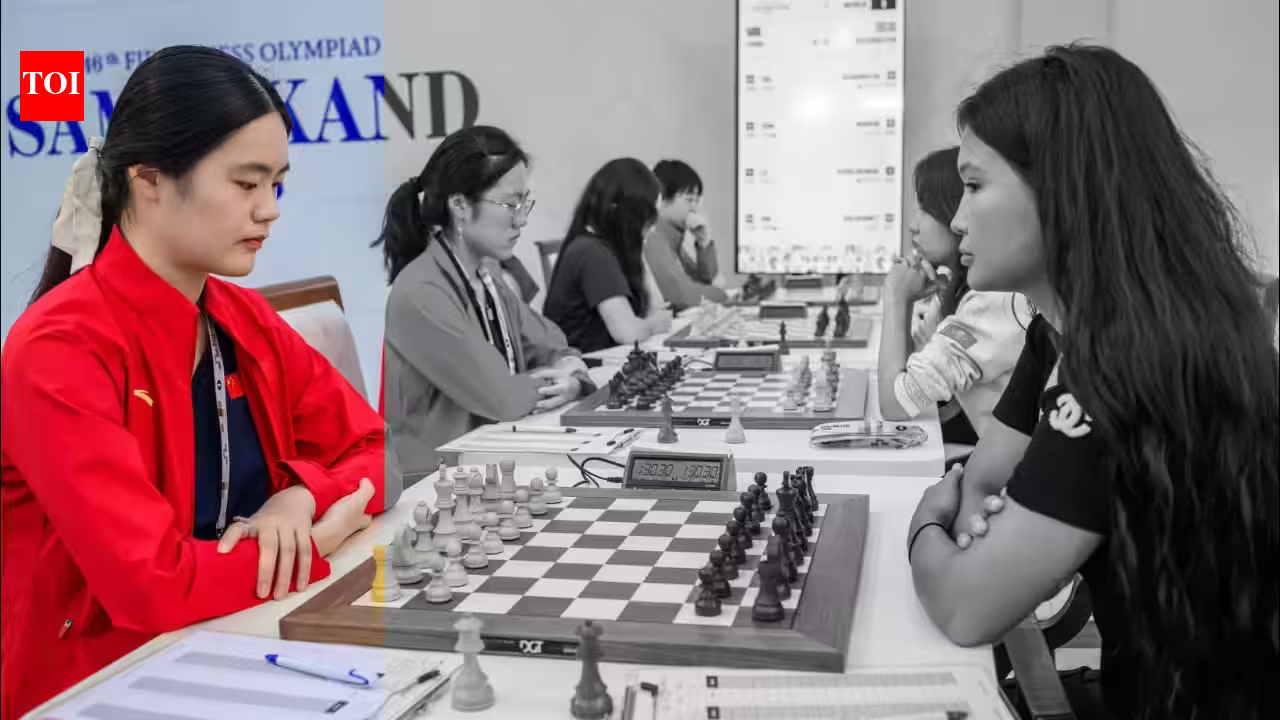







SAMARKAND, UZBEKISTAN — As the 46th Chess Olympiad reaches its nail-biting conclusion in the historic city of Samarkand, the women’s division has become the stage for a masterclass in resilience and tactical recalibration. Standing at the precipice of gold, the Chinese national team has defied conventional wisdom, proving that championship pedigree often transcends the presence of individual superstars.
While the absence of China’s top three-ranked players—Hou Yifan, Ju Wenjun, and Lei Tingjie—led many pundits to lower their expectations, one woman has silenced the skeptics: Zhu Jiner. As the World No. 4 and the anchor of the Chinese side on Board 1, Jiner has delivered a performance that can only be described as a complete turnaround from her recent struggles on the global stage.
## A Remarkable Rebound from Bengaluru
Just weeks prior to the Olympiad, Jiner was competing in the Global Chess League (GCL) in Bengaluru, India. Representing the two-time champion Triveni Continental Kings, she endured a frustrating campaign that saw the team finish second from the bottom of the group stage. Individually, the 23-year-old Grandmaster struggled to find her rhythm, recording one win, four losses, and five draws.
The taxing schedule of the GCL left little room for leisure, though Jiner remained deeply impressed by the Indian chess ecosystem. “I’ve been to India several times—New Delhi, Pune, Mumbai, and now Bengaluru,” Jiner noted during an exclusive interview. “What I like most about India is how passionate people are about chess. Whether they are players or fans, you can really feel their love for the game. The atmosphere in Bengaluru left a very deep impression on me.”
Beyond the tournament halls, Jiner was quick to acknowledge the shifting tides of the sport. She praised the explosive growth of Indian chess, noting that the country’s, and particularly its youth’s, rapid development has become a force to be reckoned with on the international circuit.
## From Prodigy to Board 1
Jiner’s ascent to the top board in Samarkand is the culmination of nearly two decades of dedication. Introduced to the game at the tender age of four, she didn’t have a singular “aha” moment that dictated her future. Instead, it was a gradual immersion, bolstered by joining the Zhejiang team at seven and committing to the rigors of the Chinese national training system.
“The professional path is very long, and there will be many difficulties along the way,” Jiner remarked on the nature of her career. “If you really love the sport, that’s what will help you keep going.”
That love for the game has been her compass in Samarkand. Faced with the unenviable task of leading a squad missing its most recognizable names, Jiner successfully reframed the team’s identity. By casting aside the burden of being the “biggest favorite,” she allowed the team to find a fluid, calm, and effective rhythm.
## Steering the Ship to Gold
Entering the tournament, Jiner remained humble about China’s prospects. “I think the competition will be extremely intense,” she observed. “So I wouldn’t consider China the biggest favorite to win the title. For us, that actually means there isn’t too much pressure. We’ll prepare carefully for each round, focus on the opponent in front of us, and try to play our best.”
That pragmatic, “one-move-at-a-time” philosophy has served the team brilliantly. Unbeaten throughout the event, Jiner has faced the fiercest opponents in the tournament on the top board and emerged unscathed, providing a stable foundation for her teammates to secure critical points.
As the tournament winds down to its final rounds, the narrative has shifted from “what the team is missing” to “what the team has achieved.” With the Indian women’s team looming in a critical penultimate-round clash, all eyes are on Jiner. Whether or not they secure the gold, her performance in Samarkand stands as a testament to the fact that internal resolve and a clear, composed mindset are often the most potent weapons on the chessboard.
For Zhu Jiner, the pressure was never about living up to the ghosts of China’s past world champions—it was about proving the enduring strength of the nation’s new generation. With the gold medal now within reach, she has done exactly that.
Disclaimer: This content is auto-generated for informational purposes only.
Source: Read Original News