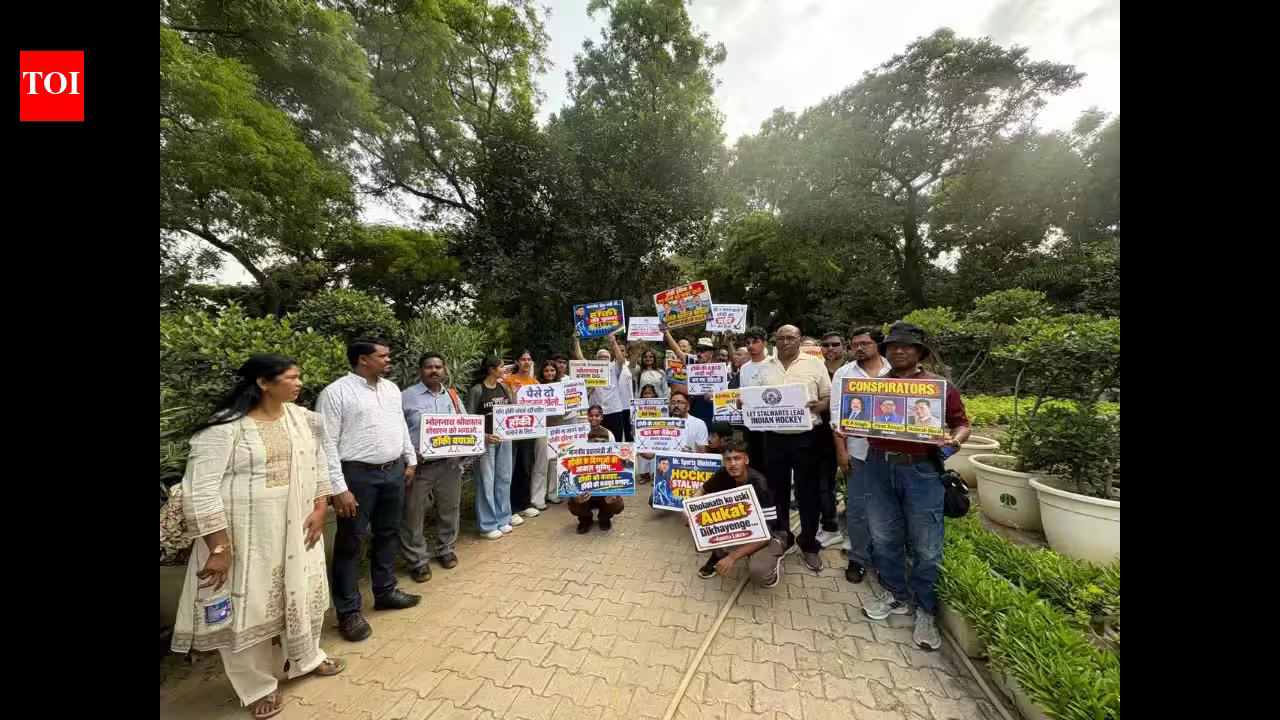




TENSIONS erupted outside the hallowed grounds of the Major Dhyan Chand National Stadium on Friday as a formidable group of Indian hockey legends staged a high-profile protest, demanding immediate structural reform within the sport’s governing body.
Led by former India women’s captain Asunta Lakra, the demonstrators—a collection of Olympians, international veterans, and decorated medallists—united to voice their profound dissatisfaction with the current administration of Hockey India (HI). The focus of their grievances centered on Secretary General Bholanath Singh, Director General Cdr R.K. Srivastava, and Treasurer Sekar J. Manoharan.
### A Call for Administrative Accountability
The core demand echoing from the protesters was clear: the dissolution of the current leadership structure and the installation of a sports ministry-backed ad-hoc committee to oversee the federation’s affairs until fresh, transparent elections can be held.
The demonstration, which carried the weight of history and the collective disappointment of the hockey fraternity, underscored a growing rift between the sport’s former stars and the officials running the show. Asunta Lakra, who has become the face of this movement, has been vocal about the toxic culture she alleges has permeated the organization.
“We are here because the integrity of our sport is at stake,” said one participant, reflecting the sentiment of the group. The protesters carried placards highlighting their concerns, signaling that the current climate of leadership is incompatible with the needs of the athletes and the growth of Indian hockey.
### Bureaucratic Hurdles and Security Scrutiny
The path to the protest was anything but straightforward. Originally, the group had intended to gather at Jantar Mantar, a traditional site for public demonstrations in the national capital, between 2:00 PM and 4:00 PM. However, police authorities denied the necessary permissions, forcing the former players to pivot.
The group subsequently shifted their focus to the Major Dhyan Chand National Stadium. Once again, they were denied access to demonstrate at the main gate, eventually settling for a symbolic protest outside Gate No. 7. The stadium complex, which serves as a hub for various government offices—including the Ministry of Home Affairs’ Foreigners-I Division and the Department of Border Management—was under high security, managed by the Central Industrial Security Force (CISF). Despite the heavy security presence and the hurdles placed in their path, the former athletes remained determined to make their voices heard, conducting their demonstration peacefully before dispersing.
### An All-Star Roster of Dissent
The presence of legendary figures added significant gravity to the day’s events. Among those standing shoulder-to-shoulder with Lakra were Olympians Ashok Kumar, Romeo James, Vineet Kumar, and Manohar Topno. Romeo James and Vineet Kumar, both veterans of the 1984 Los Angeles Olympic squad, brought an aura of distinction to the protest, reminding the public that those who have bled for the tricolor are deeply concerned about the current trajectory of the sport.
The group also included Asian Games medallist Pramod Batlaw and former internationals Bimal Lakra, Kanti Baa, and Birendra Lakra. Their collective resume represents decades of Indian hockey excellence, making their critique of Hockey India’s administration impossible for the sporting establishment to ignore.
### The Spark: Harassment Allegations and Internal Strife
The motivation behind this protest goes beyond mere administrative disagreement. Asunta Lakra has previously leveled serious allegations against Hockey India Secretary General Bholanath Singh, citing instances of intimidation and harassment. These charges stemmed from Lakra’s attempts to address reports of harassment involving young athletes in Jharkhand—a sensitive and critical issue that has since drawn the attention of the Indian Olympic Association (IOA).
The IOA has already constituted a probe panel to investigate these explosive allegations. For Lakra and her peers, the protest serves as a continuation of their pursuit of justice and a demand for a safer, more accountable environment for the next generation of hockey players.
### What Lies Ahead?
As the sun set on the National Stadium, the protesters departed, having successfully placed their demands firmly in the public consciousness. Whether the Ministry of Youth Affairs and Sports will intervene to appoint an ad-hoc committee remains to be seen, but the message delivered on Friday is unequivocal: the hockey community is no longer content to remain silent.
Hockey India now faces a crisis of legitimacy. With the IOA investigation ongoing and a vocal, highly respected faction of former players demanding change, the leadership is under unprecedented pressure. For now, the sport’s governing body has remained largely reactive, but the unity displayed by the likes of Lakra, Kumar, and James suggests that the momentum for reform is only just beginning to build.
The sport, which has long been a source of national pride, now finds itself at a crossroads. As the debate over governance intensifies, the eyes of the sporting world remain fixed on New Delhi, waiting to see if the calls for transparency will lead to a fundamental restructuring of how India’s national sport is managed.
Disclaimer: This content is auto-generated for informational purposes only.
Source: Read Original News