






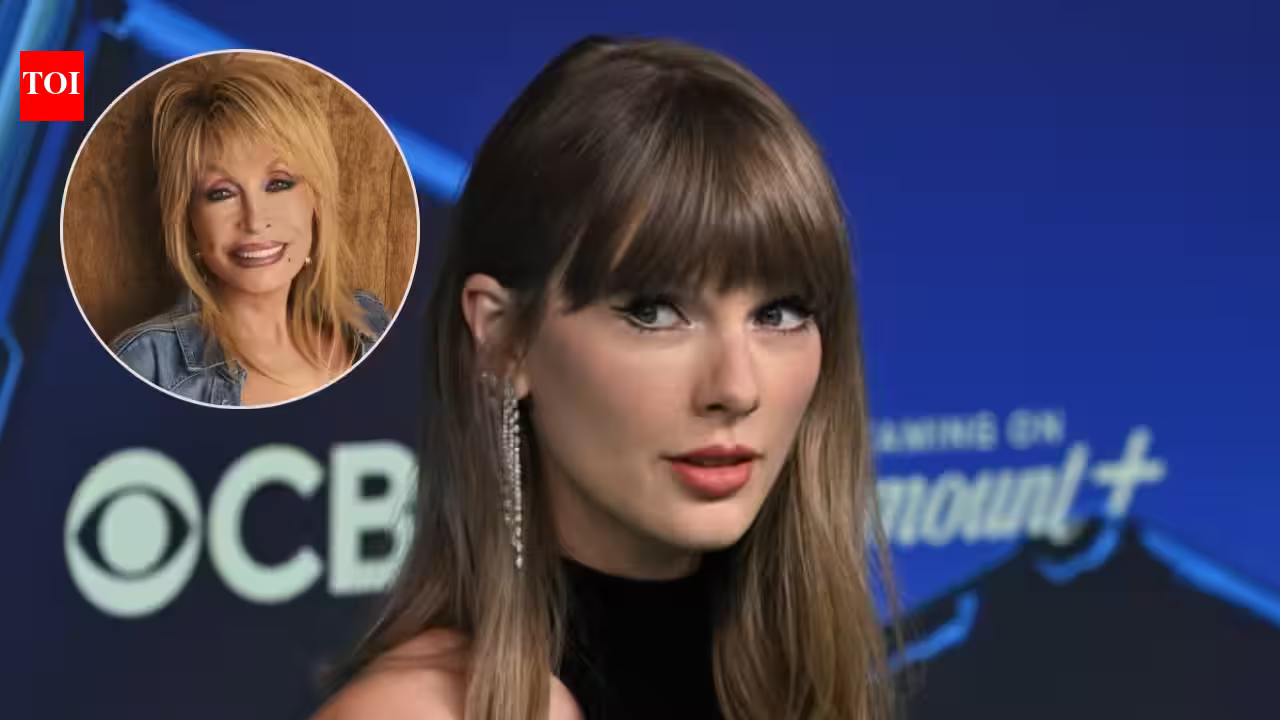
The atmosphere inside the arena was electric, vibrating with that specific, breathless tension that only occurs when music’s biggest stars collide under one roof. But as the 2026 MTV Video Music Awards reached its fever pitch, the glittering spectacle briefly gave way to a moment of profound, quiet reverence. Taylor Swift, a woman who has spent the better part of two decades mastering the art of the headline, commanded the stage once more—not just as a victor, but as a student of the industry’s greatest legends.
Securing the night’s most coveted prize, Video of the Year for Fate of Ophelia, Swift stood at the podium, the Moon Person trophy catching the stage lights. It was a victory that underscored her evolution from a pop songwriter to a visionary director, a title further solidified by her earlier receipt of the inaugural Artist Director Honors. Yet, for all her success, the spotlight felt unusually focused on the woman who wasn’t there—the late, legendary Dolly Parton.
A Night of Triple Crowns and Artistic Evolution
Swift’s trajectory this year has been nothing short of a creative metamorphosis. With the recent release of the extended version of her December album, The Life of a Showgirl, and the simultaneous premiere of the cinematic, hauntingly beautiful music video for “Patient Zero,” she has clearly pivoted toward a more narrative-driven, auteur-focused style of filmmaking.
The VMA stage, typically a venue for high-octane spectacle, became an exhibition of her growth. When her name was called for Video of the Year—besting heavyweights like Ariana Grande, Bruno Mars, and an industry-defying music film from Madonna—the applause was deafening. After a quick, warm embrace with host Snoop Dogg, Swift ascended the stage with the grace of an artist who has finally settled into her own skin. Her speech wasn’t merely a laundry list of thank-yous; it was a manifesto on the importance of visual storytelling and the lineage of songwriters who paved the way.
The Echo of an Icon
The emotional center of the evening arrived when Swift transitioned from the mechanics of her own craft to the spirit of a pioneer who passed away just last month at age 80. Dolly Parton, the “ultimate showgirl,” has long been cited as a primary influence by artists across every genre, but for Swift, the connection was clearly deeply personal.
“I want to thank and dedicate this award to one person without whom this wouldn’t be happening,” Swift told the rapt audience. “And that person is the ultimate showgirl, Dolly Parton.”
What followed was a masterclass in professional appreciation. Swift spoke with a rare, raw vulnerability about the way Parton’s lyrics function as complete cinematic experiences. She described the vivid, rich tapestry of Parton’s storytelling, noting that hearing a Dolly song is akin to watching a high-budget music video unfolding in one’s own imagination. It was an insightful observation from a woman who has spent the last year obsessed with the intersection of song and film.
Beyond the Glitter: Lessons in Grace
For the casual observer, the mention of Dolly might have seemed like a respectful nod, but for those listening closely, it was a profound tribute to the philosophy of fame. Swift emphasized how Parton managed the gargantuan weight of her own stardom with “grace, joy, and love.”
“Everything that happened in her life or her career, she channelled back into love and gratitude and appreciation for her fans,” Swift said. It was a clear parallel to her own career, which has been defined by a famously symbiotic relationship with her listeners. By honoring Parton, Swift was effectively outlining the blueprint she intends to follow as she moves into the next phase of her artistic life: leading with gratitude, even as the scale of her success reaches an almost incomprehensible height.
The Future of ‘Patient Zero’ and Beyond
As the ceremony concluded, the chatter in the press room shifted from the awards themselves to what this all means for the immediate future of music. Patient Zero is clearly the centerpiece of this new era for Swift, a track that signals a departure from her previous sound into something darker, more experimental, and decidedly more visual.
The fact that the video premiered live during the awards broadcast shows that MTV, and the industry at large, are doubling down on Swift’s status as a dual-threat artist. She isn’t just a singer-songwriter anymore; she is a producer, a director, and a curator of her own aesthetic universe.
A Legacy in the Making
There is a bittersweet quality to this year’s VMAs. The industry is currently processing the loss of a titan in Dolly Parton, while simultaneously witnessing the absolute peak of Taylor Swift. When Swift closed her speech with, “I think that we were all very lucky to share this planet with Dolly Parton for a time,” it felt like the passing of a torch.
In a world where music consumption is increasingly fragmented and fleeting, moments like these—where a superstar pauses to anchor herself in the history of the art form—are vital. Taylor Swift walked away with the hardware, as expected. But she also walked away with something more valuable: a renewed sense of purpose. As she moves forward with her expanded catalog and her budding film career, she carries the lessons of the “ultimate showgirl” with her.
If this night is any indication, the next act of the Taylor Swift saga won’t just be about breaking records—it will be about crafting a legacy that, much like the one Parton left behind, finds its strength in the power of the story.
Disclaimer: This content is auto-generated for informational purposes only.
Source: Read Original News