







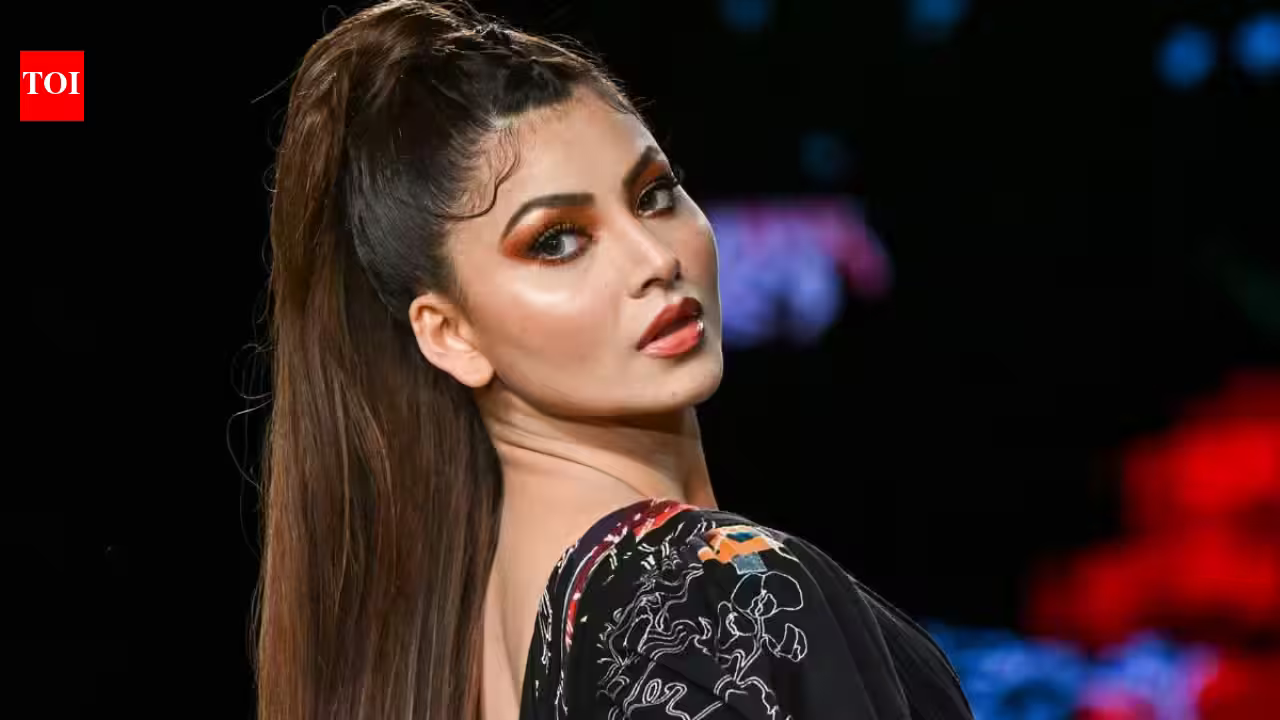
In the high-stakes, rapidly shifting landscape where Hollywood meets Silicon Valley, a new kind of battleground has emerged—and it’s costing a fortune. Actress and model Urvashi Rautela has thrust herself into the center of a massive legal firestorm, demanding a staggering Rs 7,000 crore from a Los Angeles-based artificial intelligence firm. The bone of contention? The alleged unauthorized exploitation of her name, likeness, and digital persona.
In an era where “digital immortality” is being touted as the next frontier of show business, the lines between personal brand integrity and technological progress have never been more blurred. For the A-listers of Bollywood, the question is no longer just about copyright; it’s about control over their own faces, voices, and reputations in a world governed by algorithms.
The Rs 7,000 Crore Ultimatum
The confrontation spilled into the public eye this week via a sharp, direct missive on Instagram. The statement, issued by “Team Urvashi,” was unambiguous in its intent: “We are pursuing appropriate legal remedies, including damages currently being assessed at Rs 7,000 crore against the Los Angeles-based company. Build your AI company. Build your brand. But keep Urvashi’s name out of your business unless you have permission.”
This is not a mere slap on the wrist. By slapping a price tag of Rs 7,000 crore—an astronomical sum even by Bollywood’s standards—Rautela’s camp is sending a warning shot across the bow of the AI industry. They are declaring that the celebrity brand is not a public utility to be mined by software developers. For Rautela, a star whose public image is arguably her most valuable asset, the fight is about establishing a precedent: you cannot build your future on the back of someone else’s fame without a contract.
The Silicon Valley Rebuttal
If Urvashi expected a quiet apology, she was sorely mistaken. Sheeraz Hasan, the founder and CEO of Bollywood AI and Hollywood AI, wasted no time in firing back. Hasan, who had previously interviewed the actress, framed her legal threats as not just incorrect, but “ridiculous.”
The crux of the tension seems to stem from a recent interview where Rautela expressed hesitation—perhaps even apprehension—about the encroachment of AI into the sanctity of Bollywood. When asked her thoughts on the subject, she remarked that the industry was “suffering” because of it. Hasan’s response was characteristically blunt. Taking to Instagram, the AI mogul suggested that the actress “educate” herself on the inevitability of the digital evolution rather than fighting it.
“Bollywood AI and Hollywood AI are the future of entertainment,” Hasan declared, painting a picture of a world where digital stars work 24/7, speak every language on earth, never age, and—perhaps most pointedly—have no egos. It’s a chillingly efficient vision of the future, one that treats the traditional human actor as an obsolete variable in a production line that is rapidly automating away the need for human frailty.
The Larger Crisis of Personality Rights
Rautela’s legal crusade is not an isolated incident; it is a symptom of a broader, systemic anxiety gripping the Indian film industry. As deepfake technology becomes more accessible and AI-generated avatars reach near-perfect realism, the vulnerability of public figures has never been higher.
Celebrities like Salman Khan, Preity Zinta, and Mohanlal have all, in various capacities, sounded the alarm. The legal system is finally beginning to catch up. High Courts in Delhi and Mumbai have already stepped into the fray, granting “personality rights” protections that effectively treat a star’s name and image as their private intellectual property. These rulings suggest that the law is moving toward a standard where your face—whether captured on a 35mm film camera or synthesized by a GPU—belongs to you, and you alone.
The Evolution of a Star
To understand why this matters, one must look at the path Urvashi Rautela has carved for herself. Since her debut in 2013’s Singh Saab The Great, she has meticulously curated a brand that spans high-fashion modeling, mainstream Bollywood cinema, and an expansive reach into the South Indian film markets with hit dance numbers in Waltair Veerayya and Agent.
Her career has been built on her physical presence—her ability to captivate an audience through music videos, endorsements, and live appearances. When a third party uses her likeness to promote an AI platform, they aren’t just using a “digital asset”; they are essentially cannibalizing the very brand she has spent over a decade building. If an AI company can “star” a digital version of her in a movie she never signed up for, the commercial value of the actual human Urvashi drops exponentially.
What Happens Next?
The battle between Rautela and the LA-based firm is more than a celebrity squabble; it is the first major skirmish of an inevitable, long-term war. We are entering an age where the definition of “performance” is being rewritten. If Hasan is right, and digital stars are the future of the entertainment business, then the legal framework surrounding likeness rights will have to be rewritten alongside the code.
Will the Rs 7,000 crore figure hold up in a court of law? That remains to be seen, and experts suspect it may be more of a symbolic anchor than a realistic settlement. However, the legal maneuver has successfully reframed the conversation. It has forced companies—both in India and abroad—to reckon with the fact that they can no longer treat the likenesses of stars as open-source material.
As the dust settles, one thing is clear: the future of Bollywood may indeed involve AI, but it will have to be a future negotiated by contracts, not just algorithms. Whether Sheeraz Hasan and his contemporaries like it or not, the “human ego” they wish to eliminate is exactly what is suing them today. And as it turns out, that human ego has a very high price tag.
Disclaimer: This content is auto-generated for informational purposes only.
Source: Read Original News