









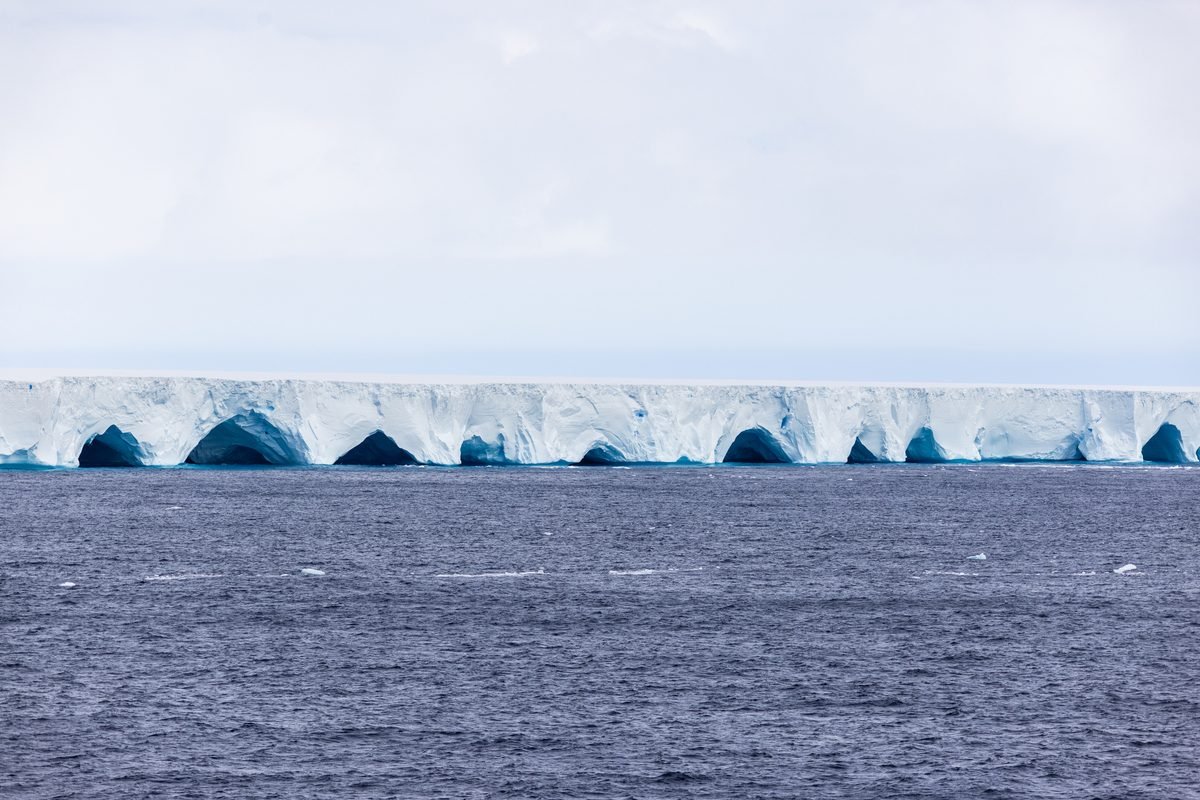
The majesty of an iceberg is often overshadowed by the fact that what we see is merely a fraction of the reality. While their towering, crystalline spires capture the imagination, approximately 90 percent of an iceberg’s mass remains hidden beneath the water’s surface. This submerged bulk makes them not only formidable obstacles for navigation but also deceptively difficult subjects for scientists attempting to document their true scale.
Because icebergs are in a perpetual state of flux—calving from ice shelves, drifting on currents, and slowly melting—the title of “world’s largest” is a contested and transient record. Measuring these giants is a complex task that has evolved from the rough estimates of mariners to the high-precision satellite tracking used by modern researchers.
One of the most notable examples of this volatility is iceberg A23a. Calved from Antarctica’s Filchner Ice Shelf in 1986, A23a spent over three decades firmly grounded in the Weddell Sea. In 2020, the colossal slab began its slow migration northward, fragmenting as it encountered warmer waters. At its peak, A23a spanned an impressive 4,000 square kilometres—roughly twice the surface area of Greater London—and boasted a weight of nearly a trillion tonnes. Despite its immense size, A23a eventually relinquished its status as the world’s largest at the end of 2025 to a new formation, D15A.
Determining an all-time record is further complicated by historical limitations. The most staggering claim dates back to 1956, when the crew of the USS Glacier spotted an iceberg in the Southern Ocean estimated at a breathtaking 31,000 square kilometres—a landmass larger than Belgium. Without the aid of modern satellite imagery, however, such reports remain estimates that cannot be definitively verified.
In contrast, iceberg B15 holds the title for the largest iceberg ever accurately assessed through satellite technology. According to NASA data, B15 covered an expansive 11,000 square kilometres, stretching approximately 300 kilometres in length and 40 kilometres in width.
Beyond the competition for size records, the movement of these frozen titans is a matter of critical scientific interest. Icebergs act as significant drivers of ocean health, influencing the circulation of nutrients and carbon throughout polar regions and, by extension, the global ocean. As they drift and decay, they release minerals trapped in the ice, which can stimulate primary productivity in the water column.
However, their presence can also have detrimental effects on local biodiversity. Large, stationary icebergs can inadvertently block foraging routes for marine mammals and penguins, cutting off access to essential food sources. This disruption can have cascading effects on the stability of polar food webs.
As the climate continues to change, the frequency and scale of iceberg calving events have become a vital indicator of the health of our polar regions. Scientists monitor these icebergs not only to map the changing topography of Antarctica but to better understand how warming oceans are accelerating the breakdown of ice shelves. Whether they are considered monolithic marvels or harbingers of environmental shifts, icebergs remain one of the most powerful and enigmatic features of the Earth’s natural landscape. While the specific record-holder may change from year to year, the imperative to study these drifting giants remains constant, as they hold the key to understanding the future of our changing climate.
Disclaimer: This content is auto-generated for informational purposes only.
Source: Read Original News