









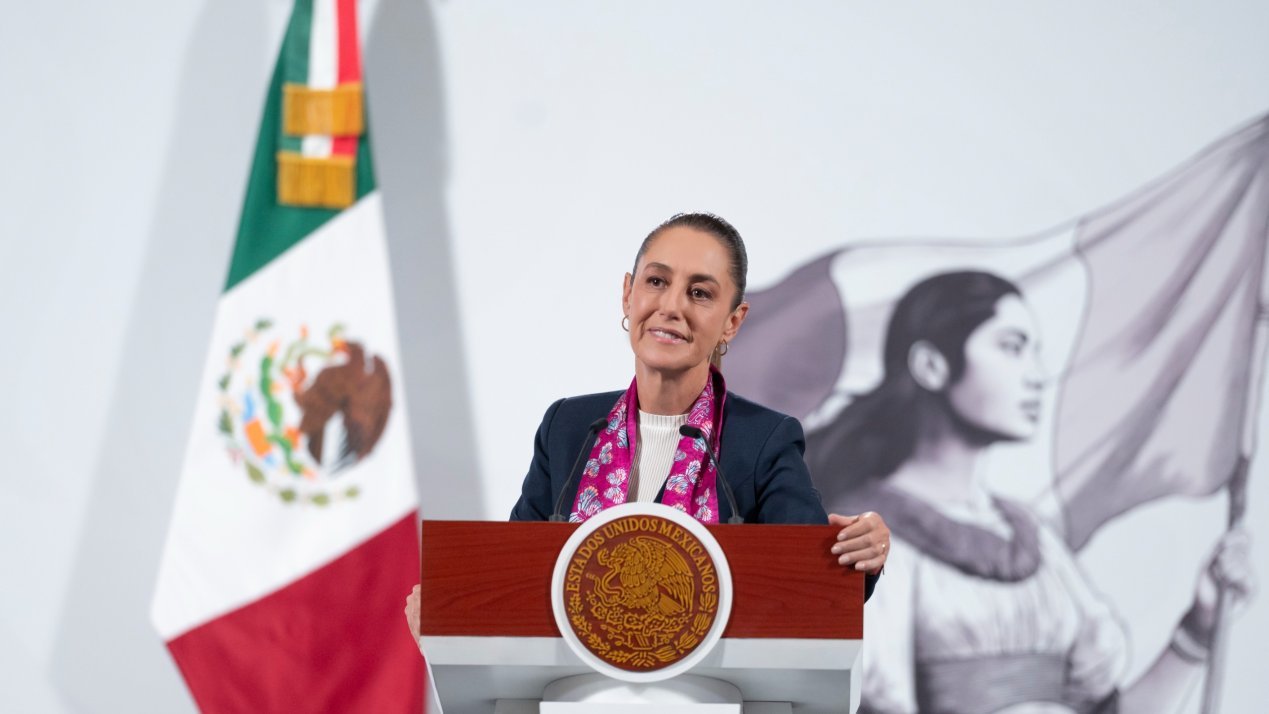
MEXICO CITY — In a wide-ranging policy address on September 30, 2026, President Claudia Sheinbaum Pardo unveiled an ambitious federal agenda that bridges the gap between environmental sustainability and institutional reform. The administration is pivoting toward a “humanistic environmentalism” model, which leverages large-scale infrastructure investments to meet climate goals, while simultaneously asserting stricter sovereign requirements for high-ranking public officials.
Infrastructure as the Backbone of Environmental Strategy
The centerpiece of the government’s environmental policy is an aggressive overhaul of water management. Minister of Environment Alicia Bárcena and the Director General of the National Water Commission (CONAGUA), Efraín Morales, introduced a multi-billion dollar investment strategy aimed at ensuring long-term resource security.
With over MX$180 billion (US$9.9 billion) earmarked for strategic projects, the administration is prioritizing the sanitation of four major watersheds—including the Lerma-Santiago and Tula-Endhó—and the expansion of rainwater capture capacity in the Zumpango and Guadalupe systems. These initiatives are not merely conservation efforts; they are essential upgrades to national infrastructure designed to mitigate the impacts of severe hydrometeorological events.
For the private sector, this shift signals a changing regulatory landscape. As the government moves to reform the National Waters Law—a process that has already seen the recovery of 5 billion cubic meters of water from irregular concessions—industrial and agricultural operators will face higher expectations for compliance and resource efficiency. The integration of advanced data management systems and modern civil engineering highlights the state’s move to treat water as a core public good that is inextricably linked to economic stability.
Digital Transformation and Climate Targets
While the physical infrastructure takes center stage, the administration’s 2030 climate targets—a 35% reduction in greenhouse gas emissions and a 38% renewable energy share—rely heavily on data-driven governance. Much like the tech industry’s current focus on integrating AI to optimize energy grids and resource consumption, the Mexican government is using the 30×30 biodiversity mandate to digitize the tracking of protected areas.
Expanding the nation’s protected territory from roughly 99 million to 152 million hectares by the end of the decade requires sophisticated satellite monitoring and environmental auditing platforms. By fostering a policy environment where water availability is managed through centralized, modernized systems, the Sheinbaum administration is essentially digitizing the management of its natural capital, ensuring that development projects remain within the bounds of sustainable, long-term operational resilience.
Strengthening Institutional and Judicial Sovereignty
Transitioning from environmental policy to political reform, President Sheinbaum emphasized the need for “institutional sovereignty.” Her proposed constitutional amendment, which would require the President and state governors to hold only Mexican nationality, serves as a mechanism to ensure exclusive political and legal allegiance to the state.
The president maintained that this requirement does not infringe upon the rights of individual citizens but is a necessary qualification for those in the highest positions of power. The press conference also served as a stage for the government to flex its judicial muscles in the international arena.
Sheinbaum addressed several high-profile legal issues, ranging from challenging the removal of Interpol red notices for specific fugitives to questioning the use of inhumane detention cells in international migrant facilities. By simultaneously tackling internal administrative standards and external judicial cooperation, the administration is signaling a more assertive stance on how Mexican law interacts with global institutions. These moves are intended to reinforce the state’s authority, ensuring that both internal governance and international relations are conducted under a unified, and strictly Mexican, legal framework.
Disclaimer: This content is auto-generated for informational purposes only.
Source: Read Original News