






HP Challenges the Ultrabook Market with the OmniBook 5 14
The laptop landscape is entering a new phase of intense competition as HP officially announces its latest hardware contender, the OmniBook 5 14. Designed to capture the attention of users currently weighing their choices against Apple’s MacBook Neo, the OmniBook 5 14 brings a fresh design language and a specific focus on display technology to the ultraportable category. With a starting price point of $699.99, HP is positioning this machine as a high-value entry into the premium segment, balancing accessible pricing with features that are typically reserved for high-end flagship devices.
The core of the OmniBook 5 14 is built around Intel’s newest “Wildcat Lake” processor architecture. The base configuration arrives with the Intel Core 5 315, paired with 8GB of RAM and a 256GB solid-state drive. This hardware foundation represents a standardized performance tier that is rapidly becoming the industry baseline for 2026 thin-and-light laptops. However, HP provides a clear path for expansion, allowing users to configure the machine up to an Intel Core 7 350 chip, accompanied by 16GB of RAM and a 1TB storage drive. By offering this range of configurations, HP intends to cater to both budget-conscious students and power users who require additional overhead for multitasking and local file management.
The OLED Advantage and Display Strategy
Perhaps the most significant differentiator for the OmniBook 5 14 is the decision to standardize OLED technology across the entire product line. In an industry where high-end display panels are often locked behind the most expensive configurations, HP’s choice to provide an OLED experience as a default feature is a substantial move. This brings deeper contrast ratios and more vibrant color reproduction to even the entry-level $699.99 model.
Technical specifications for the displays will vary as the product matures. At launch in October, the base model will feature a 1920 x 1200 resolution panel with a peak brightness of 300 nits. While this is adequate for most indoor office or classroom environments, it is a modest starting point. HP has confirmed that a touchscreen variant will be available at the initial October launch window. For users requiring higher fidelity, a performance-tier panel—boasting a 2560 x 1600 resolution and an increased brightness rating of 400 nits—is scheduled to arrive in March 2027. This phased rollout allows HP to manage manufacturing supply chains while ensuring that the visual experience remains a competitive cornerstone of the OmniBook identity.
Engineering and Portability Specs
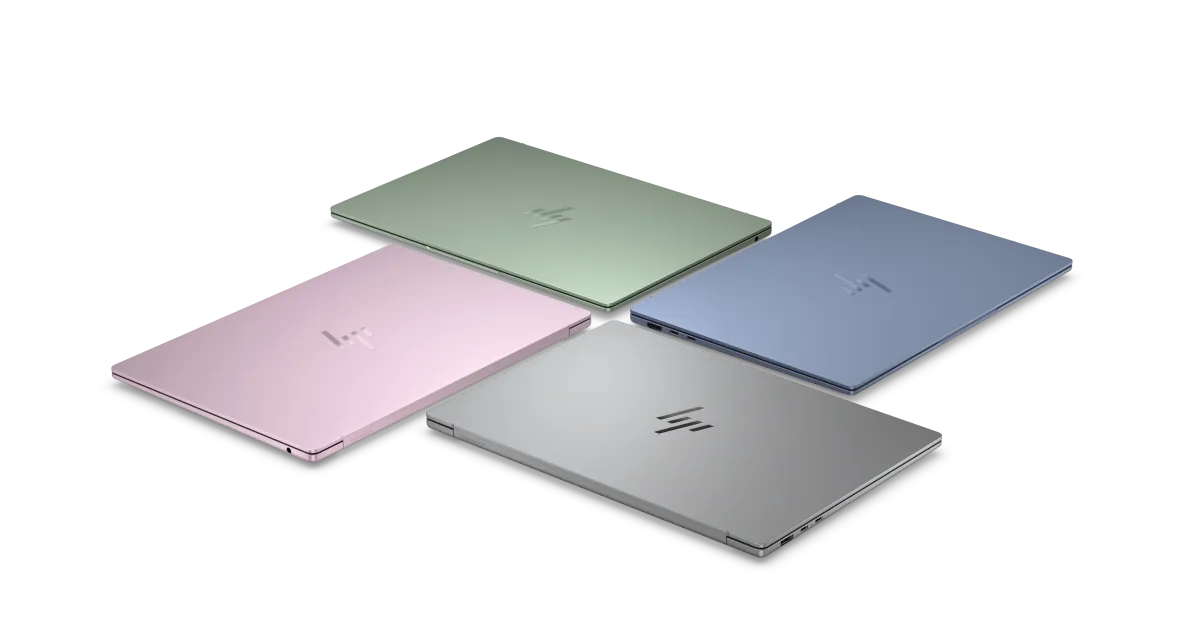
HP has placed a heavy emphasis on industrial design for the OmniBook 5 14, targeting a form factor that challenges the physical dimensions of its primary competitors. The device measures a mere 0.46 inches (11.7mm) at its thickest point, achieving a profile that is slightly thinner than the Apple MacBook Neo. Weight is similarly minimized, with the base model starting at 2.56 pounds. To enhance the aesthetic appeal, HP has opted for a sleek lid logo typically reserved for their premium “Spectre” or “Elite” lines, suggesting that the OmniBook 5 is intended to bridge the gap between commercial reliability and aesthetic sophistication.
The physical connectivity suite is designed for minimalists. The chassis houses two 10Gbps USB-C ports, an HDMI port for external display connectivity, and a standard 3.5mm audio jack. While power users may find the reliance on two USB-C ports restrictive, the inclusion of an HDMI port provides a level of legacy convenience that is often omitted in competing ultraportables. To ensure balanced media performance, the machine is equipped with dual speakers and a 1080p webcam, standardizing the essential tools required for modern hybrid work and video conferencing.
Intel Wildcat Lake and Battery Efficiency
The transition to the Intel Wildcat Lake architecture is critical to the OmniBook’s performance trajectory. Previous testing of this chip generation suggests a significant focus on power efficiency and thermal management, which is essential for a chassis as thin as 0.46 inches. Because the OmniBook relies on active management of these thermals, the actual battery life will be highly dependent on individual usage patterns and display brightness settings.
By utilizing the Wildcat Lake platform, HP expects the OmniBook 5 to deliver competitive runtime, though it may not necessarily outstrip the specific architectural efficiency found in Apple’s custom silicon. However, for users embedded in the Windows ecosystem, the Wildcat Lake chips offer improved integrated graphics capabilities and localized AI processing features that are becoming increasingly relevant as OS-level applications continue to integrate resource-heavy background tasks.
Expansion into Business Markets with the ProBook 4 G2iS
Beyond the consumer-focused OmniBook, HP is also addressing the enterprise sector with the announcement of the ProBook 4 G2iS. This machine serves as a direct extension of the company’s focus on thin-and-light professional hardware. Claiming the title of HP’s “thinnest business notebook,” the ProBook 4 G2iS measures 0.47 inches (12mm) in thickness.
Set for a December launch, this machine will also utilize the Intel Wildcat Lake architecture and will likely share several underlying component technologies with the OmniBook 5. By keeping the design philosophy consistent across consumer and business lines, HP is aiming to streamline their supply chain while providing a recognizable, uniform experience for enterprise clients who prioritize portability without sacrificing the security and manageability features standard to the ProBook lineage. While pricing for the ProBook 4 G2iS remains undisclosed, its debut marks a shift in how HP intends to distribute high-efficiency components across their entire portfolio.
Disclaimer: This content is auto-generated for informational purposes only.
Source: Read Original News