







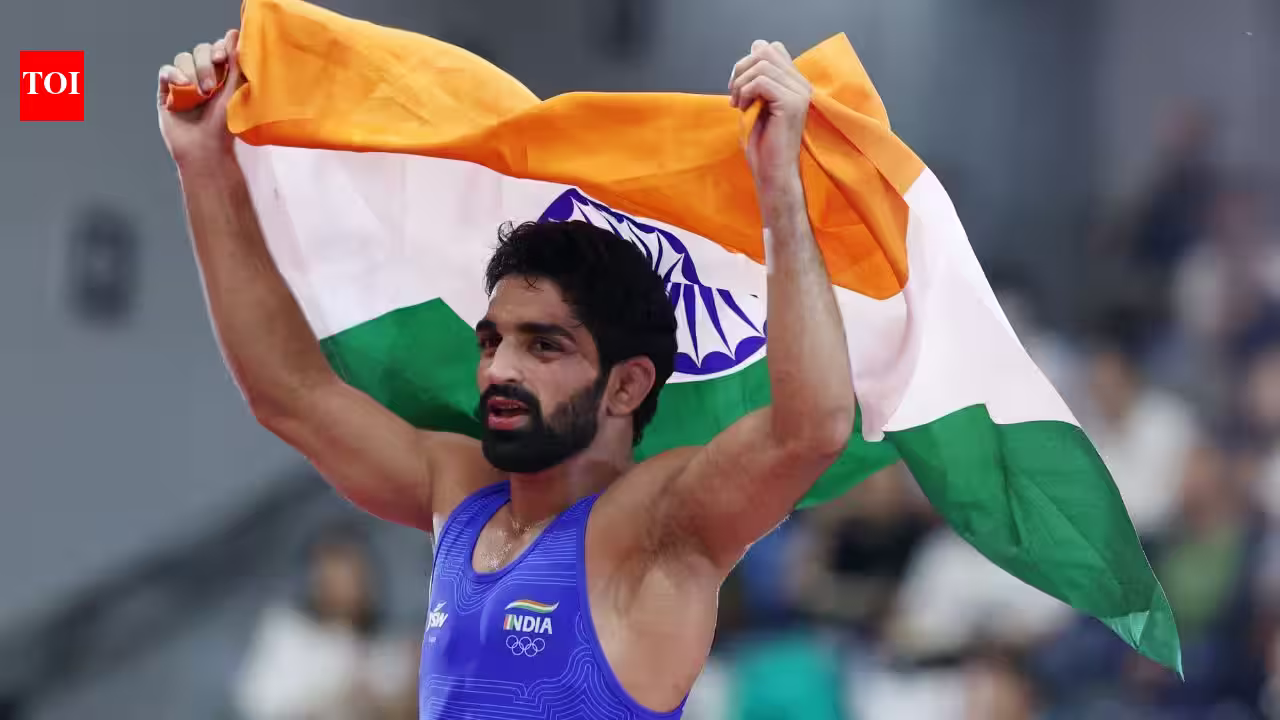
Aman Sehrawat’s journey to the top of the podium was never merely about the sport of wrestling; it was about the manifestation of a vision. For months, the 23-year-old athlete carried a singular, static image on his mobile phone: a picture of an Asian Games gold medal. It was a digital lighthouse guiding him through the grueling cycles of training, weight management, and the emotional turbulence of his young career. On Saturday, as he stood in the center of the mat, his face etched with the physical toll of a hard-fought battle, that wallpaper finally became reality.
After defeating North Korea’s reigning world champion Han Chong Song with a gritty 11-7 scoreline in the 57kg final, Sehrawat did what every champion dreams of—he held the genuine article, bit down on the metal, and allowed himself to process a moment of profound disbelief. The transition from the screen to his neck was complete.
A Battle of Grit and Resilience
The gold-medal bout was emblematic of the transformation Sehrawat has undergone. Facing a formidable world champion in Han, the match was far from a clinical exhibition. Early in the contest, a collision left Sehrawat with a visible cut beneath his left eye. The blood, however, served only to sharpen his focus.
The contest proved to be a tactical roller coaster. After Sehrawat surged to an early 6-1 lead, Han Chong Song utilized his world-class pedigree to rattle off a comeback, clawing his way to a 7-6 lead. In that pressure-cooker environment, many wrestlers might have folded, but Sehrawat’s response was clinical. He regained his footing, executed two devastating takedowns, and stifled Han’s momentum to secure the title.
His path to the final was equally commanding. Before facing the North Korean, Sehrawat systematically dismantled the opposition, dispatching Japan’s Yamato Ogawa (20-9), Kazakhstan’s Nurdanat Aitanov (12-1), and Tajikistan’s Aiaal Belolyubskii (14-8) in a display of offensive wrestling that signaled his intent from the opening whistle.
The Price of Discipline
While his performance in the ring was flawless, the victory is arguably more impressive when viewed through the prism of his recent history. Last year, the wrestling world witnessed a sobering chapter in Sehrawat’s career when he was disqualified from the World Championships for being 1.7kg over the 57kg weight limit. The resulting one-year suspension from the Wrestling Federation of India (WFI) threatened to derail his momentum.
Rather than succumbing to the setback, Sehrawat used it as a catalyst for growth. After a formal apology saw his ban lifted, he wrestled in the 61kg category at the Zagreb Open and Asian Championships, securing silver in both. The experience proved vital, yet his heart remained in the 57kg division. The discipline required to shed that weight successfully—culminating in his victory at the Budapest Ranking Series—was the crucible that forged his gold-medal performance. He is no longer just a talented prospect; he is a refined tactical force, currently holding the titles of U-23 world champion and Asian Games gold medalist.
Rising from Tragedy
To understand the resolve behind Sehrawat’s gaze, one must look toward his early life in Haryana. At just 10 years old, he lost his mother, followed by his father only a year later. Orphaned at 11, his trajectory could have been drastically different had his maternal uncles not intervened. Recognizing his potential, they brought him to Delhi’s iconic Chhatrasal Stadium. Under the tutelage of coach Lalit Kumar, the grieving child found a purpose that would eventually define a nation’s pride.
A Historic Haul for India
Sehrawat’s gold was the centerpiece of a historic campaign for Indian wrestling. With Antim Panghal securing silver in the women’s 53kg and Deepak Punia clinching bronze in the men’s 97kg, India’s total medal count in wrestling climbed to six—comprising two gold, two silver, and two bronze medals.
This tally represents India’s most successful Asian Games performance in 64 years, a feat surpassed only by the legendary 12-medal haul in the 1962 Jakarta Games. Antim Panghal, though ultimately bested by Japan’s Moe Kiyooka in a 9-1 decision, proved she belongs among the continent’s elite, solidifying her status as a future powerhouse. Deepak Punia’s route to the podium was equally gritty, overcoming a heartbreaking 8-9 semifinal loss to bounce back and edge Mongolia’s Gankhuyag Ganbaatar 2-1 in a nail-biting repechage match.
As the dust settles on the tournament, the narrative of the games will center on the young man from Chhatrasal. For Aman Sehrawat, the tournament ended with a medal around his neck, but it began with a promise he made to himself on a glowing phone screen. He has moved beyond the shadows of his past, proving that with enough discipline, even the most impossible wallpapers can come to life.
Disclaimer: This content is auto-generated for informational purposes only.
Source: Read Original News