







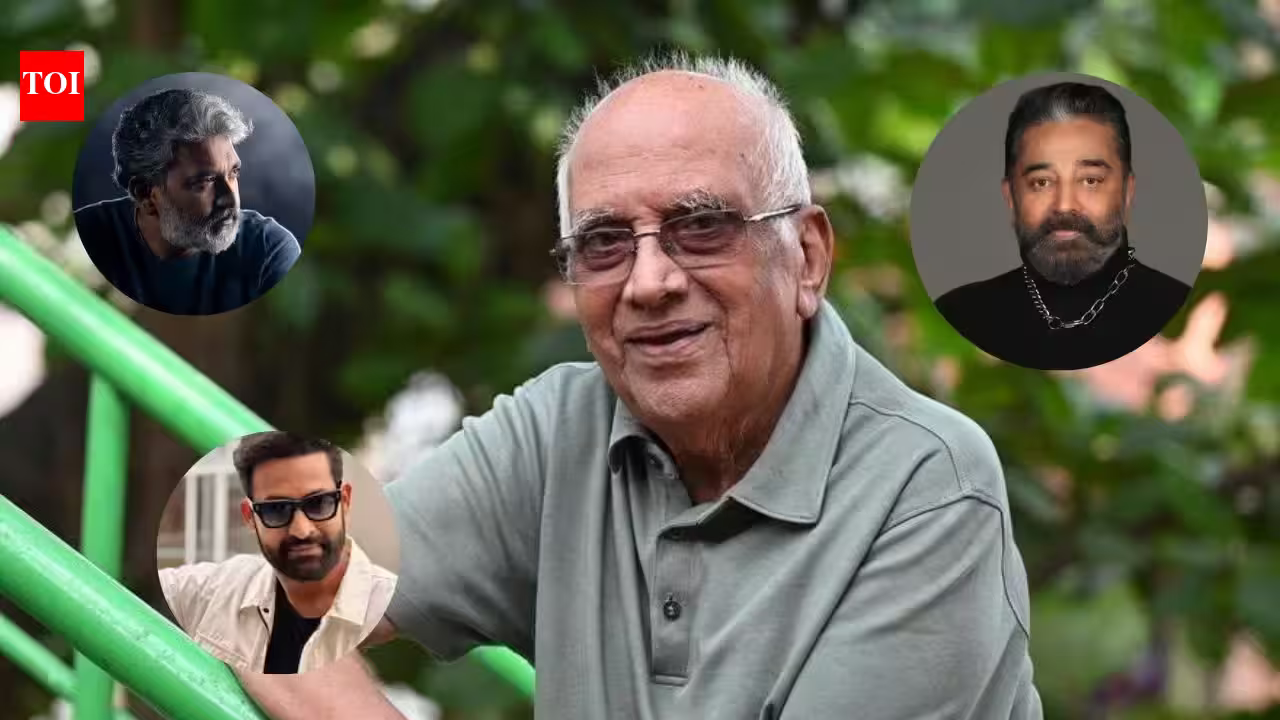
The curtains have drawn on one of the most inventive minds in the history of Indian cinema. Singeetham Srinivasa Rao, a director who treated the silver screen not just as a medium for storytelling but as a laboratory for the impossible, has passed away at the age of 94. His departure from Kauvery Hospital on October 3 marks the end of an era—a period defined by audacity, technical ingenuity, and an unyielding commitment to the “what if” factor of filmmaking.
While the industry mourns, the prevailing sentiment across the corridors of Hyderabad and Chennai is not merely one of sorrow, but of profound gratitude. Rao was not just a filmmaker; he was the architect of dreams that many thought were beyond the reach of South Indian cinema at the time.
SS Rajamouli remembers a visionary pioneer
In a landscape currently dominated by massive budgets and cutting-edge visual effects, SS Rajamouli took a moment to remind us of the man who paved the way long before the tools were readily available. For the RRR director, Singeetham Srinivasa Rao was a North Star—a filmmaker who prioritized conceptual brilliance over the limitations of his era.
“Long before we had the tools or the budgets, he dared to dream bigger than anyone around him,” Rajamouli noted in his tribute. It is a poignant observation: Rao’s filmography reads like a defiance of logic. Whether it was the silent black comedy Pushpaka Vimanam or the dizzying complexity of the time-travel narrative Aditya 369, he operated in a space where genre definitions were merely suggestions. Rajamouli’s admission that he—and every other filmmaker who dared to experiment in Telugu cinema—owes a debt to Rao, speaks volumes about the legacy left behind. For the modern generation, Rao wasn’t just a peer; he was the primary reference point for imaginative courage.
Jr NTR pays tribute to the architect of ‘freshness’
For stars like Jr NTR, Rao’s films are not just pieces of cinematic history; they are works of art that remain unnervingly contemporary. In his tribute, NTR pointed out the sheer staying power of Rao’s vision, noting that films like Aditya 369, Pushpaka Vimanam, and Mayuri do not suffer from the usual wear and tear of “vintage” cinema.
“A visionary who thought ahead of his time, delivering films that feel fresh even across generations,” NTR wrote. This sentiment resonates with cinephiles who often struggle to categorize Rao’s work. How does a film like Pushpaka Vimanam, made in 1987, still elicit the same delight from a 2024 audience? The answer lies in Rao’s ability to tap into universal human emotions while wrapping them in high-concept plots. He didn’t just chase trends; he created a timeless internal logic for his films, making them immune to the rapid turnover of commercial cinema.
Kamal Haasan’s intimate reflection on a creative soulmate
Perhaps the most deeply felt tribute came from Kamal Haasan, an actor who shared a creative frequency with Rao that few could ever replicate. Their partnership, which gifted audiences cult classics like Apoorva Sagodharargal and Michael Madana Kama Rajan, was rooted in a mutual desire to push the envelope.
Haasan’s words were characteristically poetic, focusing on the director’s perpetual state of youth. “Singeetham sir, by his own choice, passed away in his youth, along with his youth,” Haasan reflected. This was not a traditional lament for the elderly; it was a celebration of a man who refused to allow his spirit to grow stagnant. Haasan’s declaration that he now aspires to live as Rao did—fully and creatively to the very end—is perhaps the greatest eulogy a mentor could receive. It frames a 94-year-old’s life not as a long, fading sunset, but as a bright, consistent flame that never flickered out.
A legacy that defies the definition of ‘The End’
Singeetham Srinivasa Rao’s career was a kaleidoscopic journey that traversed Telugu, Tamil, Kannada, Malayalam, and Hindi cinema. He had an innate ability to pivot between dance dramas like Mayuri—which broke new ground in storytelling about disability and determination—and the frantic, slapstick brilliance of Michael Madana Kama Rajan.
His refusal to be categorized was his signature. In an industry that often forces directors into specific “slots” (the action director, the romantic lead director, the political drama director), Rao was the ultimate nomad. He went wherever his curiosity took him.
The fact that his final project, Sing Geetham, was helmed at the age of 94 is the ultimate testament to his character. Even in the twilight of his life, he was working with new blood, exploring musical fantasy and collaborating with contemporary stars like Vijay Deverakonda. It suggests that for Rao, filmmaking was not a job or a career—it was a mode of existence.
As the film fraternity reflects on his contributions, it is clear that Singeetham Srinivasa Rao leaves behind more than a catalog of movies. He leaves behind a blueprint. He taught a generation that the “limits” of cinema are not found in the budget, the technology, or the box office returns. They are found only in the lack of imagination. By that metric, Singeetham Srinivasa Rao will remain truly limitless.
Disclaimer: This content is auto-generated for informational purposes only.
Source: Read Original News