








The cricketing world knows him as the icy-veined strategist who steered India to global glory, but behind the scenes, MS Dhoni has always been a man of quiet, understated passions. While his love for motorcycles and his Ranchi farmhouse is well-documented, a recent social media reveal has offered a rare, soulful glimpse into the private life of the man they call ‘Thala.’
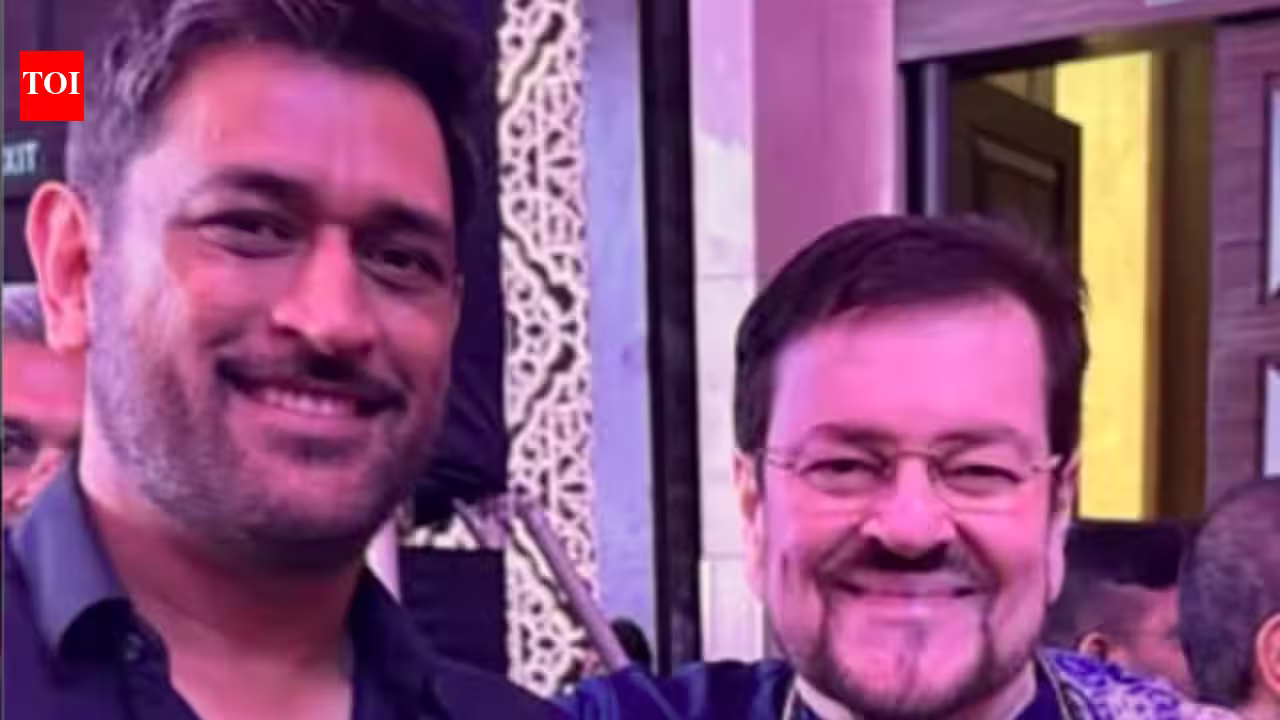
In a heartwarming encounter that has sent the internet into a frenzy, former Indian cricket team captain Mahendra Singh Dhoni recently crossed paths with veteran playback singer Nitin Mukesh. The meeting was not just a brief brush between two icons of different fields; it turned into a moment of musical camaraderie that has warmed the hearts of millions.
A Musical Meeting of Minds
The bridge between the cricket field and the golden era of Bollywood was built by a shared love for a timeless classic. Nitin Mukesh, a voice that has defined generations of Indian cinema, took to Instagram to share a snapshot of the encounter. Dressed in coordinated shades of blue—a coincidence that didn’t go unnoticed by fans—the duo looked every bit like two friends catching up on old times.
The caption, however, was where the real magic lay. Nitin Mukesh revealed that Dhoni isn’t just a casual listener of his father’s work; he is a devotee of the legendary Mukesh’s iconic track, “Main Pal Do Pal Ka Shayar Hoon.” The song, a philosophical masterpiece from the film Kabhi Kabhie, captures the fleeting nature of life and fame, themes that seem to resonate deeply with a man who has lived his life under the relentless glare of the spotlight.
“I have two reasons to be proud of today,” Nitin Mukesh wrote, his admiration palpable in every character. “Firstly, that I met this illustrious, legendary son of India… secondly, he loves the song ‘Main Pal Do Pal Ka Shayar Hu’ and that he sings it too… with the same passion… You are a national treasure, MS Dhoni sir… ‘Thala’ for a reason.”
Why ‘Thala’ Still Resonates
The term “Thala”—a Tamil word meaning ‘Leader’ or ‘Head’—was bestowed upon Dhoni by the passionate fans of the Chennai Super Kings. Yet, as the years go by, the moniker has transcended the boundaries of cricket stadiums. It has become a symbol of a man who commands respect not through loud declarations, but through a grounded, almost spiritual approach to life.
Seeing Dhoni, a man synonymous with high-pressure finishing in the T20 format, find solace in the melancholic, reflective poetry of a song like “Main Pal Do Pal Ka Shayar Hoon” adds a layer of depth to his public persona. It suggests that while he may be a titan of the sport, he remains deeply connected to the cultural fabric of the nation. For his fans, this isn’t just a viral photo; it’s a confirmation that the values they adore in him—humility, poise, and an appreciation for the classics—are very much real.
Bridging Generations Through Melody
The encounter also serves as a poignant reminder of the enduring legacy of Nitin Mukesh and the Mukesh lineage. Nitin Mukesh has always been a custodian of his father’s musical heritage, ensuring that the soul of the 70s and 80s remains vibrant in the modern age. His willingness to celebrate the next generation of icons, like Dhoni, shows the bridge between the eras.
Nitin Mukesh’s recent tribute to the late, great Lata Mangeshkar on her birth anniversary earlier this September proved that he operates from a place of profound respect for musical history. By sharing memories of the past while engaging with current legends, he keeps the spirit of Indian playback singing alive. When he refers to Dhoni as a “national treasure,” he is acknowledging that greatness, in any form, deserves a place in the same pantheon.
The Tracks That Defined an Era
For those who only know Nitin Mukesh through his recent Instagram posts, it is worth remembering the staggering impact he has had on the Indian musical landscape since his debut in the 1970s. His voice was the heartbeat of the blockbuster era. From the soul-stirring “Zindagi Ki Na Toote Ladi” in the patriotic epic Kranti to the infectious, foot-tapping energy of “My Name Is Lakhan,” Nitin Mukesh’s discography is a roadmap of Indian cultural history.
His work on tracks like “So Gaya Yeh Jahan” and “Aaja Re O Mere Dilbar Aaja” represents a level of vocal texture that defined the romantic and dramatic tropes of his time. He was, and remains, a voice that could convey longing, joy, and existential philosophy with the same ease. It is little wonder that a man like Dhoni, who has navigated the tumultuous peaks and valleys of a high-profile career, finds comfort in such expressive, timeless melodies.
A Legacy of Shared Humanity
Ultimately, the image of Dhoni and Nitin Mukesh standing side-by-side acts as a mirror to our own national psyche. We love our cricketers as gods and our singers as poets, but we are at our happiest when we see them being simply human.
Whether it is the “Captain Cool” of Indian cricket singing lines like “Main pal do pal ka shayar hoon, pal do pal meri kahani hai” (I am a poet of a moment or two, a moment or two is my story), the message is clear: Even the most celebrated individuals are just people, finding beauty in the fleeting moments that make up their own “pal do pal” (moment or two) in the sun. As the internet continues to buzz over this interaction, one thing is certain: the legend of ‘Thala’ continues to grow, one soulful song at a time.
Disclaimer: This content is auto-generated for informational purposes only.
Source: Read Original News