








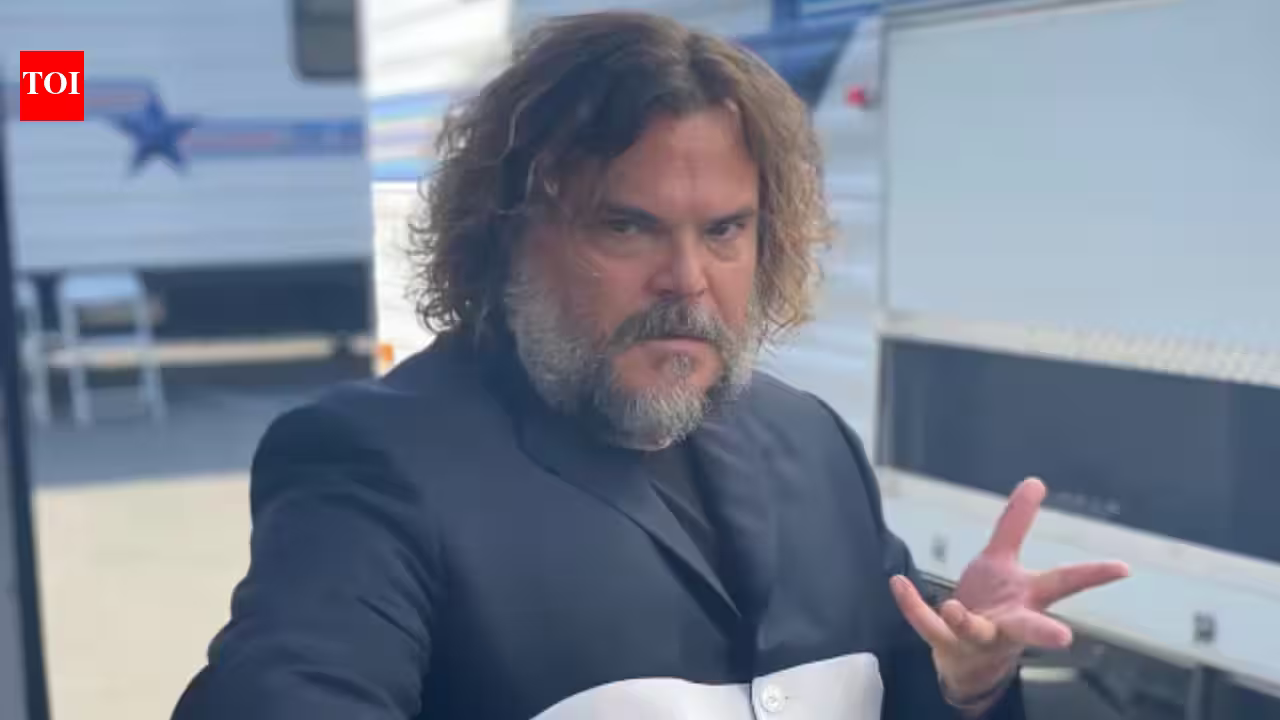
If there is one thing Jack Black has mastered, it is the art of the glorious bellyflop. For over three decades, the man has made a career out of being the loudest, most unhinged, and unapologetically goofy presence in any room he walks into. Whether he’s shredding a Gibson SG as Dewey Finn in School of Rock, lending his voice to the ravenous Po in Kung Fu Panda, or stepping into the pixelated world of A Minecraft Movie, Black operates with a singular, high-octane energy that most actors would find terrifying. He doesn’t just play characters; he inhabits the potential for absurdity, and more importantly, he isn’t afraid to look like an absolute fool.
In a recent interview with Access Hollywood to promote his latest blockbuster, A Minecraft Movie, Black dropped a piece of wisdom that hits harder than a power chord at a Tenacious D concert. Addressing the paralysis that often stops creative people in their tracks, he offered a simple, bracing mantra: “Don’t be afraid of failure because that’s the demon that will get in the way. Failure is your friend; that’s when you learn.”
It’s a deceptively simple sentiment, but coming from a man who has spent his entire professional life jumping off high-dives into the unknown, it resonates with the kind of gravitas that only experience can provide.
The Demon in the Room: Why We Fear the Fall
Black isn’t just talking about the nuances of comedic timing or script analysis. He is speaking to a universal human condition: the paralyzing fear of looking stupid. In the age of social media, where every misstep is documented, archived, and GIF-ified for eternity, the pressure to be perfect—or at least polished—has never been higher. Most of us treat failure like a social death sentence. We avoid the risks that could lead to our biggest breakthroughs because we are terrified of the potential embarrassment.
Black’s philosophy flips this script entirely. By labeling the fear of failure as a “demon,” he identifies exactly what it is: an internal antagonist that feeds on our insecurity. When we decide that we won’t try unless we are guaranteed a win, we aren’t protecting ourselves; we are stagnating. To Black, the “bellyflop”—that moment of total, cringe-inducing failure—is a necessary part of the process. It is the raw data that allows for refinement. If you aren’t risking a public tumble, you probably aren’t aiming high enough.
Reclaiming the “Friendship” of Failure
The crux of Black’s advice is the shift in perspective. To view failure not as an enemy, but as a “friend,” is a radical act of psychological reframing. We are trained from a young age to see an ‘F’ on a report card as a sign of incompetence. In the professional world, we see a failed project as a career stain. Black sees these moments as teachers.
Think about the sheer number of projects an actor of his caliber touches—from experimental shorts and voice-over work to massive, CGI-heavy franchise films. Not every role hits the mark, and not every comedy bit lands with the intended roar of laughter. Yet, by embracing the possibility of a “miss,” Black keeps his creative output prolific and his energy fresh. He isn’t a museum piece who plays it safe to preserve a legacy; he is a living, breathing performer who understands that the only way to evolve is to stay in the game, mistakes and all.
From Santa Monica to Stardom
To understand where this fearlessness comes from, one has to look back at the origins of the man himself. Born in Santa Monica in 1969 to satellite engineer parents, Jack Black was raised in a household that appreciated the precision of science, but he found his calling in the chaos of the stage. A product of the Crossroads School—a hub for budding talent—he didn’t have a linear path to fame.
Long before he was a household name, he was a teenager doing commercials for early video games like Pitfall! and grinding through bit parts in 90s television staples like The X-Files and Northern Exposure. He had every opportunity to quit when the “big break” didn’t arrive, or when those early, smaller roles didn’t lead to instant superstardom. But he didn’t. He brought his unique, idiosyncratic flair to every project, no matter how small. He cultivated his craft in the margins, essentially failing forward until the world caught up to his brand of manic charisma.
Why This Philosophy Matters Now More Than Ever
In today’s landscape, where algorithms dictate visibility and the “cancel culture” discourse keeps many creators walking on eggshells, Black’s message is a breath of fresh, anarchic air. We live in an era that prizes the “curated life,” where showing your failures is seen as a liability. But looking at Black’s career—from the cult phenomenon of Tenacious D to his dramatic, heart-wrenching turn in King Kong—it is clear that his versatility is a direct result of his willingness to try things that shouldn’t work.
He reminds us that success is rarely a straight line. It is a jagged, messy, unpredictable path that requires us to occasionally trip over our own feet. Whether you are starting a business, learning an instrument, or just trying to navigate the anxieties of modern life, the lesson remains the same: the barrier isn’t the failure itself. The barrier is the hesitation that comes before you even attempt to start.
Jack Black is effectively telling us to stop trying to be the hero of a perfectly edited montage and start being the person in the outtakes. Because, as he’s proven with every high-pitched scream and frantic guitar solo, the most interesting parts of the story usually happen right after you’ve risked looking like a total disaster. So, go ahead and bellyflop. The water’s fine, and you might just learn how to swim in the process.
Disclaimer: This content is auto-generated for informational purposes only.
Source: Read Original News