









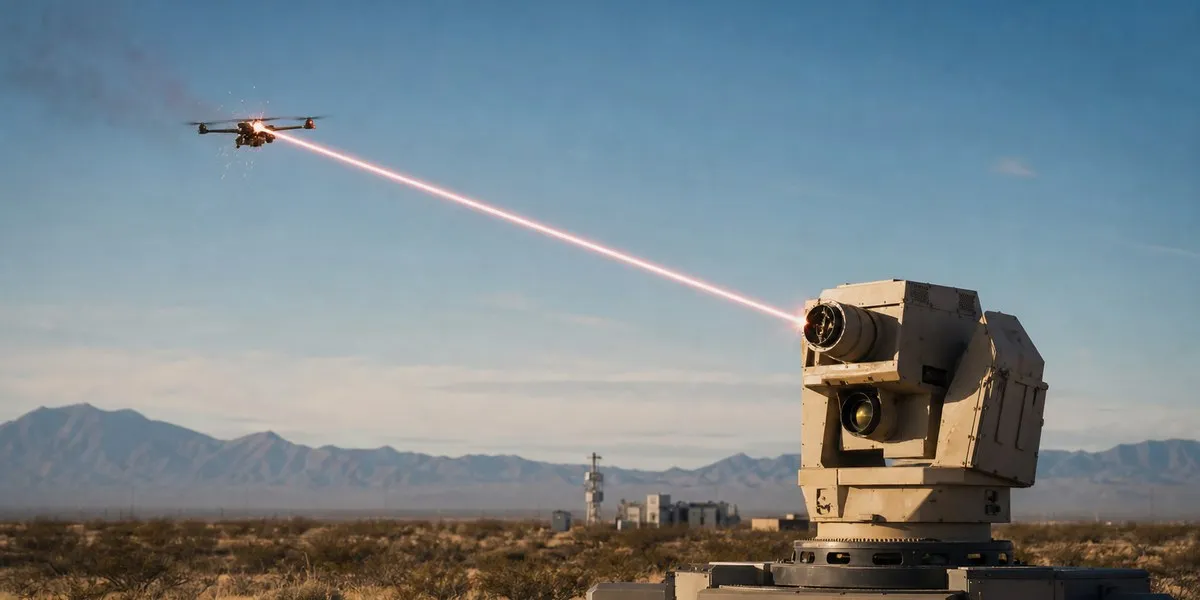
The Pentagon has officially selected four major defense contractors—AeroVironment, Epirus, Kord, and Boeing—to participate in a critical pilot program aimed at bolstering the United States’ ability to neutralize unauthorized drone threats. The initiative, overseen by the Joint Interagency Task Force 401 (JIATF-401), marks a significant step toward integrating high-tech, directed-energy weapons into the nation’s domestic defense architecture.
JIATF-401 Director Brig. Gen. Matt Ross confirmed that the primary objective of the program is to rigorously verify the performance of these directed-energy systems within an operational environment. Beyond mere technical capability, the project is designed to develop a comprehensive framework for how these tools can be seamlessly integrated and sustained to protect critical U.S. territory. The effort is being executed through high-level coordination between the Department of Defense, the Federal Aviation Administration (FAA), U.S. Northern Command, and various military branches.
The urgency for this development follows a high-profile operational breakdown in February, when the FAA was forced to temporarily close the airspace around El Paso International Airport in Texas. The closure stemmed from a miscommunication between federal agencies regarding the deployment of a counter-drone laser operated by U.S. Customs and Border Protection—a system that had been provided by the U.S. Army.
To prevent future disruptions, JIATF-401 has been working closely with the FAA to establish new safety standards. Recent collaborative risk assessments conducted during a high-energy laser demonstration in New Mexico indicated that such systems pose minimal risk to the national airspace system when properly managed. This successful demonstration has already paved the way for a joint agreement regarding the deployment of laser systems intended to safeguard the U.S. southern border.
The pilot program is moving quickly to capitalize on these breakthroughs. In December, JIATF-401 is scheduled to conduct comparative testing of the solutions provided by the four selected vendors. These tests will be the final hurdle before potential procurement. According to the Pentagon, systems that demonstrate superior performance during these trials may be fast-tracked for immediate acquisition.
While AeroVironment, Epirus, Kord, and Boeing are the current focus, the Department of Defense and the task force have signaled that this is an ongoing process. Officials will continue to evaluate a broader range of directed-energy technologies to ensure that the U.S. military remains equipped with the most effective, reliable, and safe countermeasures against the rapidly evolving threat of unmanned aerial systems. As the pilot program unfolds, the results will likely dictate the future of how the United States secures its domestic skies against increasingly sophisticated aerial incursions.
Disclaimer: This content is auto-generated for informational purposes only.
Source: Read Original News