







Engineering a New Genre Within Retro Hardware
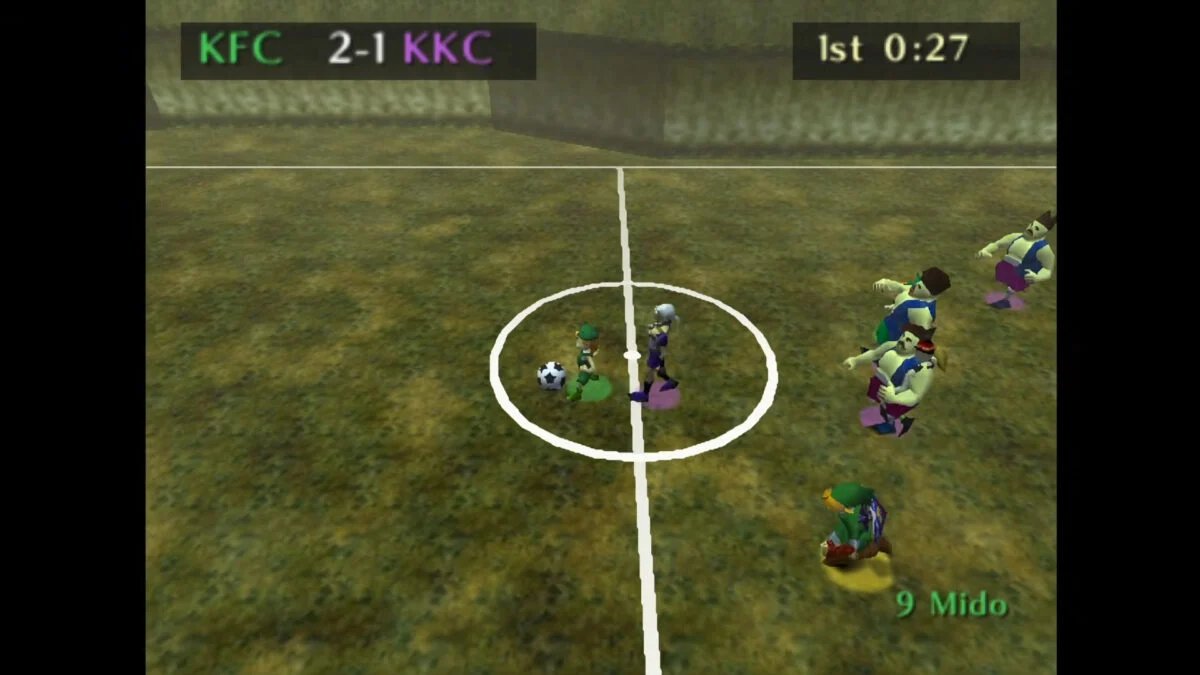
The landscape of retro gaming modding has expanded significantly, moving beyond simple texture swaps or difficulty adjustments. A prime example of this evolution is Soccerina of Time, a technical project that transforms the core engine of the 1998 classic The Legend of Zelda: Ocarina of Time into a fully functional soccer simulation. Developed by modder shonj352, the project repurposes the title’s existing assets and movement logic to support an entirely new genre. By reframing Hyrule’s iconic locales into pitch-based arenas, the mod demonstrates the versatility of the Nintendo 64 software architecture when subjected to rigorous code manipulation.
The technical foundation of the project relies on intercepting the game’s primary control loop to prioritize ball physics and collision detection over the standard exploration and combat mechanics. Integrating a sports simulation into a game engine never designed for such dynamics requires substantial memory management and script injection. The result is a system that allows users to select from eight distinct teams, including groups based on regional factions like Kakariko City, Zora United, and Kokiri FC. This transformation highlights how modern developers are leveraging reverse-engineering techniques to push vintage hardware toward performance metrics once considered impossible for the platform.
Technical Innovations in Animation and Mechanics
At its core, Soccerina of Time introduces custom state machines to govern player movement. Traditional movement in Ocarina of Time follows a static animation set designed for third-person exploration. To facilitate soccer, the mod introduces high-frequency input polling, enabling fluid dribbling, passing, and shooting animations. One of the most technically impressive features is the custom damage and recovery system. During gameplay, if a player character suffers a collision, the system triggers a scripted event where two teammates assist the injured party off the field via a stretcher animation. This implementation requires precise coordinate synchronization to ensure that NPCs interact with the user-controlled character without causing clipping or engine crashes.
The project also incorporates a sophisticated UI overlay that tracks match progression, scoring, and player statistics, all running alongside the base game’s rendering pipeline. By remapping the Ocarina of Time camera system, the mod provides an isometric view conducive to sports games, departing from the original’s locked or proximity-based camera control. These changes suggest a deep understanding of the memory offsets used by the game’s display lists and controller input buffers, allowing for a seamless transition between the adventure engine and the sports simulation interface.
Systemic Features and Modularity
Beyond the basic scrimmage gameplay, Soccerina of Time includes a suite of management tools that elevate it from a simple novelty to a complex simulation. The inclusion of a league mode, a custom character creator, and a manager mode indicates the implementation of a persistent database that stores player stats and team configurations. This requires the mod to handle data persistence outside of the standard game save files, likely utilizing expanded RAM or external patches to manage the increased computational load of multiple AI entities competing on a single field.
The recent implementation of a “trial and jail” system and specific injury mechanics introduces a layer of systemic complexity rarely seen in N64-era projects. By assigning hidden variables to player interactions—potentially tied to foul frequency or aggressive movement—the mod creates a dynamic consequences loop. The “trial” logic suggests an event-trigger system where match officials or environment-based scripts evaluate player behavior, potentially removing athletes from the active roster. This level of feature creep demonstrates the maturity of the current modding community, which is no longer content with cosmetic changes and now seeks to rewrite the core logic loops of classic titles.
The Intersection of Human and Synthetic Code
The development history of Soccerina of Time highlights a growing debate regarding the intersection of artificial intelligence and fan-driven software modification. Recent scrutiny reveals that segments of the underlying source code for this mod were generated using large language models. This integration represents a significant shift in how complex modifications are constructed. While AI assistance can accelerate the creation of repetitive scripts or complex mathematical logic for physics, it also introduces challenges regarding transparency and community standards.
The use of AI in this context allowed the developer to iterate rapidly on feature implementation, such as the aforementioned league management and team balancing. However, the lack of disclosure in early stages of the project sparked a discourse regarding authorship in the modding community. This development serves as a technical case study on how generative tools are becoming embedded in the software development lifecycle, even for community-driven passion projects. It underscores the difficulty of vetting codebases for provenance as these tools become more accessible to non-professional developers.
Impact on the Future of ROM Hacking
Soccerina of Time serves as a benchmark for what can be achieved through persistent modification of legacy titles. By successfully decoupling the game’s engine from its original intent, the project highlights the potential for future “genre-shifting” mods. It provides a blueprint for how developers can utilize existing environmental assets—such as the Gerudo Town square or Kokiri Forest—as modular platforms for entirely new gaming experiences.
The longevity of the Nintendo 64 ecosystem is largely due to these persistent efforts. Projects of this nature invite a broader audience to engage with technical documentation and coding practices, ensuring that the skills required to manipulate complex game engines remain active. While the methodology behind the code continues to evolve, the impact of such creations is clear: they extend the lifecycle of established intellectual property, encouraging fans to reimagine classic environments through the lens of modern design and mechanical complexity.
Disclaimer: This content is auto-generated for informational purposes only.
Source: Read Original News