








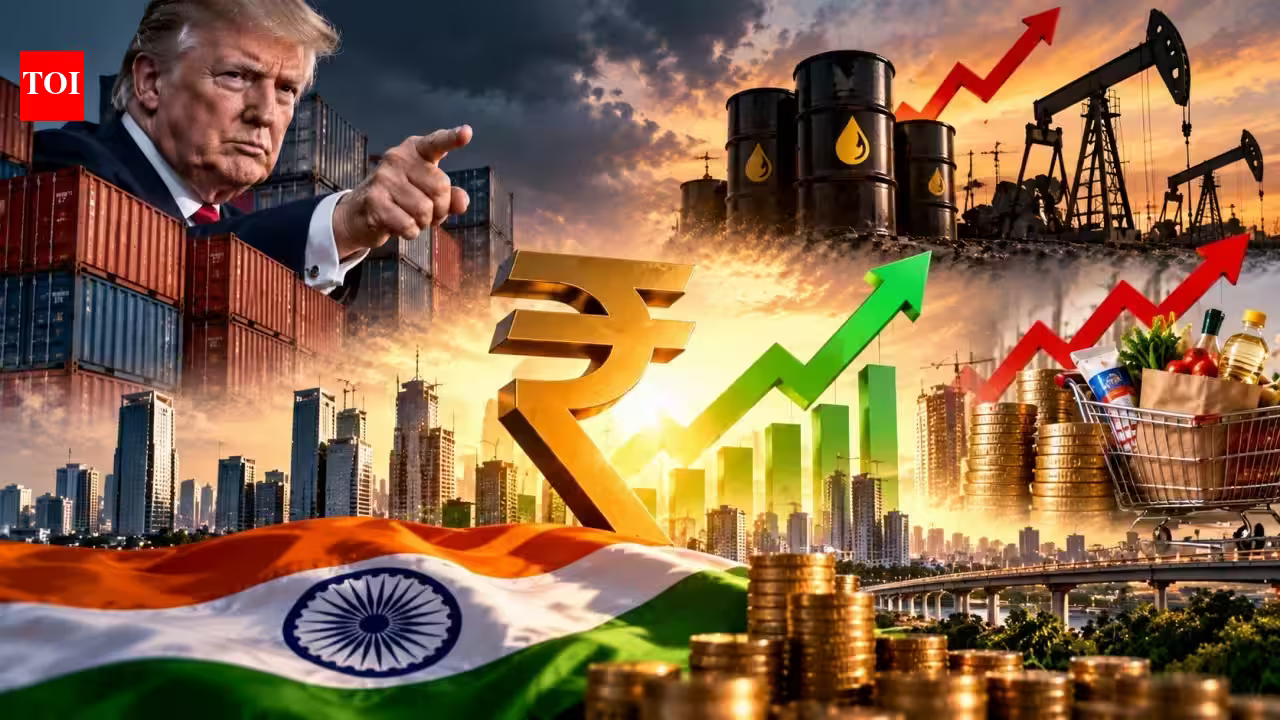
The Indian economy currently finds itself in a paradoxical position. While it maintains its status as the world’s fastest-growing major economy, underpinned by robust domestic consumption and strong industrial production, the horizon is darkened by significant external threats. As a nation that imports approximately 90% of its crude oil requirements, India is uniquely vulnerable to the volatility inherent in global geopolitical friction, particularly the escalating tensions involving the US and Iran. While the fiscal indicators remain strong—marked by record-high foreign exchange reserves and healthy bank credit growth—policymakers are increasingly cautious, acknowledging that past successes do not guarantee future performance in a shifting global landscape.
The Convergence of External Headwinds
The primary risk to India’s growth trajectory remains the external environment. The recent spike in crude oil prices, which surged in the latter half of the year, serves as a direct threat to both inflation management and the current account deficit. When crude oil remains consistently above the $100 per barrel mark, the imported inflationary pressure forces a delicate balancing act for the Reserve Bank of India (RBI). Tightening liquidity or raising interest rates might stabilize the rupee and curb inflation, but these actions carry the risk of suppressing private investment and household consumption.
Furthermore, the geopolitical landscape has shifted toward the weaponization of supply chains. With the potential implementation of stringent US policies, such as the Graham Bill, which permits aggressive tariff imposition on nations purchasing Russian crude, India faces a complex diplomatic and economic challenge. These measures not only disrupt logistics and procurement but also increase the cost of doing business globally. When combined with elevated bond yields in developed markets, these factors create a scenario where capital flows become increasingly volatile, forcing domestic assets to contend with downward pressure.
Assessing Domestic Vulnerabilities
While global shocks garner the most attention, domestic factors also necessitate careful monitoring. Recent data regarding gross tax revenues for the first five months of the fiscal year 2026-27 indicate a growth rate of approximately 6.5%, which is below historical averages. This deceleration, largely attributed to structural rate reductions under recent GST reforms, limits the government’s fiscal maneuverability. If revenue collections do not accelerate, the administration may struggle to maintain the aggressive capital expenditure momentum that has been the primary engine of India’s economic growth for the past several quarters.
Additionally, internal consumption patterns are sensitive to inflationary pressure. A monsoon deficit, combined with food inflation hovering near the 6% mark, directly impacts the purchasing power of the rural demographic. As the economy pivots toward the 12-to-18-month outlook, the transition from government-led capital expenditure to a self-sustaining private investment cycle becomes critical. If private corporate investment remains sluggish, the overall growth rate may moderate, testing the resilience of the current economic model.
The Resilience of India’s Structural Buffers
Despite these mounting challenges, it is essential to recognize the structural strengths that act as shock absorbers. India’s trade performance has demonstrated surprising robustness; merchandise exports have shown double-digit growth, and the surplus from services exports has successfully offset a significant portion of the merchandise trade deficit. This performance suggests that India’s bilateral trade agreements are yielding tangible results, providing a cushion against global manufacturing slowdowns.
Furthermore, the depth of India’s domestic financial markets has increased, providing a buffer against the erratic nature of Foreign Portfolio Investment (FPI) outflows. Record-high foreign exchange reserves offer the central bank a vital tool to manage currency volatility and prevent abrupt depreciation that could trigger imported inflation. The ongoing expansion of renewable energy capacity is also gradually reducing the economy’s absolute dependence on imported fossil fuels, creating a long-term structural hedge against energy-induced economic instability.
Pathways to Sustainable Growth
Sustaining a growth rate above 7% requires more than just defensive measures; it demands a proactive evolution of the industrial ecosystem. Economists emphasize that for India to achieve its “Viksit Bharat” ambitions, the national focus must shift toward enhancing competitive efficiency. This involves increasing the investment-to-GDP ratio from current levels of roughly 31% to 35%. Achieving this transition necessitates a persistent commitment to reform, particularly in streamlining business approvals, improving labor productivity, and ensuring that MSMEs have seamless access to formal credit.
The Ministry of Finance has correctly identified that a “business-friendly” environment is insufficient on its own. Instead, the focus must shift toward being “competition-friendly.” This means moving beyond merely facilitating large-scale enterprise to fostering an environment where innovation is incentivized through competition. Enhanced state capacity—where the government becomes a more efficient facilitator of economic activity—remains the linchpin of long-term productivity.
Looking Beyond the Horizon
The overarching lesson from the current economic cycle is that India’s growth must be earned every quarter. The era of relying on favorable global tailwinds is ending, replaced by a period of strategic navigation in an era of “geo-economic” uncertainty. As global powers increasingly use trade, energy, and technology as strategic tools, India must maintain its commitment to macroeconomic stability while simultaneously aggressively pursuing internal structural improvements.
The trajectory of the Indian economy in the coming years will likely be determined by how successfully it manages the trade-off between fiscal prudence and growth-oriented spending. If the government can maintain its capital expenditure, bolster private investment, and leverage its growing network of trade agreements, it will likely remain an outlier in global growth figures. However, complacency remains the greatest threat. The volatility of energy prices, the uncertainty of capital flows, and the shifting nature of global trade relations all demand a high degree of agility from policymakers. Ultimately, the durability of India’s economic success will depend on its ability to transform from a resilient emerging market into a highly competitive, self-sustaining global manufacturing and innovation hub.
Disclaimer: This content is auto-generated for informational purposes only.
Source: Read Original News