








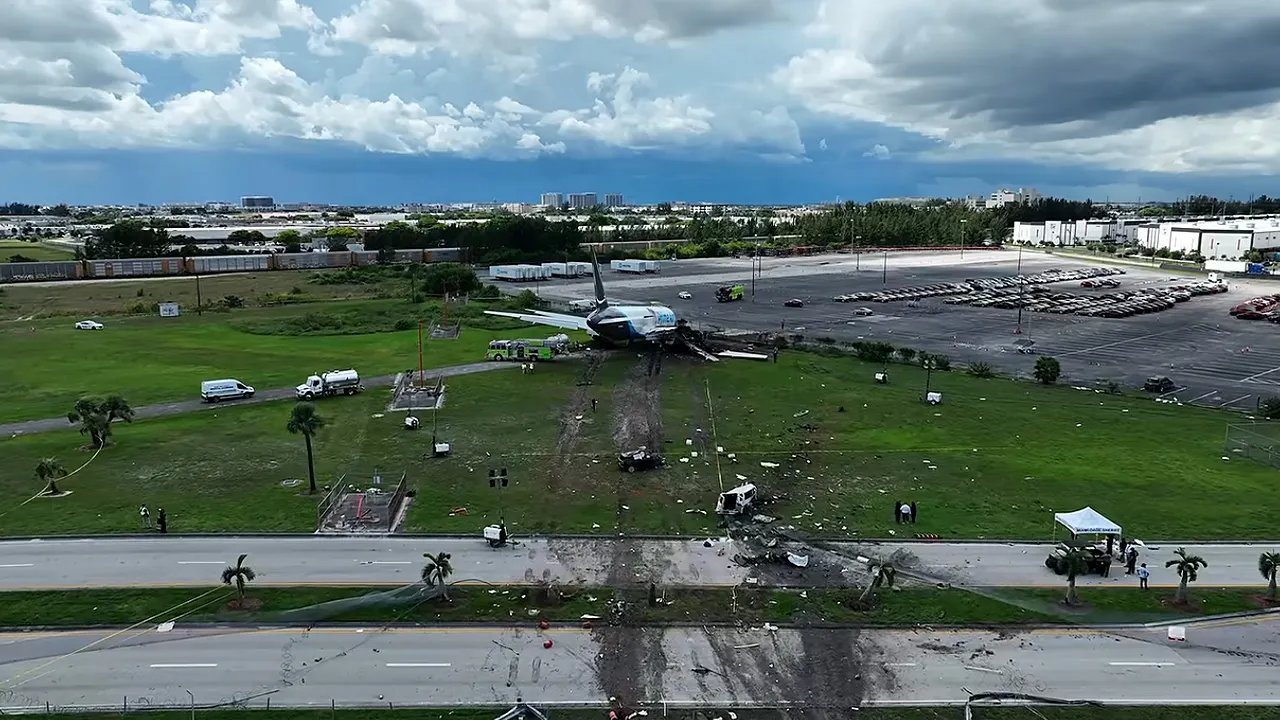
Attorneys representing the family of a victim killed in last month’s fatal Amazon cargo jet crash are leveling sharp accusations against the retail giant and its air carrier, 21 Air, labeling the tragedy a “100% preventable” disaster. The claims follow preliminary findings from the National Transportation Safety Board (NTSB) that suggest significant lapses in pilot experience and operational protocols contributed to the runway overrun in Miami.
The accident resulted in the death of 75-year-old Julio Pineda, who was struck while traveling in a van near the airport perimeter when the Boeing 767 surged past the runway end. A total of five people were killed in the incident.
## Questionable Crew Pairing and Pilot Experience
Legal representatives for the Pineda family, Mark Lopez-Trigo and Joshua Padron, are focusing their scrutiny on the backgrounds of the flight crew. According to NTSB data, the captain had only 150 hours of flight time on a Boeing 767—a fraction of their 7,267 total hours—while the first officer had roughly 800 hours on the specific aircraft model.
“This is a completely different animal,” Lopez-Trigo argued, noting that despite the captain’s military background, the complexity of the cargo jet required more specialized proficiency. The attorneys highlighted that the two pilots were paired together for the very first time on the day of the flight, a scheduling decision they describe as a failure of industry safety protocols.
## Alleged Operational Failures During Landing
Beyond pilot experience, the attorneys pointed to alarming patterns in the cockpit during the final approach. NTSB reporting indicates that the first officer issued multiple warnings regarding excessive speed, yet those cautions were ignored by the captain. Even as the plane’s automated safety systems triggered a series of alerts, the crew reportedly missed several opportunities to execute a “go-around” to abort the landing.
The legal team further alleges that the crew neglected critical deceleration procedures, including the failure to deploy reverse thrusters. “They didn’t just miss once, twice, or three times—they missed more than five or six times mandatory go-arounds where they could have prevented this,” said Padron.
## Accountability in the Logistics Supply Chain
The legal challenge extends to Amazon, with the attorneys arguing that the company failed to conduct rigorous due diligence when vetting the safety standards of 21 Air. In an era where corporations rely on complex, tech-integrated logistics networks to deliver goods at rapid speeds, the legal team contends that Amazon’s “branding” on the aircraft makes them directly responsible for the vetting of the companies they authorize to carry their freight.
In response, Amazon spokesperson Kelly Nantel stated that the loss of life “weighs heavily on all of us,” and confirmed the company is fully cooperating with the NTSB investigation. 21 Air also addressed the incident, asserting that they are conducting an internal review of their safety and operational procedures. The carrier emphasized that they are committed to a culture of accountability and are taking steps to learn from the NTSB’s findings to ensure future compliance and safety.
As investigators continue to parse the technical data from the flight, the incident has sparked a broader conversation about the oversight of contract carriers in the logistics industry. For the families of those involved, the ongoing probe represents a search for closure and a demand for systemic changes to prevent similar “domino effects” in the future.
Disclaimer: This content is auto-generated for informational purposes only.
Source: Read Original News