





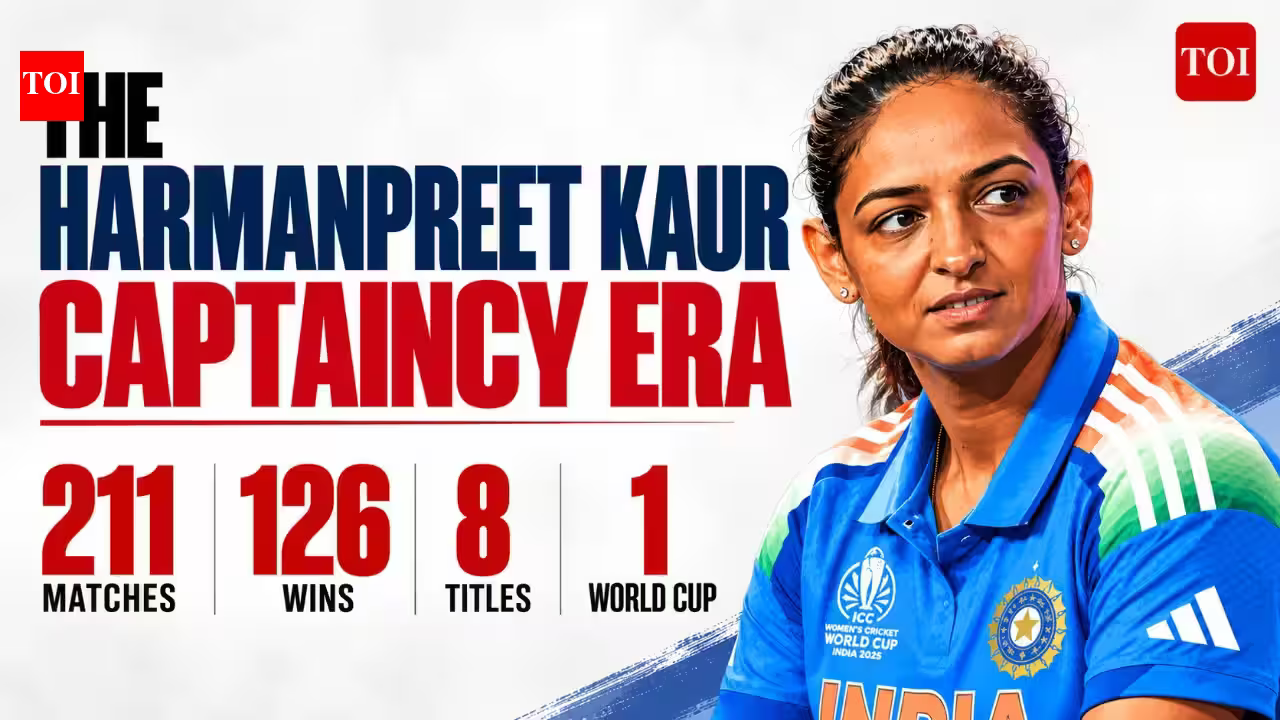
Harmanpreet Kaur’s captaincy began with a final and ended with one, bookending a 14-year odyssey that redefined the landscape of Indian women’s cricket. From her emergency stand-in role as a 23-year-old in the 2012 T20 Asia Cup final to her golden exit at the 2026 Asian Games, Kaur has been the central figure, the primary agitator, and the ultimate engine behind India’s rise to global prominence.
Spanning an incredible 5,074 days, her leadership tenure saw her take charge in 211 matches across all formats, securing 126 victories and eight major titles or gold-medal finishes. As she steps down from the leadership role to continue her career as a specialist batter, she leaves behind a statistical legacy that is as profound as it is polarizing.
The Questions Around Harmanpreet Kaur’s Captaincy
Throughout her tenure, Kaur existed in a state of perpetual scrutiny. Her captaincy was often treated as a point of contention rather than a settled matter, even during her most successful periods. Following the heartbreak of the 2020 T20 World Cup final defeat to Australia, legends like Diana Edulji and Shantha Rangaswamy openly questioned whether the burden of the armband was blunting her natural, explosive batting style.
This narrative of “change” followed her like a shadow. Even after steering India to its historic 2025 ODI World Cup triumph, calls for her to step aside intensified. It was a unique form of pressure—one where success was often met with demands for transition, and failure was analyzed through the lens of her personal tactical decisions. Despite this, she remained steadfast, accumulating a win rate of 59.7% and navigating India through a period of immense growth in professional infrastructure and international expectations.
With The Bat: 1,804 ODI Runs At 44
Critics often argued that captaincy weighed down her performance at the crease, but the hard data suggests quite the opposite. During her tenure, Kaur was a prolific engine for the Indian side, amassing 1,804 runs in 48 ODI innings at an impressive average of 44.00. Her strike rate of 89.3 as captain was a significant jump from her 77.2 mark in matches where she didn’t lead the side, proving that the pressure of command actually sharpened her offensive instincts.
Perhaps most telling was the correlation between her individual brilliance and India’s results. All four of her ODI centuries as captain came in matches that India won. Her career-defining 143* against England at Canterbury in 2022 remains the high-water mark for an Indian female captain, signaling her ability to take the game by the scruff of the neck when it mattered most.
Australia Remained The Biggest Hurdle
If there is a single asterisk on her otherwise glittering resume, it is the struggle against the Australian juggernaut. Against the world’s most dominant side, India managed only nine wins in 44 encounters under her leadership. The emotional scars of the 2020 T20 World Cup final and the 2022 Commonwealth Games final—both losses to Australia—seemed to create an aura of invincibility around the Aussies that the Indian team struggled to penetrate for years.
The dam finally broke in the most spectacular fashion during the 2025 ODI World Cup semi-final. Facing a colossal target of 339, Kaur played the innings of her life, scoring 89 off 88 balls to anchor the highest successful chase in women’s ODI history. It was her first fifty as a captain in a knockout match that ended in a victory, effectively exorcising years of frustration and paving the way for her crowning achievement four days later: the World Cup trophy.
Captaincy Milestones: A Record Book of Firsts
Kaur leaves as a pioneer who forced the record books to be rewritten. She remains the first captain, male or female, to reach the 150-T20I appearance milestone, finishing her career with 155 matches as skipper. Her 92 T20I wins as captain stand as the most by any woman in the history of the sport.
Beyond the numbers, she transformed the team’s identity. Under her stewardship, India recorded their first-ever Test win over Australia and a staggering 347-run margin of victory over England—a statement of intent for a side that was increasingly comfortable in whites. She joins an elite, ultra-exclusive fraternity of Indian captains—alongside legends like Kapil Dev, MS Dhoni, Rohit Sharma, and Suryakumar Yadav—who have hoisted a 50-over World Cup.
The Final Stretch
The final year of her tenure was perhaps the most turbulent, featuring a seven-match losing streak and a difficult group-stage exit at the 2026 T20 World Cup. Yet, she showed her resilience one last time, leading the team through an eight-match winning streak to capture the Asia Cup and the Asian Games gold medal.
In her farewell statement on Instagram, the tone was one of peace. “This is not an easy decision,” she wrote, reflecting on a journey that saw her evolve from a volatile young talent into the steady, experienced architect of a championship-winning team. “Now, I’m ready to play for the love of the game again. Captaincy ends. The journey continues.”
For a player whose tenure began in the pressure-cooker of a final, it was only fitting that she walked away with a gold medal around her neck and a legacy that has permanently elevated the status of women’s cricket in India. Her duty is done, but the standard she set for future generations will likely remain the benchmark for years to come.
Disclaimer: This content is auto-generated for informational purposes only.
Source: Read Original News