






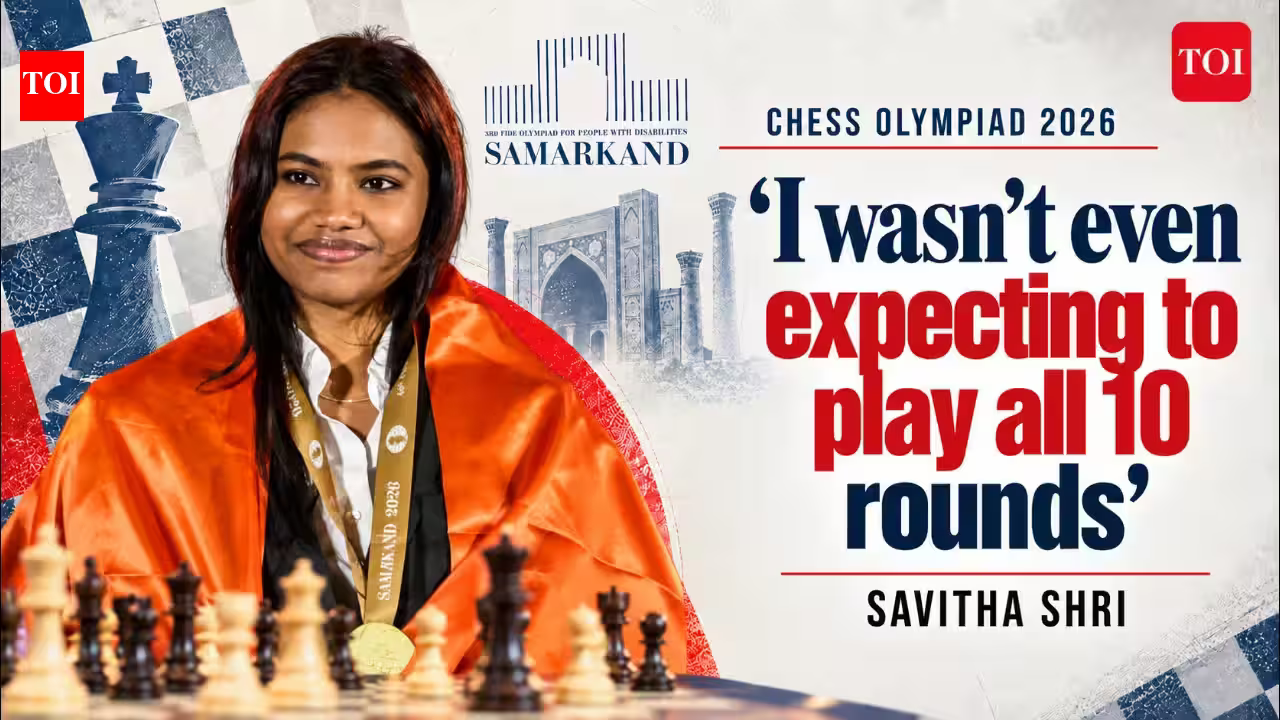
SAMARKAND — The path to gold is rarely a straight line, but for 19-year-old Savitha Shri Baskar, the road to the 2026 Chess Olympiad was paved with sacrifices that go far beyond the sixty-four squares of a chessboard. Emerging as India’s only individual gold medallist at the prestigious event, the young International Master’s triumph is a testament to resilience, a father’s unwavering conviction, and an uncanny ability to thrive under the weight of expectation.
Today, Savitha stands as a beacon for Indian chess, but her ascent was once fueled by the quiet clatter of gold jewellery being pawned. Years ago, her father, a dedicated electrician, made the wrenching decision to quit his job in Singapore and return to India, liquidating the family’s assets to fund his daughter’s entry fees for national tournaments. It was a gamble that defied financial logic, yet it was the only option for a family determined to see their daughter reach the summit of the sport.
The narrative of her climb is uniquely bittersweet. Chess was originally intended for her older brother, Mugesh. Savitha, an observant younger sibling, found her calling merely by watching him train. As the costs of nurturing two professional chess careers became untenable, the family faced a heartbreaking crossroads. Mugesh stepped back after his eighth standard to allow his sister the singular opportunity to chase greatness. Savitha never looked back.
The Pressure of the Selection
Savitha’s journey to Samarkand was not without its skeptics. Her inclusion in the squad, replacing the legendary Harika Dronavalli—who opted to step aside after a storied career—raised eyebrows among pundits and critics who questioned whether the teenager was ready for the global stage.
Women’s captain Swayams Mishra, however, saw something different. “There were a lot of people who questioned her spot, journalists saying there are players higher than her,” Mishra told TimesofIndia.com. “But according to the selection, she was qualified, and she’d won the Asian continental… whenever we gave her the opportunity, she delivered. If India won a medal, we owe it to her.”
Deliver she did. In a display of poise that belied her age, Savitha finished with an extraordinary 9/10, becoming the only member of the Indian contingent to clinch individual gold while serving as a fundamental pillar in the team’s bronze-medal campaign.
A Reserve with a Starting Mentality
Coming into the tournament as a reserve, Savitha’s expectation was to play a supporting role. Instead, she found herself in the thick of the action for every single round.
“I wasn’t even expecting to play all 10 rounds,” she admitted. “So I’m grateful for the trust my teammates and my captain had in me. I’m happy with the score, 9 out of 10; but game-wise, I think I could have done a bit better.”
Her presence alongside titans of the game, including Koneru Humpy, R. Vaishali, and Divya Deshmukh, turned the Olympiad into a masterclass. Throughout the campaign, the teenager maintained a humble perspective, prioritizing team success over her personal accolades. “The team medal will always come first,” she remarked. “I wasn’t even caring about my individual gold; I only found out I’d won it after the final round finished.”
The ‘Endless Coffees’ and Defining Moments
The path to the podium was marred by logistical hurdles—including a sleepless arrival in Samarkand—and high-stakes tension on the board. The tournament turned on matches against powerhouses Kazakhstan and China, where Savitha served as the ultimate pressure-cooker. In both encounters, she remained at the board until the final moment, managing her clock with surgical precision to exploit the fatigue of her opponents.
She credits much of her psychological fortitude to captain Swayams Mishra. When the team stumbled against Poland, it was Mishra who acted as the emotional anchor. “Swayams sir is the best captain ever,” she laughed. “He was bringing me endless coffees because I played until the last moment every time. He even jokingly said it was because of those coffees that I was able to swing all my games.”
Beyond the humor, the support was a lifeline. “He believed in me more than I believed in myself,” she added.
Eyes on the Grandmaster Title
With her Olympiad triumph now a part of history, Savitha is already calibrating her sights on the next milestone: the elusive Grandmaster title. Currently rated 2405, she is under no illusions about the work that remains.
“The Grandmaster title is definitely my goal,” she asserted, planning for a brief period of rest before heading to the World Juniors in Namibia. She is equally critical of her own development, noting that while her aggressive play in complicated positions served her well in Uzbekistan, she intends to sharpen her positional understanding to become a more well-rounded competitor.
When asked about the weight of the sacrifices that brought her from a family home in India to a gold medal in Uzbekistan, Savitha remains grounded. “My parents struggled, and I know what they’ve gone through. That’s something I’ll always remember. But I don’t really think much about it while I’m playing. I just have to stay in the present.”
If her performance in Samarkand is any indication, the present—and the future—looks exceptionally bright for India’s golden girl.
Disclaimer: This content is auto-generated for informational purposes only.
Source: Read Original News