







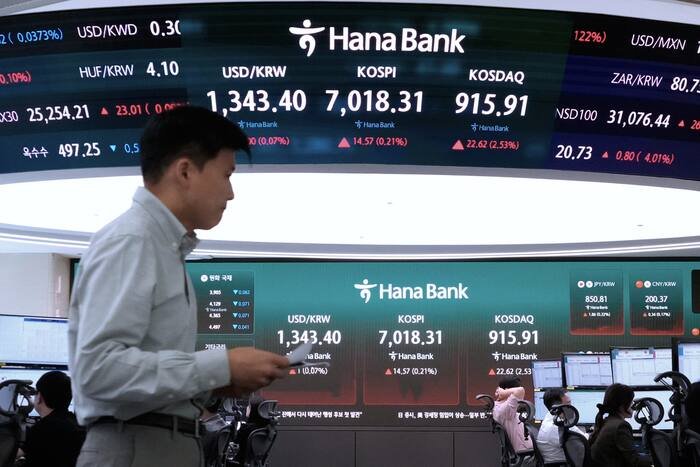
Asian markets faced a widespread pullback on Wednesday, cooling off after a record-breaking session on Wall Street. While investors in the United States continue to push major indices to unprecedented highs, global sentiment remains cautious as rising oil prices and persistent inflationary pressures weigh on international trade.
The retreat was felt across major hubs in the Asia-Pacific region. Tokyo’s Nikkei 225 dropped 0.9%, mirroring a 0.9% decline in South Korea’s Kospi. Hong Kong’s Hang Seng retreated 0.6%, while Taiwan’s Taiex saw a marginal decline of 0.2%. Markets in Shanghai remained shuttered for a national holiday, leaving the region to grapple with the volatility without one of its largest trading players.
The “Earnings Resilience” Narrative
The recent momentum in U.S. markets—where the S&P 500 reached a record 7,818.93 and the Nasdaq solidified its own all-time high—defies a backdrop of significant economic friction. Despite the geopolitical instability surrounding the conflict with Iran, elevated borrowing costs, and a cost-of-living crisis that has dampened American consumer confidence, the equity markets have demonstrated remarkable stamina.
According to analysts at Mizuho Bank, the current rally is fueled by a profound belief in corporate earnings power. Investors are increasingly prioritizing “earnings momentum” over macroeconomic risks. This trend is particularly evident in the technology sector, where the appetite for growth remains insatiable. With companies projected to deliver nearly 30% growth in earnings per share for the third quarter, Wall Street is effectively betting that firms can absorb higher energy costs and restrictive interest rates without sacrificing profitability.
AI and Tech Sector Dominance
A significant portion of the recent market buoyancy can be traced back to the ongoing artificial intelligence frenzy. AI-related stocks have become the primary engine driving major indices, with industry leaders like Nvidia recording massive gains that significantly outpace the broader market.
However, this reliance on AI has prompted some analysts to express concerns regarding a potential market bubble. The aggressive valuation of companies tethered to the AI revolution suggests that investors are pricing in perfection. If the upcoming wave of corporate reports fails to sustain this high-octane growth, the market could face a sharp correction. Nevertheless, for now, the tech sector remains the bedrock of investor confidence, signaling that the digital transformation of enterprise remains a top priority for global capital.
The Energy and Bond Market Tightrope
While stocks have thrived, the environment remains delicate due to shifts in the bond and energy markets. The 10-year Treasury yield, a key indicator for borrowing costs across the economy, eased slightly to 5.28% on Tuesday, offering a moment of relief. However, volatility in the energy sector continues to loom large.
Crude oil prices, which had shown signs of stabilization, rebounded early Wednesday, with Brent crude climbing to $101.49 per barrel. Rising fuel costs threaten to exacerbate inflation, potentially forcing central banks to maintain restrictive monetary policies longer than anticipated.
As the market transitions into the earnings season, all eyes are on the upcoming performance reports. Following positive results from firms like Lamb Weston, upcoming disclosures from banking giants and transportation leaders like Delta Air Lines will serve as a bellwether for the broader economy. For now, the narrative remains one of resilience: as long as corporate profits can outpace the friction of high inflation and geopolitical strife, the bull market appears determined to test new, uncharted territory.
Disclaimer: This content is auto-generated for informational purposes only.
Source: Read Original News