









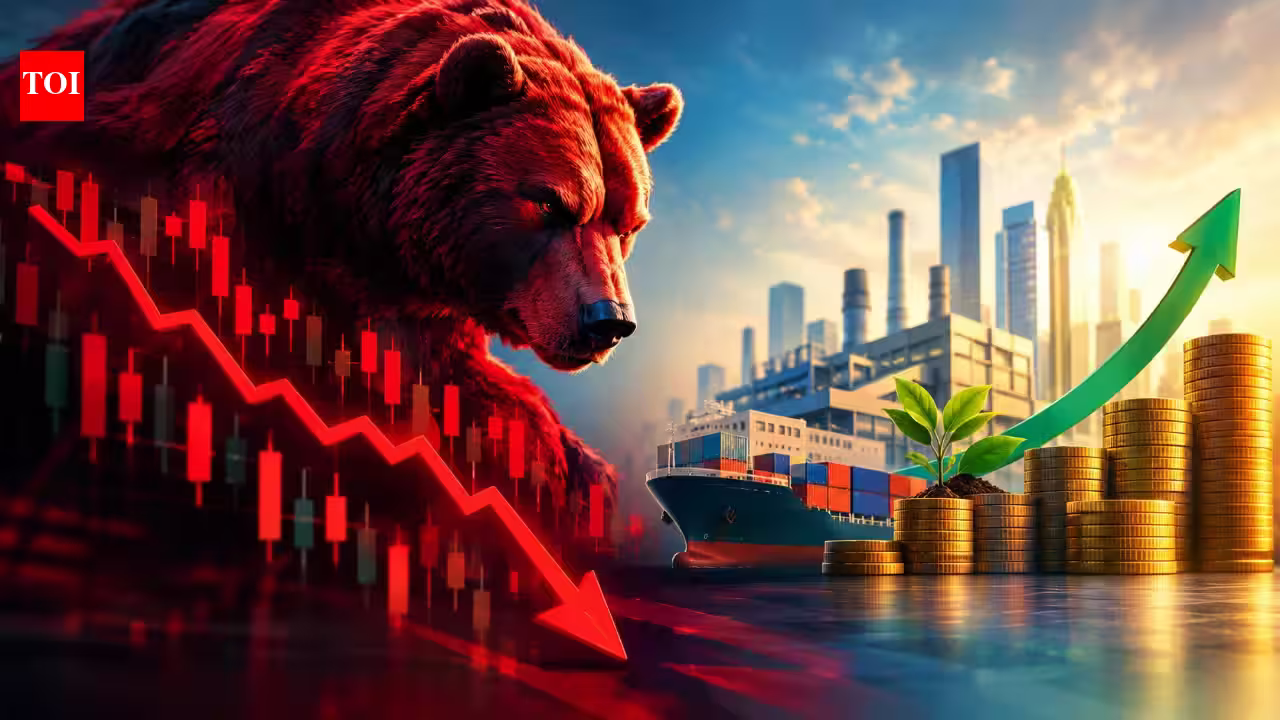
The Divergence Between Economic Growth and Equity Markets
The paradox of India’s current financial landscape—booming GDP growth coupled with a struggling stock market—often creates confusion among retail and institutional participants. While India has reported robust GDP growth of 7.8%, Dalal Street has witnessed significant drawdowns. To understand this, one must recognize that the economy and the equity market operate on different timelines. GDP figures function as a retrospective scorecard, reflecting economic activities, industrial production, and consumption patterns that have already occurred. In contrast, the equity market acts as a forward-looking mechanism. It discounts future expectations, ranging from projected corporate profitability and liquidity conditions to global macroeconomic risks.
The disconnect is primarily driven by shifting global variables. While India’s internal consumption and fixed investments remain strong, the stock market is currently reacting to external pressures such as elevated US bond yields, fluctuating crude oil prices, and substantial outflows from foreign portfolio investors (FPIs). Consequently, a growing economy does not always equate to an immediate rally in share prices, especially when global cost-of-capital factors tighten.
The Pressure of Foreign Outflows and Currency Depreciation
Foreign portfolio investors have significantly influenced recent market volatility. After a two-month buying streak, September saw massive divestment from Indian equities, with outflows reaching levels not seen in the last six months. This shift in capital is largely attributed to the relative attractiveness of other global markets and the strengthening of the US dollar. When US Treasury yields climb to multi-decade highs, global funds naturally gravitate toward these relatively risk-free, dollar-denominated assets.
The resulting demand for dollars has placed the Indian rupee under pressure. A weakening rupee creates a compounding effect for foreign investors: even if an Indian company performs well, the depreciation of the currency erodes the dollar-denominated returns for the foreign stakeholder. This realization often triggers a sell-off as investors prioritize capital preservation in harder currencies. Furthermore, competition from other emerging markets that are heavily positioned in AI-driven sectors has diverted some liquidity away from India, forcing Dalal Street to face a more competitive environment for global capital.
Impact of Energy Costs and Global Macroeconomics
India’s reliance on imported crude oil remains a critical vulnerability. As a net importer, any spike in oil prices directly impacts the country’s current account deficit and inflationary expectations. When Brent crude rises, the cost of production for Indian industries increases, potentially narrowing corporate margins. This serves as a bottleneck, as companies may struggle to pass these costs on to consumers in a price-sensitive market.
The geopolitical uncertainty, particularly concerning the Strait of Hormuz, adds a layer of risk that investors are currently pricing into their portfolios. Higher crude costs not only squeeze corporate bottom lines but also fuel domestic inflationary concerns, which may force the Reserve Bank of India (RBI) to maintain a cautious or restrictive monetary policy. When liquidity is tight and input costs are high, the outlook for corporate earnings becomes blurred. This uncertainty creates a hurdle for equity markets, as analysts re-evaluate growth projections in light of potential margin compression across sectors that are highly energy-dependent.
Reconciling GDP Growth with Corporate Earnings
A critical insight for market participants is that macroeconomic growth does not automatically translate into a linear increase in corporate earnings. GDP growth is an aggregate measure of economic output, whereas equity markets respond to the profitability of listed firms. While the overall economy might expand due to government spending or infrastructure development, private sector companies may face challenges such as rising wage bills, increased interest expenses, and intense competition.
There is also a technical distinction between real GDP, which is inflation-adjusted, and corporate revenues, which are reported in nominal terms. If inflation remains elevated, companies might report higher top-line revenues, but their real purchasing power or net profit margins might remain stagnant. Furthermore, the recovery from recent volatility is uneven. Domestic-facing sectors often exhibit different resilience levels compared to export-oriented businesses. While India’s domestic consumption and manufacturing metrics remain strong, the translation of this activity into net profit growth requires time and stable input costs.
Strategic Outlook for Long-Term Investors
Despite the recent turbulence, analysts generally suggest that the current market correction is not a signal for long-term panic. Historical data indicates that the Nifty 50 has navigated similar drawdown phases in the past, often followed by significant recovery periods. The presence of strong domestic institutional investors (DIIs) and consistent systematic investment plan (SIP) flows have provided a floor to the market, preventing a freefall during periods of heavy FPI selling.
For the individual investor, the current climate presents a period of consolidation. Rather than attempting to time the market, financial experts emphasize maintaining long-term asset allocation. A balanced portfolio, diversified across large, mid, and small-cap segments, can help mitigate risks associated with sector-specific volatility. The key to navigating this phase is monitoring the intersection of global rate cycles and domestic inflation. If global tensions de-escalate and the US Federal Reserve signals a pivot toward rate cuts, the external headwinds currently stifling Dalal Street may dissipate, allowing the market to realign with the country’s underlying fundamental growth story.
In summary, while the headlines highlight a cooling market, the underlying economic engine of India remains robust. The current disconnect is primarily a response to global capital flight and temporary cost pressures rather than a structural failure. Investors who remain disciplined and focus on the strength of domestic demand are better positioned to weather the near-term volatility and participate in the eventual market stabilization. The path ahead will likely remain event-driven, with corporate earnings reports and RBI policy signals serving as the primary drivers for the next phase of market direction.
Disclaimer: This content is auto-generated for informational purposes only.
Source: Read Original News