







Nationwide Protests Intensify: Left-Wing Organizations Challenge Election Commission and Government Repression
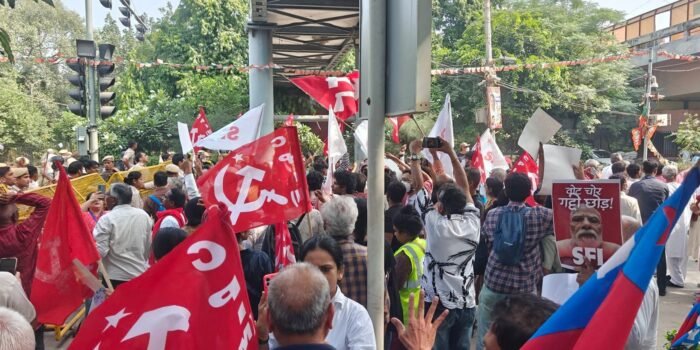
Across India, a surge of grassroots mobilization is challenging the central government, with thousands of students, workers, and activists taking to the streets to defend democratic institutions. The protests, spearheaded by a coalition including the Communist Party of India (Marxist) (CPI(M)), the Students Federation of India (SFI), and the Democratic Youth Federation of India (DYFI), represent a growing pushback against what organizers describe as the authoritarian agenda of the Bharatiya Janata Party (BJP).
Controversy Over Electoral Integrity
At the heart of the ongoing unrest is a demand for the resignation of Chief Election Commissioner (CEC) Gyanesh Kumar. Demonstrators are expressing deep concerns regarding the Election Commission’s “Special Intensive Revision” (SIR) process. Protesters argue that the move to create a unified voter roll is being weaponized to systematically disenfranchise marginalized communities.
Critics allege that millions of voters from impoverished backgrounds have been surreptitiously removed from the electoral registers. This perceived attempt at mass disenfranchisement, coupled with reports of irregularities during recent state-level elections, has galvanized the opposition. For the protesters, these actions are not mere bureaucratic errors but deliberate strategies intended to secure electoral advantages for the ruling right-wing administration.
A Growing Momentum of Dissent
The current wave of activism follows a significant victory earlier this summer, when a youth-led movement successfully pressured Education Minister Dharmendra Pradhan to step down. Buoyed by that success, the streets of India have become a focal point for those demanding broader structural changes. The protesters, who are flooding urban centers in the hundreds of thousands, are increasingly calling for the right to live with dignity and the autonomy to determine the nation’s political trajectory.
The State’s Crackdown
The government’s response to these demonstrations has been marked by a heavy-handed security presence. On October 10, the national capital witnessed a particularly intense crackdown. Law enforcement officials arrested hundreds of demonstrators, including high-ranking members of the CPI(M) Central Committee and two former Chief Ministers. Reports of physical mistreatment and hours of illegal detention have fueled further outrage among the public.
To curb the spread of the movement, authorities have implemented a series of restrictive measures, including the closure of metro stations, the barricading of major transit arteries, and the implementation of targeted internet blackouts. Despite these efforts to isolate the movement and stifle dissent, organizers maintain that the public’s resolve remains unshaken.
A Call for Continued Resistance
CPI(M) Secretary General M A Baby has emerged as a vocal critic of the state’s tactics, framing the current situation as a defining moment for Indian democracy. During a recent address, Baby warned that the government’s reliance on “a reign of terror” to shield officials like Gyanesh Kumar is a failing strategy. He asserted that if the administration persists in its attempt to dismantle democratic norms through force, the public will inevitably organize to hold the leadership accountable.
The call for unity remains central to the protests. As the movement expands, it has drawn attention from international solidarity groups, including the Party for Socialism and Liberation (PSL) in the United States, which has praised the Indian resistance as a vital example of how a united front can confront rising authoritarianism. As the stalemate between the government and the populace continues, the streets of India remain a volatile space where the future of the nation’s democratic character is being contested.
Disclaimer: This content is auto-generated for informational purposes only.
Source: Read Original News