








Prehistoric Titan Unearthed: Gujarat Fossils Reveal Existence of Massive Ancient Snake
In a discovery that has sent ripples through the paleontological community, researchers have unveiled the remains of a colossal prehistoric snake that once roamed the landscape of western India. Found within the lignite mines of the Kutch district in Gujarat, the creature—named Vasuki indicus—is estimated to have reached lengths of up to 15 meters, positioning it as one of the largest snakes ever documented in Earth’s history.
A Significant Paleontological Find
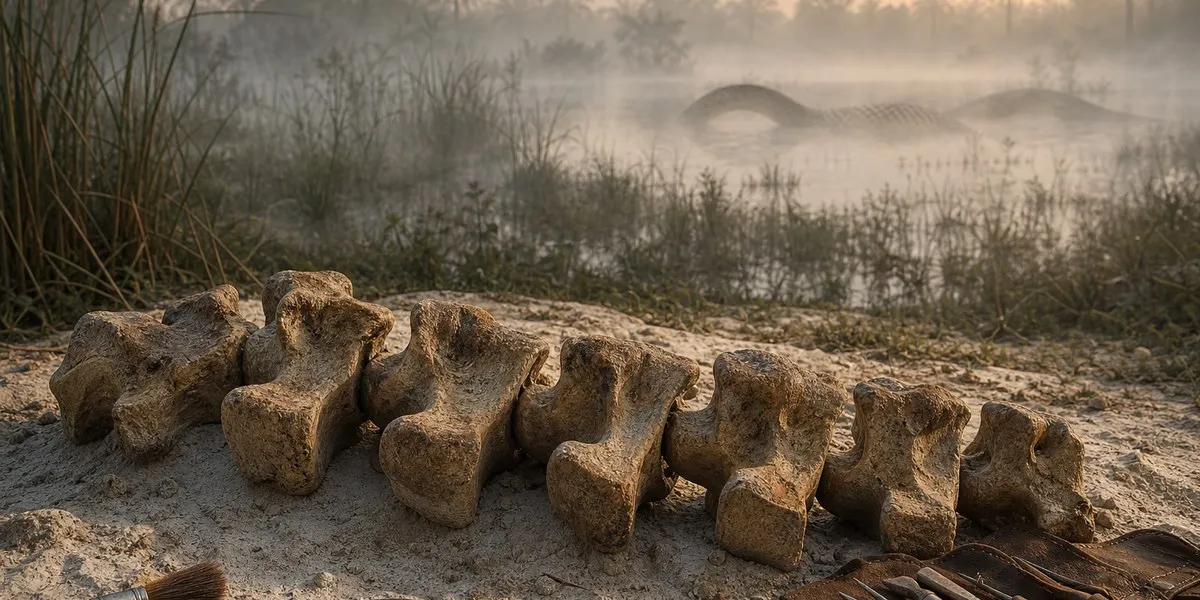
The identification of the species was spearheaded by Debajit Datta and Sunil Bajpai, prominent paleontologists from the Indian Institute of Technology (IIT) Roorkee. The team recovered 27 fossilized vertebrae from the Panandhro lignite mine, dating back to the Middle Eocene epoch, roughly 47 million years ago.
During this era, the region enjoyed a significantly warmer climate, with average temperatures hovering around 28 degrees Celsius. This tropical, humid environment provided the ideal conditions for such gargantuan reptiles to thrive. Among the collected fossils, several vertebrae remained articulated, providing researchers with a clearer picture of the serpent’s anatomical structure. The dimensions of the bones, which measured up to 62.7 millimeters in length and over 111 millimeters in width, indicate that the snake possessed a broad, heavy, and cylindrical body.
Rivaling the Legends
While the lack of a complete skeletal structure necessitates some scientific caution, researchers employed comparative analysis with modern-day snake species to estimate the animal’s massive scale. Depending on the statistical model utilized, Vasuki indicus is estimated to have measured between 10.9 and 15.2 meters in length.
This sheer size places the Indian snake in direct comparison with the famous Titanoboa, the extinct giant snake from Colombia that lived approximately 60 million years ago. While it remains unclear which of the two claimed the title of the world’s longest snake, the discovery confirms that ancient India was home to apex predators of unprecedented scale. The species was fittingly named in honor of the mythical serpent Vasuki, often associated with the Hindu deity Shiva, reflecting both the snake’s massive stature and its profound significance to Indian heritage.
Life as an Ambush Predator
Based on the evidence recovered from the Kutch district, scientists believe that Vasuki indicus was not a high-speed hunter. Given its immense girth, it likely moved with sluggish grace, relying on stealth and surprise rather than pursuit to capture its meals. Experts speculate that its hunting tactics were similar to those of contemporary large constrictors, such as pythons and anacondas, which ambush their prey and subdue them through constriction.
The findings also provide new insights into the family Madtsoiidae, an extinct group of snakes that once inhabited diverse regions including Africa, Europe, Australia, and South America. The discovery of Vasuki indicus in India serves as a vital piece of the puzzle regarding how these reptiles migrated and adapted to changing global climates over millions of years. As researchers continue to study the remaining fossils, they hope to unlock further secrets about the ecology of the Eocene epoch and the life of one of nature’s most formidable predators.
Disclaimer: This content is auto-generated for informational purposes only.
Source: Read Original News