








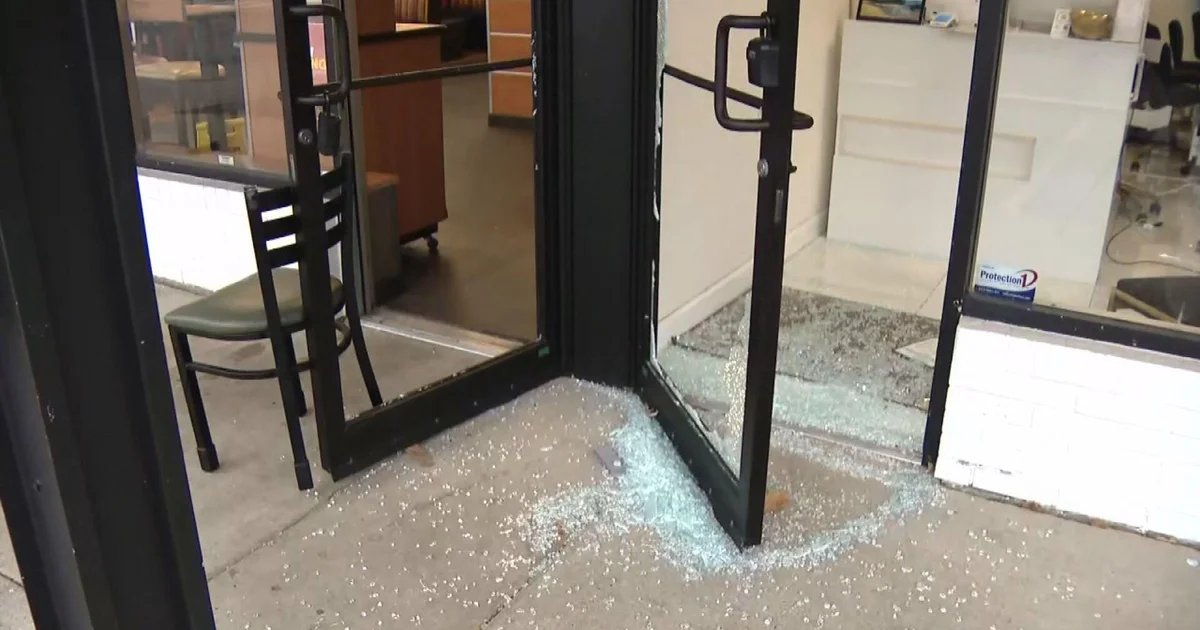
Chicago small business owners are calling for increased security and police action after a wave of more than 20 coordinated smash-and-grab burglaries rocked the city overnight. Authorities report that a group of four suspects, operating out of a red sedan believed to be stolen, targeted storefronts across several neighborhoods, leaving behind a trail of shattered glass and financial distress.
## The Human Toll of a High-Tech Crime Wave
For many business owners, the financial loss is compounded by the psychological impact on their staff. At Terra Coffee in Avondale, a barista was forced to flee for safety when an intruder hurled a brick through the front door at 6 a.m. Wednesday.
“They more than spooked her, they traumatized her,” said co-owner Jocelyn Telles. Despite the shop’s clear signage indicating that no cash is kept on-site and that 24/7 security surveillance is active, the perpetrators proceeded with the destruction. The incident serves as a stark reminder of the limitations of traditional, non-integrated security systems when faced with brazen, mobile criminal groups.
Across town in Portage Park, the story was much the same. At Fry the Coop, general manager Lewis Tovar reported nearly $4,000 in property damage—all for a haul of roughly $10 in loose change from the register. “Where do we go from here?” questioned Azazi Morsi of Migos Fine Foods, another targeted business. “What is being done to change these things?”
## The Role of Modern Surveillance and Digital Forensics
While investigators are currently reviewing hours of footage from the targeted storefronts, the case highlights an ongoing struggle for local law enforcement: utilizing advanced data to track highly mobile suspects. Chicago Police are currently tracking the red sedan as a central piece of evidence, noting that one suspect was identified via a distinctive sweatshirt design captured by high-definition interior security cameras.
In the tech industry, the integration of AI-driven surveillance has become a focal point for retailers. Modern security suites now employ advanced motion-detection algorithms and real-time object recognition that can send instant alerts to business owners’ smartphones the moment a perimeter is breached. These AI tools can even categorize “suspicious activity”—such as a vehicle idling outside a shop at 4 a.m.—triggering automated warnings. However, for many small businesses operating on tight margins, the cost of upgrading to these advanced, AI-linked ecosystems remains a significant barrier, leaving them reliant on passive recording systems that provide footage only after the crime has occurred.
## Searching for Solutions in a Connected World
As the Chicago Police Department continues its investigation, the incident has reignited a debate regarding public safety and the use of technology to deter recurring crime. With no arrests made thus far, the city’s business community is looking toward better integration between private security feeds and municipal crime-tracking databases.
Tech innovators are increasingly proposing “smart street” solutions, which use cameras equipped with license-plate recognition (LPR) software. Such systems can instantly flag stolen vehicles as they move between neighborhoods, potentially alerting police to the red sedan’s path before a second or third burglary occurs. While the debate over data privacy continues to influence local policy, the victims of Wednesday’s spree are demanding more aggressive, tech-enabled enforcement.
For now, the affected businesses are left to clear the debris and board up their storefronts once more, waiting for investigators to connect the digital breadcrumbs left behind by the perpetrators. Police are urging anyone with information—or those who may have captured the suspects on doorbell cameras—to come forward as they continue to map the trail of the red sedan.
Disclaimer: This content is auto-generated for informational purposes only.
Source: Read Original News