






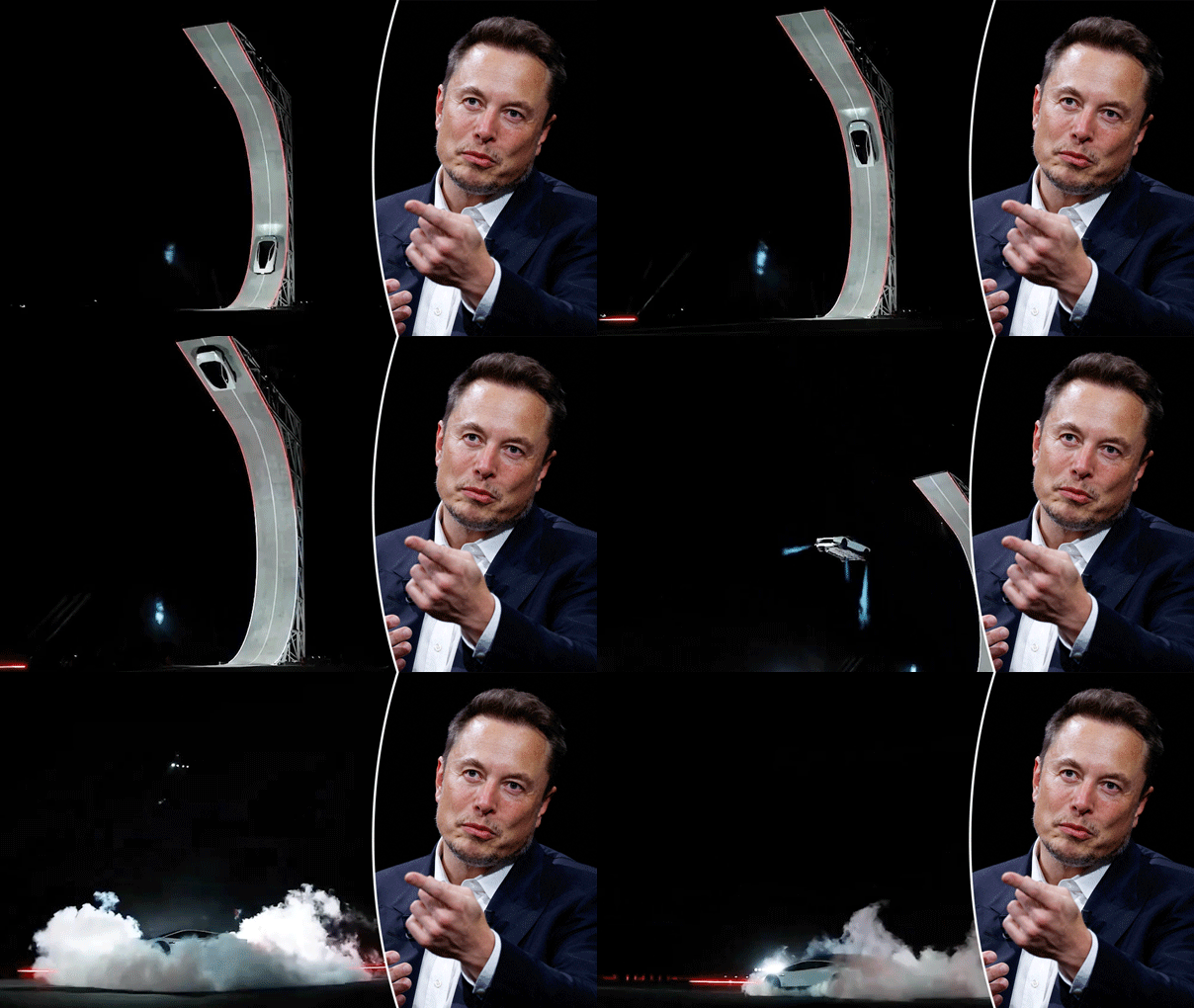
Tesla has officially entered the era of the “flying car.” In a cinematic showcase held at a SpaceX test facility in McGregor, Texas, on October 15, 2026, the automaker unveiled its next-generation Roadster. The vehicle, which utilizes specialized thruster technology developed in partnership with SpaceX, performed a series of gravity-defying maneuvers that left spectators stunned, marking a significant milestone in automotive engineering.
The event featured the vehicle utilizing compressed-air thrusters and a sophisticated fan-based suction system to navigate a curved ramp, allowing it to perform a complete midair flip before landing safely. With this display, CEO Elon Musk and Vice President of Vehicle Engineering Lars Moravy declared that the vision of flying cars has finally moved from science fiction into reality.
## Engineering the Future of Movement
The heart of the new Roadster’s performance lies in its integration with aerospace technology. While conventional vehicles are inherently limited by the friction and grip of their tires, the Roadster’s cold-gas thruster system creates force far exceeding what rubber can achieve on asphalt. This allows for physics-defying acceleration; the vehicle demonstrated a sprint from zero to 60 mph in under a second during the event.
According to Tesla, the Roadster is designed to reach top speeds exceeding 230 mph. During the live demonstration, the car successfully launched over a line of parked vehicles and a heavy-duty semi-truck, further highlighting the power of the SpaceX-developed propulsion integration. Tesla officials have branded the vehicle as “the best of the last human-driven cars,” positioning it as the ultimate intersection of high-performance driving and aerospace-grade hardware.
## Production Timeline and Market Reception
Despite the excitement surrounding the unveiling, consumers will have to wait for the technological marvel to reach the showroom floor. Tesla executives confirmed that full-scale production of the Roadster is scheduled to commence in 2028. This follows a long road for the project, which first debuted as a concept back in 2017 with an original target for delivery in 2020.
The pricing structure for the vehicle is equally ambitious, reflecting its niche as a high-end, performance-focused machine. Reservations are now open, with a $50,000 deposit required for the “Performance” version, while the “Thrust” model—which comes equipped with the specialized acceleration thrusters—requires a $250,000 down payment. Additionally, Tesla teased an invite-only “Rocket” variant, a single-seat iteration described as featuring a “full flight system.”
## Market Volatility and Investor Caution
While the unveiling served as a masterclass in product marketing, it also intensified discussions regarding Tesla’s market valuation. Analysts like Tom Hayes have pointed out that Tesla’s stock is effectively “priced for perfection.” While Hayes acknowledged Musk’s visionary status—likening him to a modern-day Thomas Edison—he also issued a warning to investors.
The high-flying nature of Tesla’s stock, coupled with the aggressive timeline for the Roadster and the company’s broader push into robotics and autonomous “robotaxis,” suggests a high-stakes environment. Investors are weighing the company’s long-term potential for radical innovation against the inherent risks of such capital-intensive projects. As the company continues to juggle its reputation as a traditional automaker with its evolving identity as an AI and aerospace powerhouse, the coming years will be critical in determining whether the Roadster’s performance translates into sustainable, long-term shareholder value. For now, the automotive industry and the tech sector alike are watching to see if Tesla can successfully bridge the gap between a stunning live performance and a scalable, profitable consumer product.
Disclaimer: This content is auto-generated for informational purposes only.
Source: Read Original News