








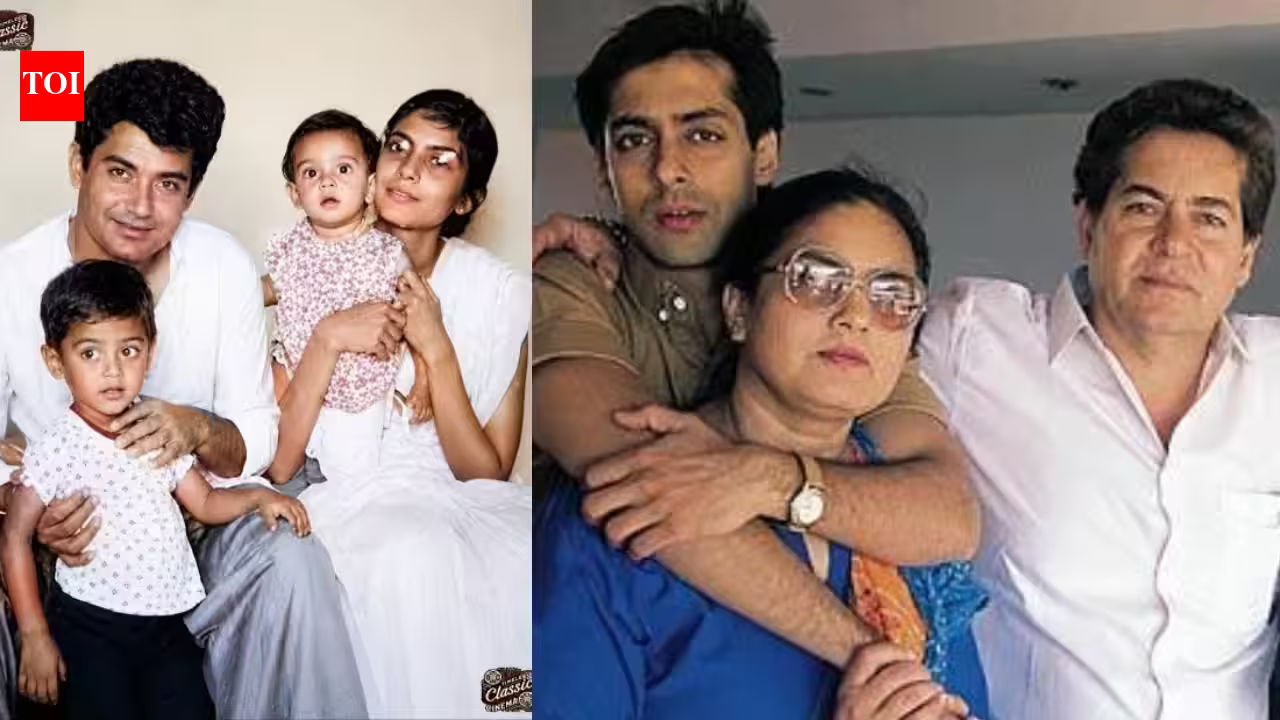
In the high-stakes, hyper-scrutinized world of Bollywood, few families command the level of public fascination that the Khan-daan does. While their sprawling Bandra home is often associated with the charisma of Salman, the resilience of Salim, and the grace of Helen, the foundation of this legacy was built on something far more fragile: an interfaith marriage that faced immense scrutiny long before the couple became a household name.
In a rare, candid moment on the sets of Bigg Boss 18, Salman Khan pulled back the curtain on his family history. Shedding his usual armor of a superstar host, he shared a deeply personal chapter regarding his parents, Salim Khan and Sushila Charak (later Salma Khan), revealing that the path to their union was fraught with a five-year silence that tested the very marrow of their relationships.
The Myth of Religious Strife
When news of an interfaith marriage breaks in the public eye, the narrative almost reflexively pivots to religious tension. However, Salman was quick to dismantle this assumption. In a poignant revelation, the Tiger 3 actor clarified that his maternal grandfather’s disapproval of Salim Khan had zero roots in religious bias.
Instead, the conflict was born from a very traditional, protective anxiety. Salim Khan was, at the time, an aspiring actor—a man chasing the mercurial dreams of the film industry. For a father in mid-century India, the “filmy world” was synonymous with instability, late nights, and a lack of societal standing. His grandfather’s hesitation was that of a protective patriarch wondering, “How will my daughter thrive in this environment?”
It was a classic clash of archetypes: the concerned father versus the ambitious romantic. For five long years, the distance between the two men remained unbridged, a quiet tension that hovered over the early years of the couple’s marriage.
The Breaking Point of a Five-Year Silence
The reconciliation, as Salman recounted, was as cinematic as the industry his father eventually conquered. It wasn’t a grand, scripted event, but rather the quiet, undeniable arrival of life itself. The thaw began with the birth of Sohail Khan.
There is something inherently humanizing about a grandfather traveling from Mahim to Bandra, carrying a box of jalebis, to see his grandson. That simple act—a box of sweets representing an olive branch—signaled the end of half a decade of coldness. Salman recalled the weight of that moment, noting that his grandfather’s arrival wasn’t just a visit; it was a profound acknowledgement of a missed opportunity.
The elder man realized that in his desire to protect his daughter from the “instability” of the film world, he had inadvertently sidelined himself from the formative years of his grandchildren. He had missed the chance to witness the growth of the very people he loved, a regret that haunted him until his final days.
A Legacy of Integrity
Perhaps the most striking part of Salman’s recollection was the character assessment his grandfather eventually made. After breaking the silence, the grandfather—a man who had been famously stubborn—reportedly told his family that he had missed out on getting to know the “nicest man on earth.”
This pivot from critic to admirer speaks volumes about the man Salim Khan was. While the industry saw a screenwriter and a star, his father-in-law eventually saw a man of character, reliability, and immense kindness. It is a testament to Salim Khan’s temperament that he held no visible grudge against his father-in-law for those lost five years. Instead, the family moved forward, integrating the extended family into a singular, cohesive unit that would eventually become the bedrock of the Bollywood establishment.
Boundaries and the Strength of the Matriarch
Salman also touched upon the wisdom his grandfather imparted to his mother regarding their marriage. The advice was simple, sharp, and deeply reflective of a bygone era’s moral code: “You are always welcome, but never come here after a fight with your husband.”
It was a directive designed to protect the sanctity of the household. It taught the children that conflict is an internal affair to be resolved within the marriage, rather than a prompt to flee to the comfort of one’s parents. This philosophy of “sticking it out” clearly permeated the Khan household, which has weathered its own unique challenges—including the entry of Helen into the family—with a level of poise that still baffles the tabloid press.
Beyond the Headlines
The Khan family’s story is often distilled into glossy magazine covers or dramatic snippets on reality television. Yet, Salman’s latest revelation serves as a reminder that behind the star power, the box office records, and the controversy, there exists a human story rooted in traditional family values, hard-won reconciliations, and the complex reality of human emotion.
When Salman speaks about his parents, he isn’t just talking about the titans of the film industry; he is talking about the evolution of a family that had to learn to forgive, adapt, and grow. The “jalebi box” apology serves as a poignant reminder that even the most formidable disagreements can be mended with time, humility, and the arrival of a new generation.
For the fans who have followed Salman Khan for decades, this glimpse into his childhood offers a different kind of insight. It reveals why the family remains so tightly knit today. They are survivors of their own private history, individuals who learned early on that pride is a poor substitute for the presence of the people who matter most. As the curtain falls on this particular anecdote, one is left not with the image of a superstar, but with the image of a grandfather, a box of sweets, and the long, slow, beautiful process of family forgiveness.
Disclaimer: This content is auto-generated for informational purposes only.
Source: Read Original News