







ASUS Enters the Professional GPU Market with the UGen Arc Pro B70
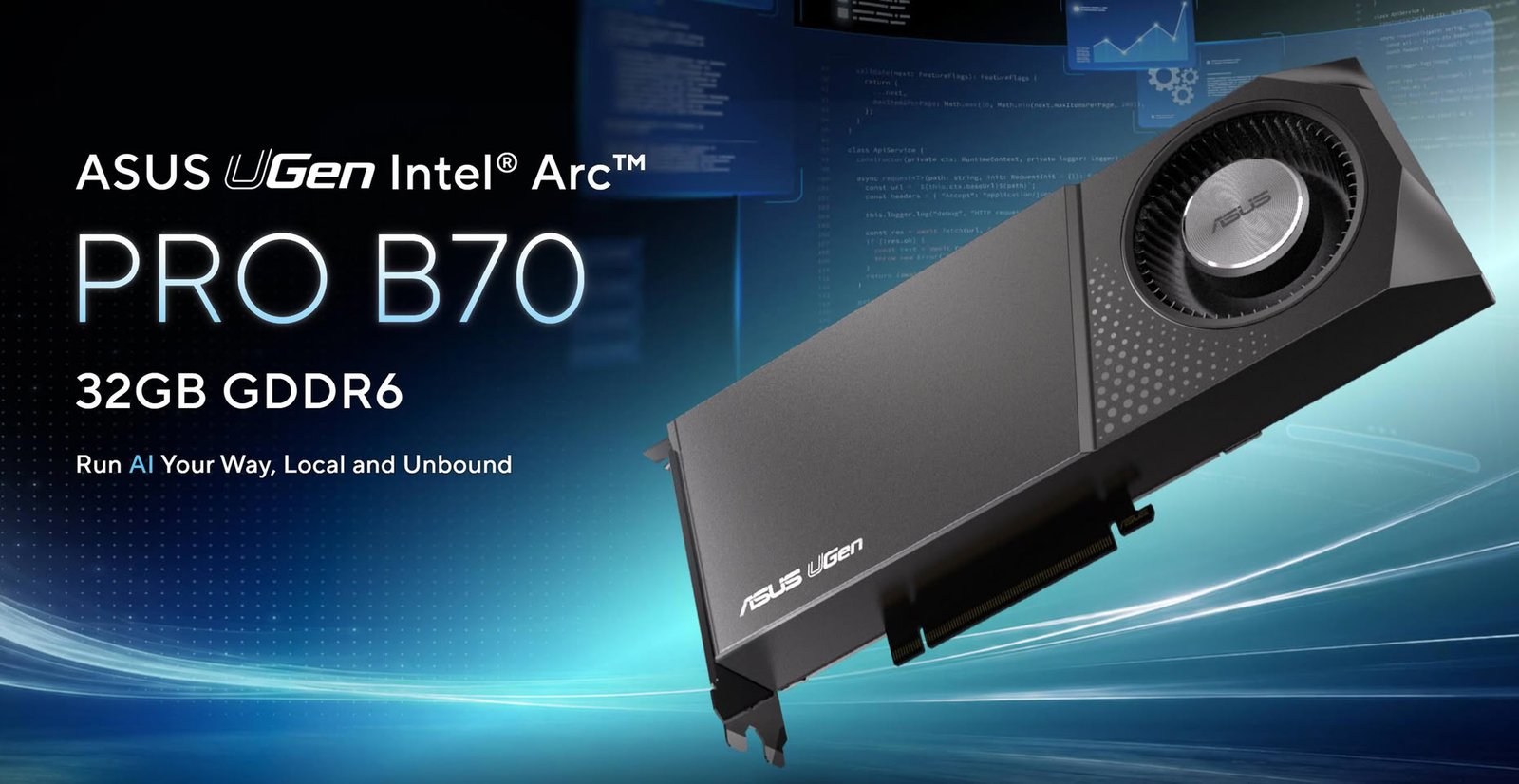
ASUS has officially expanded its hardware portfolio with the introduction of the UGen Arc Pro B70 32 GB, marking the company’s return to the Intel discrete graphics market. While ASUS previously produced the passively cooled Iris Xe DG1-4G in 2021, it notably bypassed the Alchemist and Battlemage consumer cycles. This new offering signals a strategic pivot for the manufacturer, placing the card squarely within its UGen AI accelerator lineup rather than the consumer-facing ProArt branding. By categorizing the B70 alongside the UGen300 USB AI accelerator, ASUS highlights the intended purpose of this hardware: artificial intelligence workload processing rather than high-end gaming or traditional creative rendering.
The UGen Arc Pro B70 is built upon Intel’s high-performance Xe2 Battlemage architecture. It leverages the full BMG-G31 die, which represents the upper tier of Intel’s latest graphics silicon. By integrating this architecture into a professional-grade blower-style card, ASUS provides a dedicated hardware solution for systems integrators and enterprise clients who require substantial local compute power without the limitations of consumer-grade thermal solutions.
Technical Specifications and Core Performance
At the heart of the UGen Arc Pro B70 lies a robust technical configuration designed to handle heavy compute tasks. The card features 32 Xe2 cores and 256 XMX engines, the latter being critical for accelerating matrix multiplication—the fundamental operation in neural network processing. The inclusion of 32 GB of GDDR6 ECC (Error Correction Code) memory, running on a 256-bit bus, allows for a memory bandwidth of 608 GB/s. This bandwidth is crucial for large-scale data ingestion during inference and model fine-tuning.
ASUS has pushed the limits of the reference specification by rating the B70 with a boost clock of 2,800 MHz. While Intel specifies a thermal design power range between 160 W and 290 W for the B70, the ASUS version is tuned to the top end of that spectrum at 290 W. This aggressive power profile is sustained by a dual-slot blower cooling system, a design choice typical for enterprise servers where front-to-back airflow is standard. These specifications equate to a performance metric of 367 INT8 TOPS (Tera Operations Per Second), positioning the card as a competitive player in the professional GPU landscape.
Enterprise Utility and Scalability
The primary use case for the UGen Arc Pro B70 is enterprise-level AI inference. With 32 GB of VRAM per card, the B70 is optimized for running medium-to-large language models (LLMs) locally. One of the most significant features of this product is its modular scalability. ASUS has confirmed that up to four of these cards can be installed in a single workstation, providing a total of 128 GB of combined VRAM.
This multi-card configuration allows for the deployment of models with up to 120 billion parameters, offering a cost-effective alternative to high-end enterprise accelerators that often command significantly higher price points. By utilizing ECC memory, ASUS ensures that these calculations remain stable over long periods of operation, mitigating the risk of data corruption—a standard requirement for professional-grade deployments. This hardware is intended for developers, researchers, and data scientists who require consistent, high-uptime performance rather than the variable clock speeds and aesthetic focus of gaming-oriented graphics cards.
Market Positioning and Competition
ASUS enters a market that has already seen rapid adoption by several other hardware vendors. ASRock, Sparkle, and Maxsun have all released their own versions of the B70, creating a competitive landscape for the Intel-based accelerator. Intel initially introduced the Arc Pro B70 with a launch price of $949; however, market volatility and supply constraints have seen retail pricing drift closer to the $1,300 mark in recent months.
The success of the ASUS UGen version will depend heavily on its pricing strategy and the reliability of its driver support. Since this card is positioned within the UGen AI family, it is likely that ASUS will bundle or provide specific software support tailored to professional AI workflows. This is a crucial distinction, as the performance of professional hardware is defined as much by its software environment—specifically libraries and drivers optimized for AI frameworks—as it is by its silicon. By aligning itself with the broader UGen ecosystem, ASUS aims to provide a more cohesive bridge between the hardware and the software tasks performed by AI professionals.
The Future of Intel-ASUS Collaboration
The arrival of the UGen Arc Pro B70 indicates a revitalized relationship between ASUS and Intel in the discrete GPU space. By skipping the consumer Battlemage segment, ASUS has essentially bypassed the intense competition and market saturation of the gaming GPU sector, opting instead to focus on the growing demand for local AI infrastructure. This move reflects a broader industry trend where hardware manufacturers are increasingly tailoring their flagship products toward specific compute-heavy workloads rather than general-purpose graphics.
As the industry moves toward decentralized AI and edge computing, the availability of specialized accelerators like the B70 becomes increasingly vital. ASUS is positioning itself to be a primary provider for businesses that are currently priced out of the extreme-performance enterprise market but still require significant VRAM and compute density. With no official release date or final pricing announced, the industry is currently observing how this iteration of the Battlemage architecture will perform in real-world, high-load enterprise environments. The move suggests that while the consumer segment remains crowded, the professional and enterprise segments remain fertile ground for manufacturers capable of engineering reliable, high-performance silicon solutions.
Disclaimer: This content is auto-generated for informational purposes only.
Source: Read Original News