








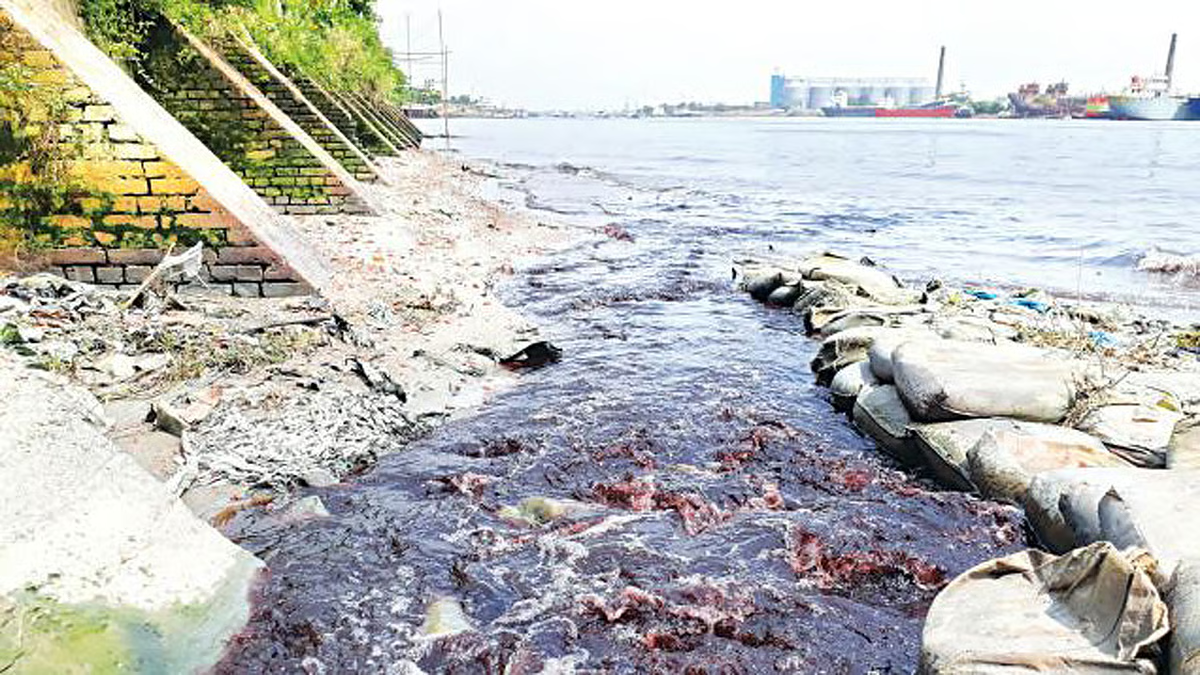
The garment industry has long been heralded as the bedrock of Bangladesh’s economic success, providing livelihoods for millions and anchoring the nation’s export prowess. However, a growing body of evidence suggests that this industrial prosperity is being built upon an increasingly precarious foundation of environmental degradation. Recent findings from the industrial hubs of Ashulia and Savar paint a concerning portrait: the chemical footprint of textile production has breached factory walls, posing significant threats to soil, water, and human health.
Studies in these regions have identified levels of PFAS—often referred to as “forever chemicals”—that sit hundreds of times above international drinking-water benchmarks. Concurrently, soil analysis has revealed lead concentrations exceeding national agricultural thresholds, while mercury has been detected at elevated levels in human hair samples from local residents. These findings, when coupled with the presence of a wide range of hazardous industrial chemicals in wastewater and local water sources, indicate that the environmental toll of textile manufacturing has reached an inflection point.
For decades, the prevailing narrative in many developing nations has been that industrial pollution is an unavoidable trade-off for economic growth. Yet, experts argue that this perspective is fundamentally flawed. Environmental and social justice advocate Dr. Shahriar Hossain emphasizes that economic development which destroys rivers, contaminates soil, and exposes workers to hazardous toxins is ultimately self-defeating. When a nation attempts to protect its export competitiveness by externalizing environmental and health costs onto its workforce and surrounding communities, it is merely deferring a crisis that will eventually undermine the industry itself.
The situation in Ashulia and Savar serves as a stark warning. The people living in these industrial zones should not be forced to choose between employment and health, or between economic opportunity and access to clean water. Protecting workers and communities from toxic exposure is not an argument against industrialization or exports; rather, it is a necessary requirement for responsible, sustainable industrialization.
The challenge now lies in ensuring that Bangladesh’s industrial trajectory does not mirror the historic mistakes of other nations, where environmental protection was neglected until the damage became irreparable. Pollution is not an inevitable byproduct of development; it is a management failure that can be addressed through systemic reform.
A transition toward a sustainable model requires a multifaceted approach. Central to this is the implementation of stronger, strictly enforced regulations governing chemical discharge and waste management. Factories must adopt cleaner production technologies and commit to transparent chemical management practices, ensuring that the substances used in production are accounted for and disposed of safely.
Furthermore, the responsibility extends beyond the factory floor. Global supply chains—the brands and retailers that source from these facilities—must hold their suppliers to higher environmental and safety standards, ensuring that “responsible sourcing” includes the protection of the local ecosystem. Independent monitoring, coupled with the meaningful participation of workers and local communities in environmental oversight, is essential to foster accountability.
The evidence emerging from Ashulia and Savar is clear: the time for recognition has arrived. If Bangladesh is to secure its future as a global leader in the textile industry, it must prove that economic growth and environmental stewardship are not mutually exclusive goals. By prioritizing health and safety today, the nation can transform these industrial zones from cautionary tales into models of how modern manufacturing can coexist with a safe, healthy environment. The path forward demands a move away from the exploitation of natural resources and toward an industrial framework where human life and environmental integrity are valued as highly as economic output.
Disclaimer: This content is auto-generated for informational purposes only.
Source: Read Original News