








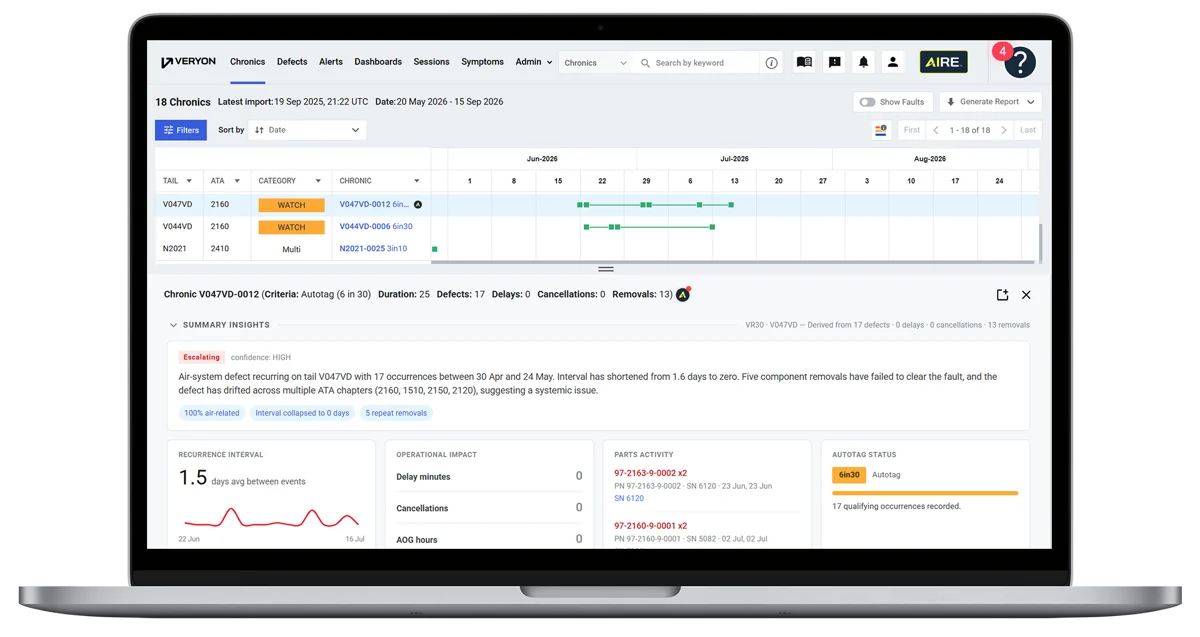
Aviation software leader Veryon has officially entered the era of autonomous maintenance, launching a new AI-enabled platform designed specifically for the business aviation sector. The technology marks a significant shift in how private jet operators and maintenance providers manage the complex, high-stakes workflow of keeping aircraft in the air, leveraging advanced machine learning to automate historically manual troubleshooting processes.
By integrating artificial intelligence into its existing suite of MRO (Maintenance, Repair, and Overhaul) tracking tools, Veryon aims to reduce technical downtime—a critical pain point for business aviation, where time spent on the ground translates to substantial financial losses and missed opportunities for owners.
Harnessing Agentic AI for Troubleshooting
At the core of the new platform is an “agentic” AI engine. Unlike basic automated systems that simply organize data, this technology acts as a virtual expert. It scans thousands of pages of maintenance manuals, service bulletins, and historical flight data to assist technicians in identifying the root causes of mechanical snags.
In an industry where a grounded aircraft can cost thousands of dollars per hour in charter revenue, the speed of diagnosis is everything. Veryon’s tool allows technicians to input symptoms of a technical fault and receive a distilled, prioritized list of potential solutions. By synthesizing complex technical documentation into actionable workflows, the platform minimizes the “human element” of search time, allowing mechanics to focus on repairs rather than administrative documentation.
Integration with Tech Ecosystems
The move toward AI integration reflects a broader trend in the tech industry, where specialized “vertical” AI applications are outperforming generic large language models. Veryon has focused on embedding this intelligence directly into the user’s daily software environment. By creating an integrated workflow, the company ensures that the AI does not exist in a silo; instead, it is a persistent assistant that follows a task from the moment a pilot reports a fault until the aircraft is cleared for its next departure.
This update effectively mirrors the shift seen in other enterprise sectors—such as the recent push for AI-assisted coding in software development—where the goal is to enhance the professional’s expertise rather than replace it. The platform’s ability to “learn” from the specific maintenance history of an individual aircraft allows for a tailored experience, with the AI recommending parts and procedures based on the unique lifecycle and configurations of that particular jet.
Driving Efficiency in Business Aviation
For the business aviation market, this update is a welcome modernization of a sector that has traditionally relied on paper-heavy processes and manual data entry. The platform’s ability to generate rapid summaries of maintenance status reports serves to bridge the communication gap between maintenance crews, pilots, and fleet owners.
As the industry faces a persistent shortage of skilled technicians, tools that empower junior mechanics to perform at a higher level are becoming essential. Veryon’s platform serves as a force multiplier, distilling decades of industry maintenance expertise into an accessible, digital-first interface.
Moving forward, the success of this platform may well depend on the accuracy of the data models powering it. Because aircraft safety protocols are strictly regulated, Veryon has positioned its AI as a support system that highlights key technical data while leaving final oversight in the hands of certified professionals. This “human-in-the-loop” architecture ensures that while technology handles the heavy lifting of data analysis, the ultimate responsibility for flight safety remains aligned with established aviation authority standards.
Disclaimer: This content is auto-generated for informational purposes only.
Source: Read Original News