








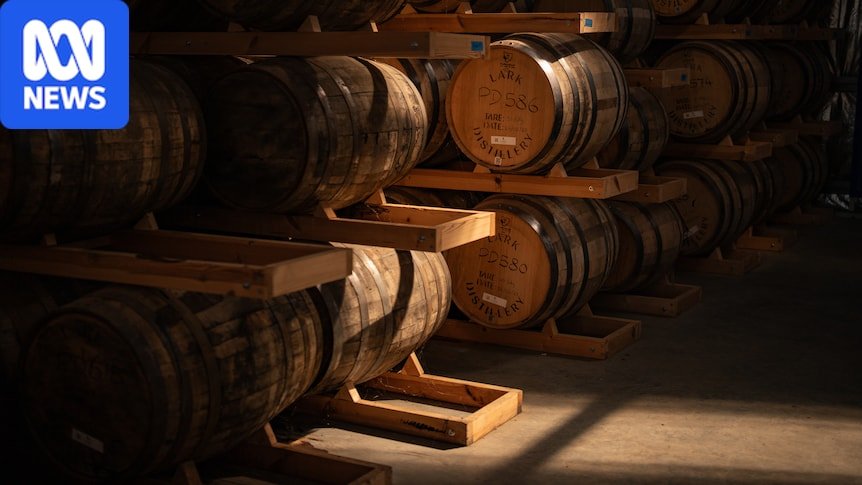
Tasmania’s world-renowned whisky industry, which once faced a colonial ban spanning over 150 years, is currently navigating its most precarious chapter since the modern revival of spirit production began in the 1990s. While legendary local distilleries have long prided themselves on high-quality craft and global acclaim, the sector is now bracing against a cooling worldwide market that has already forced major international players to halt operations and shed staff.
## A Legacy of Resilience and Modern Challenges
The narrative of Tasmanian whisky is defined by sharp pivots. After Governor John Franklin declared private distillation illegal in 1839—famously driven by his wife’s disdain for the industry—the craft remained dormant for over a century. It wasn’t until 1992, following a grassroots campaign by local publican Bill Lark, that the legislation was reformed to allow smaller producers to operate.
This legislative victory sparked a golden era, culminating in 2014 when Sullivans Cove secured the title of best single malt whisky at the World Whisky Awards, proving that non-traditional regions could challenge the dominance of Scotland and Japan. However, this period of growth was frequently punctuated by high-profile scandals, including the high-stakes collapse of the Nant distillery and internal leadership crises at other prominent firms. Today, the industry faces a different kind of trial: a global downturn. Producers like McHenry Distillery have been forced to cut staff and significantly scale back production as consumer spending tightens, highlighting how vulnerable boutique craft remains to macroeconomic shifts.
## Tech-Driven Trends and Industry Efficiency
Amidst this climate of instability, the whisky industry is increasingly looking toward modern tech to maintain relevance and operational efficiency. While distilling remains an ancient, analog art, today’s producers are utilizing data-driven supply chain management tools to monitor inventory turnover and navigate the “bond store” dilemma—the challenge of balancing long-term maturation cycles against short-term market volatility.
Furthermore, AI-driven marketing and analytics are becoming essential for boutique brands looking to reach international audiences. As traditional marketing becomes prohibitively expensive, small-scale Tasmanian distillers are leveraging social media algorithms and direct-to-consumer digital storefronts to bypass the clutter of physical bottle shops. These technological adaptations are vital, as they allow distillers to target premium markets directly, ensuring that even during a period of reduced demand, they can maintain a strong connection with loyal, high-value customers who prioritize provenance and quality.
## Balancing Growth with Fiscal Policy
A point of contention for many producers is the federal government’s current excise tax framework. Under the existing scheme, while smaller players receive a $400,000 rebate, mid-sized distilleries argue that the flat tax rate per litre of pure alcohol—currently $110—creates a “price ceiling” that inhibits scale. Critics argue this system forces producers to choose between extreme price discounting or stagnation.
Despite these structural hurdles and the broader economic gloom, there is an undercurrent of optimism. New entrants, such as the Bicheno-based Waubs Harbour, are reporting significant sales growth, suggesting that premium, craft-distilled products remain resilient even when mass-market sales falter. Industry leaders remain focused on long-term expansion, aiming to increase Tasmania’s share of the global whisky market from a negligible 0.05 percent to a more competitive 1 percent. By marrying the historic “let’s give it a go” spirit of the 90s with modern, data-informed business strategies, the Tasmanian industry is looking beyond the current downturn, betting that the global appetite for premium, craft spirits will eventually stabilize the market.
Disclaimer: This content is auto-generated for informational purposes only.
Source: Read Original News