








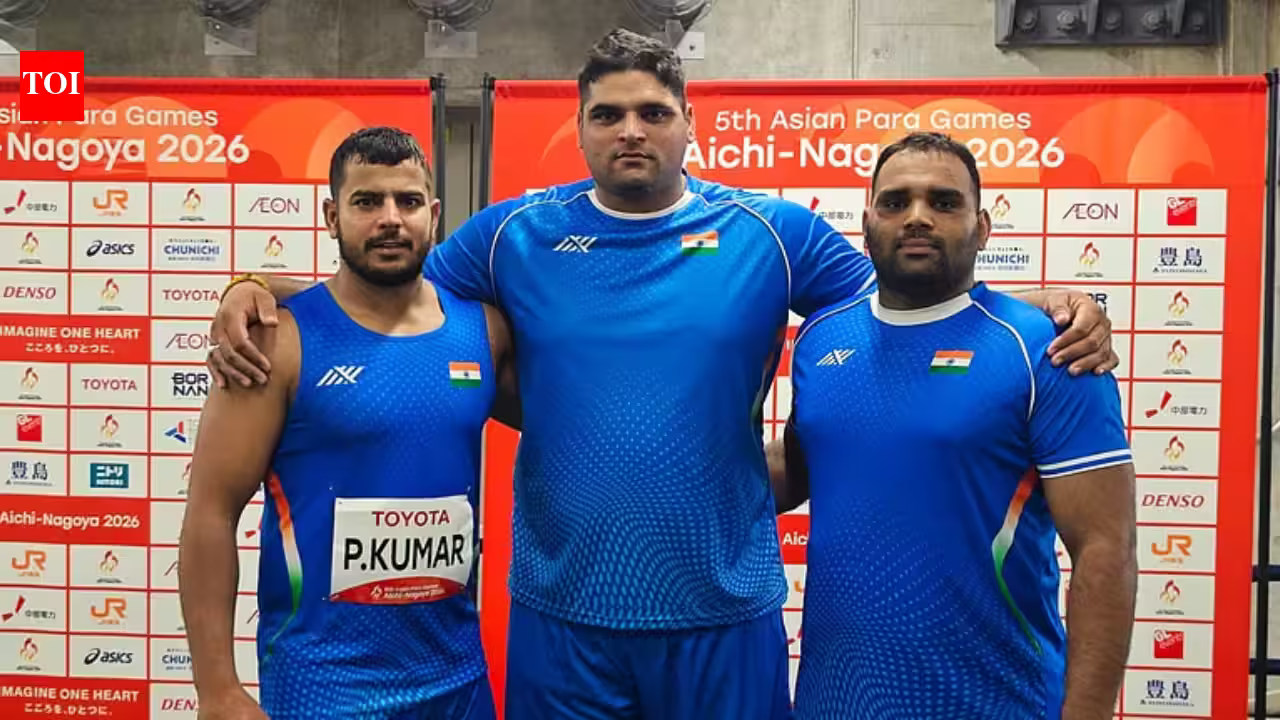
HANGZHOU — In a display of sheer dominance and strategic mastery, India painted the podium in national colors at the Asian Para Games, delivering a historic 1-2-3 finish in the men’s discus throw F43/F44/F62/F64 final. The trio of Devender Kumar, Rakesh, and Pardeep Kumar turned the field into their personal theater, cementing a day that will be etched into the annals of Indian sporting history.
While the raw distance of the throws captured the attention of the spectators, the competition was defined by the intricate Raza points system, a metric that ensures fair play by accounting for the diverse classifications of the competing athletes. Navigating the complexity of the format, India’s athletes proved that precision, strategy, and resilience are as vital as physical prowess.
Devender’s Golden Second-Round Clincher
The gold medal charge was led by Devender Kumar, who showcased nerves of steel in a high-stakes environment. Devender wasted little time setting the standard, opening his account with a solid 48.85m effort. However, it was his second attempt that truly put the pressure on the rest of the field. Launching the discus to a best distance of 49.71m, he secured the mark that would ultimately lead him to the top of the podium.
The competition was far from a straightforward victory parade for the eventual champion. After his stellar second throw, Devender faced a turbulent middle stretch, fouling on his third and fourth attempts. A recovery of 45.20m in the fifth round kept him in the driver’s seat, and despite a final-attempt foul, his earlier 49.71m stood firm, netting him 781 Raza points and the gold medal.
Rakesh and Pardeep Complete the Sweep
Supporting the golden effort, Rakesh claimed the silver medal with a calculated performance that kept him ahead of the field for the majority of the final. Rakesh, who finished with 771 points, showed consistent technical application. His best throw of 49.35m came during his fourth attempt, following a steady 47.87m opener and a 46.08m second round. While he could not improve upon his fourth-round peak in the final two throws, his consistency allowed him to comfortably secure the silver.
The story of the afternoon, however, was anchored by the bronze medalist, Pardeep Kumar. In a fascinating demonstration of why the Raza points system is so crucial to the integrity of para-sports, Pardeep delivered the longest throw of the competition—a massive 51.15m effort in his second round—yet ended up third in the overall standings.
Competing in the F64 classification, Pardeep proved his mettle by showing incredible range. After an initial 46.95m, his explosive second throw was followed by a 50.83m effort in the third round. While he could not surpass his personal best, his final tally of 669 points completed the historic sweep, underscoring the depth of talent within the Indian contingent.
Decoding the Raza Points System
For those watching from the stands or following the statistics, the podium finish raised questions regarding the final rankings, given that Pardeep’s longest throw did not equate to the gold medal. The event was governed by the Raza points system, which acts as a equalizer in multidisciplinary events.
Because athletes from different disability classifications (F43, F44, F62, and F64) competed in the same final, the system converts distances into points. This adjustment ensures that the field remains level, as it accounts for the varying levels of physical functional impact on each athlete’s performance. The Indian trio’s ability to maximize their points within their specific classes stands as a testament to their coaching staff’s tactical preparation and their own adaptability on the grand stage.
A Historic Day for India
The podium sweep was the crown jewel of an extraordinary Day 2 for India at the Asian Para Games. The nation enjoyed a record-breaking haul, securing 24 medals across a variety of disciplines, including para table tennis, shooting, powerlifting, and swimming.
The surge of success was not limited to the discus circle. The day was punctuated by stellar performances across the board, most notably Nishad Kumar’s gold-medal-winning performance in the men’s high jump T47, where he set a new Games record. On the track, Deepthi Jeevanji claimed gold in the women’s 400m T20, while Pranav Soorma dominated the men’s discus throw F51/F52/F53 to add another gold to the Indian tally.
As the dust settles on the competition, the image of the three Indian flag-bearers standing side-by-side on the podium will remain an iconic reminder of the progress of para-athletics in India. With these results, the Indian contingent has signaled its intent to be a powerhouse on the continental stage, blending technical proficiency with an unrelenting competitive spirit. For Devender, Rakesh, and Pardeep, Hangzhou will forever represent a moment of national pride, tactical brilliance, and athletic history.
Disclaimer: This content is auto-generated for informational purposes only.
Source: Read Original News