







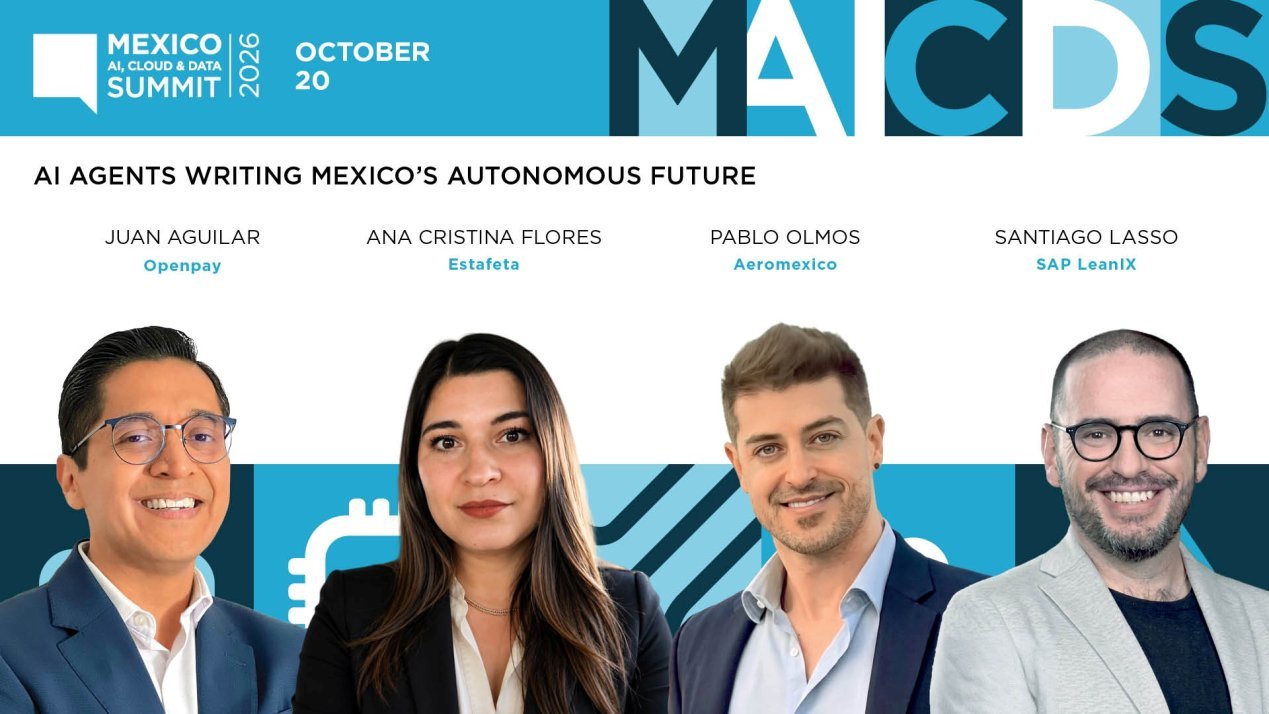
Mexican corporations are rushing to adopt autonomous AI agents, yet industry experts are sounding an alarm: without robust data governance and structural re-engineering, the shift from advisory AI to action-oriented agents could trigger widespread operational failure.
While global interest in AI continues to surge—with total worldwide spending projected to hit US$2.7 trillion by 2026—the Mexican market is demonstrating an aggressive appetite for innovation. Data from Microsoft suggests that 89% of business leaders in Mexico intend to deploy autonomous agents, significantly higher than the 82% global benchmark. However, as revealed at the Mexico AI, Cloud & Data Summit 2026, the transition from experimentation to production-grade deployment is fraught with technical and strategic hurdles.
## The Perils of Unconstrained Autonomy
The primary distinction between today’s generative AI and the next generation of “agentic” systems lies in execution. While standard AI models provide suggestions, autonomous agents have the capability to perform commercial transactions and execute multi-step workflows. This leap in functionality introduces significant risk.
Industry veterans note that the “hallucination” rate for autonomous agents increases dramatically—between 20% and 40%—when models are tasked with complex, multi-step tool-calling. Juan de Dios Aguilar, Chief Data and AI Officer at Openpay, underscores the stakes: “A chatbot that hallucinates gives a wrong answer, but an agent that hallucinates takes a wrong action.”
To mitigate these risks, experts argue that companies must move away from treating autonomy as an “on-off switch.” Instead, they advocate for the implementation of external, deterministic guardrails—rules that sit outside the AI model to constrain its actions, enforce access permissions, and set hard thresholds for decision-making.
## Addressing the Architectural Deficit
A major friction point for Mexican enterprises is the lack of a mature digital architecture. Despite heavy investment plans—totaling roughly US$171 million over the next year according to KPMG—many firms are attempting to layer advanced agents over fragmented, disorganized data silos.
“You cannot govern what you do not know,” explains Santiago Lasso, Senior Solution Advisor at SAP LeanIX. He notes that many companies are prioritizing the adoption of flashy new tools without first mapping how data flows across their existing systems. This technological mismatch is common; research shows that 83% of organizations globally acknowledge their infrastructure is currently inadequate to support production-grade agentic AI.
Data stewardship is the essential prerequisite to scaling. Ana Cristina Flores, Chief Data and Analytics Officer at Estafeta, emphasizes that firms must assign clear responsibilities to business stewards who define the operational parameters for these agents. Without this foundational maturity, the drive toward automation risks creating more “expensive technological novelties” rather than meaningful business transformation.
## Redefining the Human-Agent Workforce
The successful integration of AI agents ultimately rests on human supervision. As organizations transition to a model where employees act as managers of digital units, change management becomes just as critical as the technology itself.
Currently, only 37% of the Mexican workforce feels comfortable with agentic workflows. This creates a significant “trust gap” where employees may continue to rely on legacy manual processes—such as “magic spreadsheets”—if they do not understand or trust the autonomous systems being deployed.
Industry leaders suggest that the solution is a hybrid workforce. Companies are beginning to create specialized roles, such as “guardrail managers,” tasked with evaluating agent outputs against commercial metrics. By fostering a culture of transparency and providing rigorous training, Mexican enterprises can align their AI investments with actual strategic outcomes, ensuring that as agents take on more budgetary and transactional authority, they remain under the firm, guided control of the organization.
Disclaimer: This content is auto-generated for informational purposes only.
Source: Read Original News