





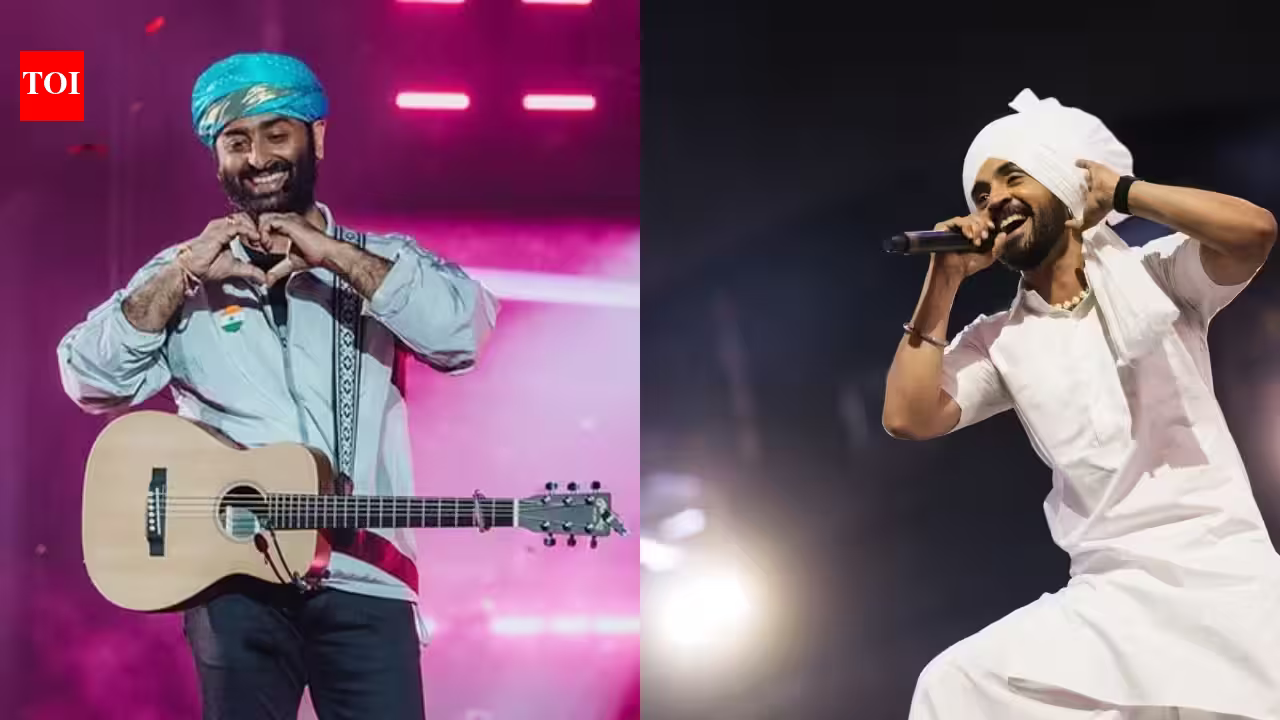
The landscape of live music in India has officially entered its “Big-Ticket Era.” As the concert economy explodes, two of the country’s biggest musical juggernauts—Arijit Singh and Diljit Dosanjh—are gearing up to dominate stadium stages across the nation. Yet, as their respective tours loom, the conversation has shifted from setlists and production values to something far more visceral: the price of admission.
While both artists are titans in their own right, their strategies for engaging fans couldn’t be more distinct. We are looking at a tale of two business models, separated by nearly 1.1 million rupees, reflecting two very different philosophies on what it means to experience a “legendary” night out.
The Arijit Singh Experience: Luxury at a Premium
When Arijit Singh announced his nine-city India tour for 2027 to commemorate two decades in the music industry, the buzz was immediate. The singer, who famously teased a pivot away from playback singing toward independent artistry earlier this year, is clearly leaning into his status as a national icon. However, it isn’t just the music that is drawing headlines—it is the sheer exclusivity of his premium offerings.
For the average fan, the entry point remains accessible, with tickets in Ahmedabad starting at a modest Rs 999. But for those looking to experience the “Arijit magic” through a lens of extreme opulence, the numbers are dizzying. His most expensive concert package, set for the Mumbai show at the Mahalaxmi Racecourse, commands a staggering Rs 11.8 lakh. To be clear, this isn’t just a ticket; it’s a hospitality suite designed for 15 people.
This isn’t merely about a view of the stage. The premium tier includes couch seating, dedicated entry and exit points, private lavatories, curated gifts, and premium alcohol service. In a move that highlights the modern-day obsession with social currency, the package even includes a dedicated content creator to film an Instagram Reel of the group’s experience, which is then professionally edited and delivered the next day. Despite the eye-watering cost, market reports indicate that roughly 60% of these premium slots are already snapped up—a testament to the singer’s unparalleled, almost religious, following.
Diljit Dosanjh’s Accessible Anthem
Contrast this with the trajectory of Diljit Dosanjh, the Punjabi superstar who has been turning global stages into, quite literally, festivals of culture. Following the seismic success of his 2024 “Dil-Luminati” tour—which reportedly generated an astonishing Rs 943 crore—Dosanjh is bringing his “Aura World Tour” to India with a markedly different approach.
If Arijit is selling an exclusive, white-glove “membership” to his musical world, Diljit is selling a communal energy. His highest-priced tickets for the upcoming India leg are capped at Rs 18,000. While still a significant investment for many, it operates on a different plane entirely from the luxury lounges associated with Singh’s tour. Dosanjh’s model relies on mass participation—the “sold-out stadium” aesthetic where the energy is raw, shared, and democratized.
His tour, which kicks off in Delhi-NCR this November, feels less like a VIP experience and more like a cultural pilgrimage. By keeping his price ceiling firmly in the five-figure range rather than the six-figure bracket, Dosanjh is capitalizing on the high-octane, youthful enthusiasm that characterizes his fan base. He is arguably the most popular performer in the country right now, and his pricing strategy seems designed to keep the gates open to as many of his “Dosanjh-waala” devotees as possible.
Two Eras, Two Legacies
To understand why these pricing gaps exist, one must look at the journeys both artists have taken to reach these stadium-sized milestones. Arijit Singh’s rise is the stuff of Bollywood lore. Emerging from the 2005 reality show *Fame Gurukul*, he spent years refining his craft to become the voice of a generation. From the aching vulnerability of “Tum Hi Ho” to the recent global chart-dominance of his film hits, Arijit has cultivated an image of the “gifted recluse”—an artist who lets his music do the talking, but who is now demanding a premium for the physical presence of his persona. His move toward high-end hospitality acknowledges that for a segment of his audience, the concert is a corporate or social networking event as much as it is a musical one.
Diljit Dosanjh, conversely, has built his brand on accessibility and authenticity. He is not just a singer; he is an actor, a style icon, and an expert in the art of the “fan-friend” relationship. Whether he is interacting with the crowd in broken English or sharing snippets of his life on social media, he remains remarkably relatable. His concerts are an extension of that personality—loud, colorful, and fiercely energetic.
The Future of the Indian Concert Economy
The divergent strategies of Singh and Dosanjh signal a maturing Indian entertainment market. We are moving past the era where a concert was just a concert. Now, artists are segmenting their audiences with surgical precision.
Arijit’s model is an evolution of the “experience economy,” where the barrier to entry for the elite is high, but the amenities ensure that the wealthy are separated from the crowds. It is a model we have seen in global residencies in Las Vegas or high-end sporting events.
Diljit’s model remains rooted in the “pop-star phenomenon,” prioritizing the density of the crowd and the decibel level of the sing-alongs. It is a model of scale, where the revenue is generated by volume and the sustained fervor of the fanbase.
Both artists are set to begin their tours at the iconic Narendra Modi Stadium in Ahmedabad, a venue that serves as a fittingly massive backdrop for these two distinct visions. Whether you choose to pay Rs 18,000 for the roar of the crowd or opt for an Rs 11.8 lakh table for an intimate, high-comfort evening, one thing is certain: Indian fans have never had more choice—or more reason—to spend big on the soundtrack of their lives. The question is no longer whether they will show up, but what kind of experience they are willing to pay for.
Disclaimer: This content is auto-generated for informational purposes only.
Source: Read Original News