







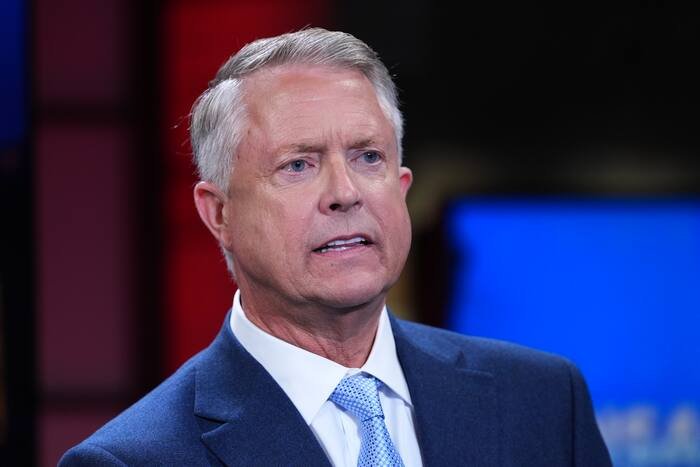
TOPEKA, Kan. – High-stakes friction over the economy and foreign policy dominated the final debate in the Kansas Senate race on Wednesday, as Republican incumbent Sen. Roger Marshall and Democratic challenger Adam Hamilton clashed over the skyrocketing cost of diesel fuel and the United States’ role in international conflicts.
With diesel prices in Kansas reaching an average of $6.32 a gallon—up from $3.62 a year ago—the fuel crisis has become a central issue in a state where the agricultural economy relies heavily on diesel. As the Nov. 3 election nears, the candidates offered starkly different explanations for the financial strain facing Kansas farmers.
Sen. Marshall broke with the conventional wisdom of his opponent, arguing that the war between Ukraine and Russia is the primary driver of current fuel prices. In doing so, Marshall signaled an alignment with President Donald Trump’s increasingly antagonistic stance toward Kyiv. Trump has recently asserted that Ukrainian strikes on Russian oil refineries are destabilizing fuel markets, even floating the controversial idea of importing Russian diesel to stabilize prices.
While Marshall admitted that importing Russian fuel “doesn’t sound like a great idea,” he stopped short of outright rejection. “If this brings Russia to the bargaining table, and it ends the war, then I am all for it right now,” Marshall said.
Hamilton, the founder and senior pastor of the nation’s largest United Methodist church, immediately seized on the comment. He argued that the high cost of fuel is largely a result of what he called an “unnecessary” war with Iran, which he vowed to push President Trump to end.
“What you said just now is you’re going to sell out our friends in Ukraine,” Hamilton told Marshall during the debate. “That’s not OK. Nobody believes [Ukraine is to blame for prices].”
To address the immediate financial burden on Kansans, Hamilton reiterated his proposal to temporarily suspend federal fuel taxes. Conversely, Marshall pivoted to domestic energy policy, accusing his opponent of supporting liberal “Green New Deal” proposals. Marshall claimed these environmental mandates have hindered the construction of new diesel refineries, thereby exacerbating the supply chain issues. While Hamilton acknowledged supporting portions of the Green New Deal, he maintained he does not support the full legislative package.
The debate marked the final meeting between the two candidates before the election. Although Kansas has not elected a Democrat to the U.S. Senate since 1932, polls suggest the race is unexpectedly competitive. The outcome rests heavily on whether voters prioritize the economic realities of the agricultural sector or the ideological differences regarding America’s commitments to its allies abroad.
As voters head to the polls, the contrast could not be sharper: Hamilton is framing the current climate as a result of foreign policy mismanagement, while Marshall is betting that tying his challenger to national progressive agendas and blaming global instability will secure his second term.
Disclaimer: This content is auto-generated for informational purposes only.
Source: Read Original News