







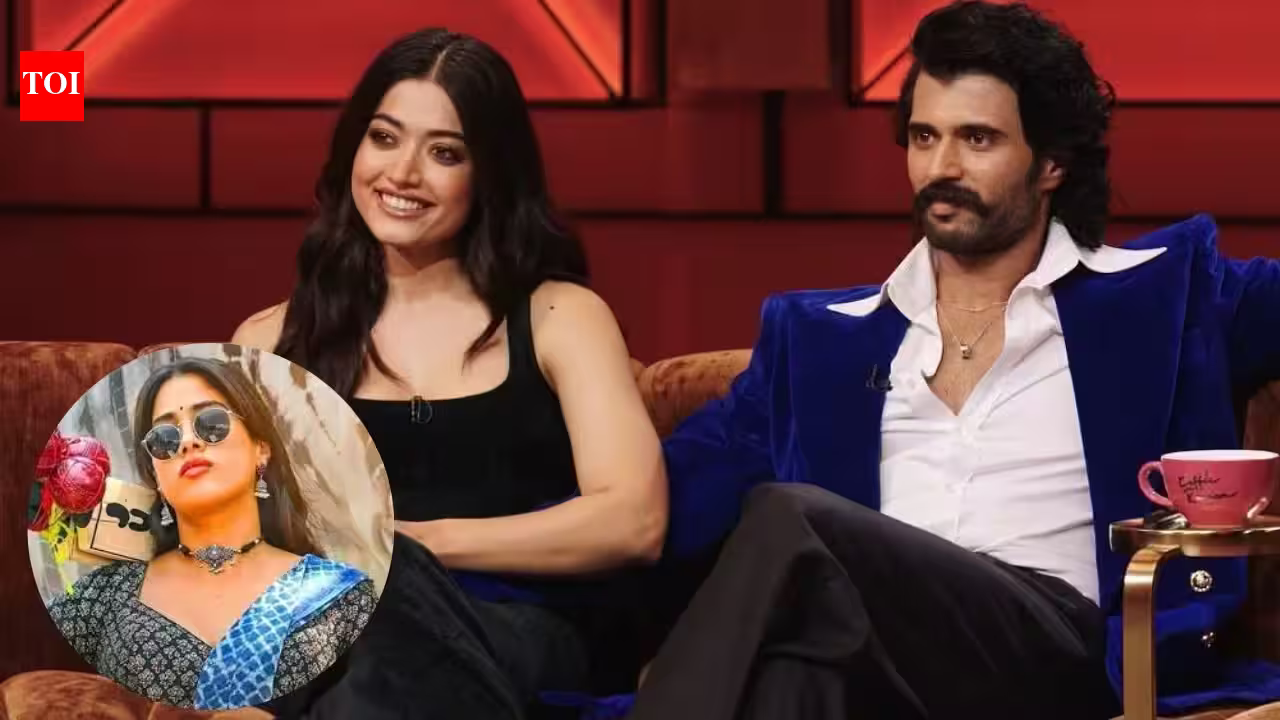
The iconic “Koffee” couch has seen its fair share of revelations, but this week’s episode of Koffee With Karan Season 9 delivered something far more substantive than the usual rapid-fire gossip. In a candid, nuanced conversation that has since sent shockwaves through social media, power couple Rashmika Mandanna and Vijay Deverakonda peeled back the curtain on one of the most persistent issues in the film industry: the battle for agency in the face of commercial objectification.
The timing could not have been more potent. With the industry currently locked in a fiery debate over Janhvi Kapoor’s portrayal in the recent Ram Charan-starrer Peddi, Karan Johar steered the conversation toward the uncomfortable reality of how women are framed—both literally and metaphorically—on the silver screen.
Rashmika Mandanna’s Boundaries: Agency Over Optics
For years, the “National Crush” has navigated the complexities of being a massive pan-Indian star while maintaining a persona that feels authentic to her values. When asked by Johar if she consciously guards against the kind of criticism currently surrounding Peddi, Rashmika didn’t mince words.
“There are some things that I am not okay with,” she stated firmly. While acknowledging the demands of commercial cinema—where certain aesthetics are often considered essential for the “glamour” quotient—she clarified that her comfort is non-negotiable. “I know some characters sort of need something like a bikini or something like that, but even in that, I would say I am not very comfortable with exposing or skin show; I am not that kind of person.”
What was most refreshing about Rashmika’s stance was her emphasis on professional compatibility. She noted that she actively seeks out collaborations with directors who respect her boundaries. By framing these limits not as a hindrance to her work, but as a filter for who she chooses to work with, she signaled a shift in power dynamics. For a star of her stature to admit that she simply refuses projects that compromise her comfort levels is a powerful message to the next generation of actors entering the industry.
The Myth of the “Difficult” Actress
Vijay Deverakonda, who has long been a vocal supporter of his wife, stepped in to address the “invisible” pressure that keeps many actresses silent. He highlighted a pervasive, toxic narrative in the industry: the idea that once a contract is signed, an actor loses their right to object to how they are presented.
“They all need a support system to tell them that it is okay to put your foot down and say a ‘no’,” Deverakonda explained. He pointed out the gaslighting that often occurs on set, where an actor’s professional integrity is weaponized against them. “People can make you feel like you are an actress, you have signed this film, isn’t this your job?”
It’s an age-old industry trope—the “difficult” actress who questions the director’s “artistic vision” when faced with an objectifying camera angle. Deverakonda’s intervention serves as a necessary call to action for production houses and directors to stop equating professional compliance with the sacrifice of self-respect.
The ‘Peddi’ Controversy: A Mirror to the Industry
The discourse surrounding Peddi has become a flashpoint for a larger conversation about the “male gaze” in commercial Telugu and Hindi cinema. While the film’s success rests on the star power of Ram Charan and the anticipation surrounding Janhvi Kapoor, viewers have been increasingly vocal about the jarring juxtaposition between the character’s narrative weight and the way the camera lens lingers on her body.
The situation was exacerbated by the emergence of alleged screenshots circulating online, purportedly showing Janhvi Kapoor venting her frustrations to fan pages regarding the final product. While the authenticity of these messages remains unverified, the sheer volume of public discourse suggests that the audience—who were once considered passive consumers of such “masala” tropes—is now arguably the harshest critic of objectification. Whether or not the director intended it, the Peddi controversy has proven that audiences are no longer willing to look past a character’s exploitation for the sake of entertainment.
Navigating the Stardom-Integrity Tightrope
The timing of this Koffee With Karan episode coincides with the theatrical run of the couple’s latest collaboration, Ranabaali. As they juggle the pressures of a major box-office release—which, according to latest reports, has crossed the Rs 52 crore mark globally—the pair is proving that they can command the box office without bowing to regressive industry standards.
Ranabaali, directed by Rahul Sankrityan, has faced its own set of critiques regarding pacing and violence, but the chemistry between Mandanna and Deverakonda remains the film’s anchor. Their ability to talk so openly about the “ugly” side of the business—the fear of being labeled, the struggle to say no, and the need for mutual respect—only adds to their relatability.
In an industry that often demands that stars be malleable, plastic, and perpetually agreeable, Rashmika and Vijay are carving out a different path. They aren’t just selling a movie; they are advocating for an environment where the actor is a collaborator, not a prop. By using the massive platform of Koffee With Karan to validate the importance of personal boundaries, they have turned the spotlight back on the filmmakers, effectively asking: If the actor isn’t comfortable, why are we still doing it this way?
As the industry continues to evolve, the voices of stars like Mandanna, who are unafraid to draw lines in the sand, might be the most effective catalyst for change. The era of the “docile star” is fading, and if this episode is any indication, the future of cinema is one where “no” is treated with the same respect as a blockbuster opening.
Disclaimer: This content is auto-generated for informational purposes only.
Source: Read Original News